

149
3. The skills of an economic actor responsible for the operation and maintenance
(O & M) of a fleet of goods, to support objectives (3) and (7).
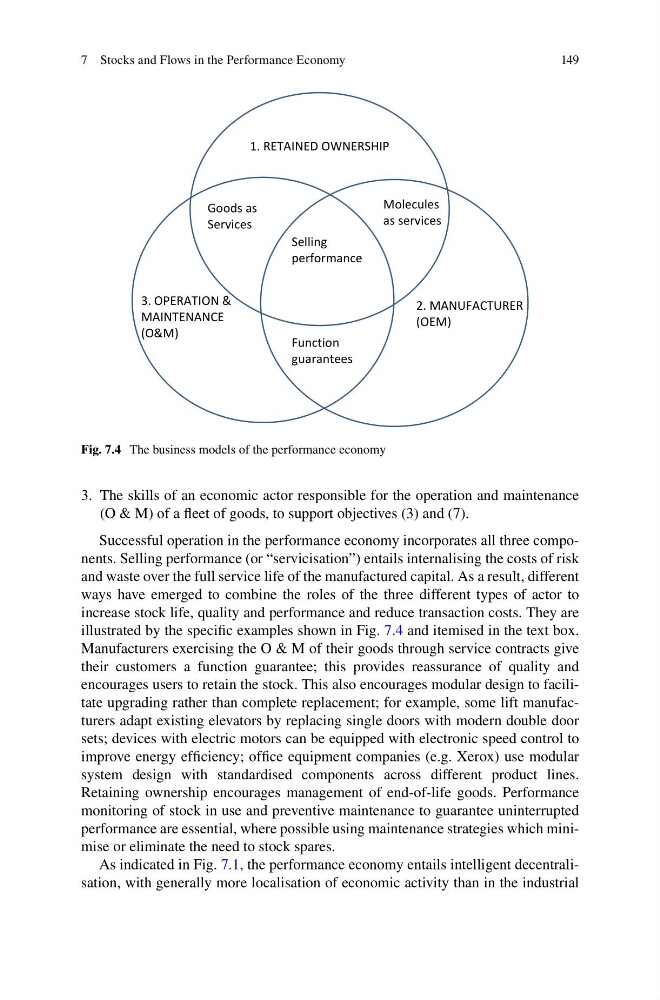
Successful operation in the performance economy incorporates all three components. Selling performance (or “servicisation”) entails internalising the costs of risk
and waste over the full service life of the manufactured capital. As a result, different
ways have emerged to combine the roles of the three different types of actor to
increase stock life, quality and performance and reduce transaction costs. They are
illustrated by the specific examples shown in Fig. 7.4 and itemised in the text box.
Manufacturers exercising the O & M of their goods through service contracts give
their customers a function guarantee; this provides reassurance of quality and
encourages users to retain the stock. This also encourages modular design to facilitate upgrading rather than complete replacement; for example, some lift manufacturers adapt existing elevators by replacing single doors with modern double door
sets; devices with electric motors can be equipped with electronic speed control to
improve energy efficiency; office equipment companies (e.g. Xerox) use modular
system design with standardised components across different product lines.
Retaining ownership encourages management of end-of-life goods. Performance
monitoring of stock in use and preventive maintenance to guarantee uninterrupted
performance are essential, where possible using maintenance strategies which minimise or eliminate the need to stock spares.
As indicated in Fig. 7.1, the performance economy entails intelligent decentralisation, with generally more localisation of economic activity than in the industrial
Function
guarantees
Selling
performance
3. OPERATION &
MAINTENANCE
(O&M)
2. MANUFACTURER
(OEM)
1. RETAINED OWNERSHIP
Molecules
as services
Goods as
Services
Fig. 7.4 The business models of the performance economy
7 Stocks and Flows in the Performance Economy
3. The skills of an economic actor responsible for the operation and maintenance
(O & M) of a fleet of goods, to support objectives (3) and (7).
Successful operation in the performance economy incorporates all three components. Selling performance (or “servicisation”) entails internalising the costs of risk
and waste over the full service life of the manufactured capital. As a result, different
ways have emerged to combine the roles of the three different types of actor to
increase stock life, quality and performance and reduce transaction costs. They are
illustrated by the specific examples shown in Fig. 7.4 and itemised in the text box.
Manufacturers exercising the O & M of their goods through service contracts give
their customers a function guarantee; this provides reassurance of quality and
encourages users to retain the stock. This also encourages modular design to facilitate upgrading rather than complete replacement; for example, some lift manufacturers adapt existing elevators by replacing single doors with modern double door
sets; devices with electric motors can be equipped with electronic speed control to
improve energy efficiency; office equipment companies (e.g. Xerox) use modular
system design with standardised components across different product lines.
Retaining ownership encourages management of end-of-life goods. Performance
monitoring of stock in use and preventive maintenance to guarantee uninterrupted
performance are essential, where possible using maintenance strategies which minimise or eliminate the need to stock spares.
As indicated in Fig. 7.1, the performance economy entails intelligent decentralisation, with generally more localisation of economic activity than in the industrial
Function
guarantees
Selling
performance
3. OPERATION &
MAINTENANCE
(O&M)
2. MANUFACTURER
(OEM)
1. RETAINED OWNERSHIP
Molecules
as services
Goods as
Services
Fig. 7.4 The business models of the performance economy
7 Stocks and Flows in the Performance Economy