

143
3 Remanufacturing, Reprocessing and Product Life
3.1 Material Intensity and Product-Service Intensity
To understand the importance of the quality and durability of stock, it is convenient
to use a formulation introduced by the IPCC in the 5th Assessment Report (2014).
2
For a sector producing materials and products for stocks that deliver quantifiable
services, the energy use (e p ) and associated GHG emissions (g p ) over a specified
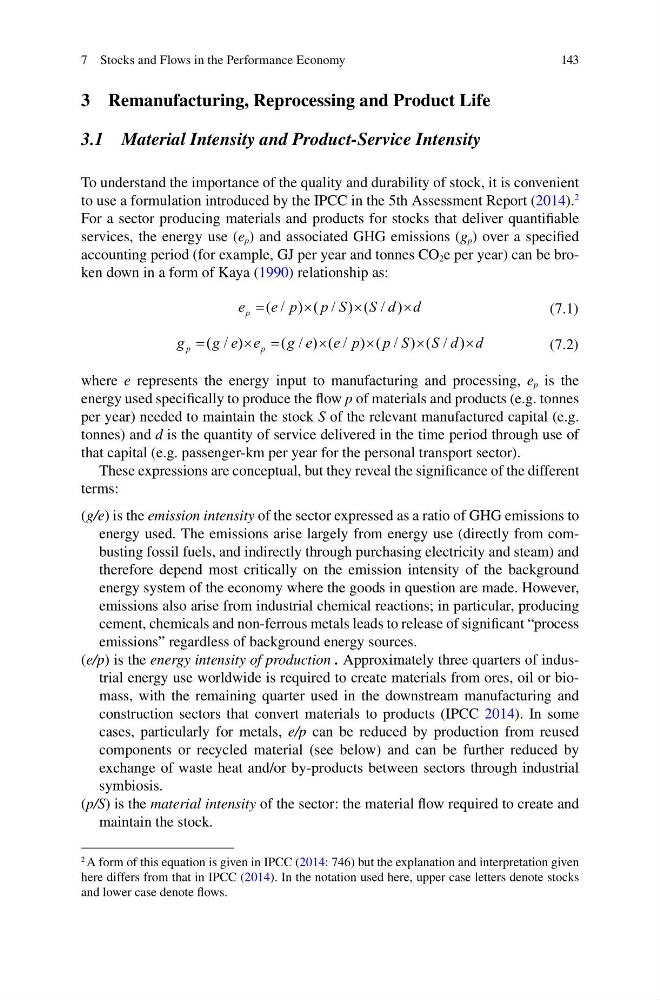
accounting period (for example, GJ per year and tonnes CO 2 e per year) can be broken down in a form of Kaya (1990) relationship as:
e
e p
p S
S d d
p = ( / ) ( / ) ( / )
×
×
×
(7.1)
g
g e e
g e e p
p S
S d d
p
p
=
=
( / )
( / ) ( / ) ( / ) ( / )
×
×
×
×
×
(7.2)
where e represents the energy input to manufacturing and processing, e p is the
energy used specifically to produce the flow p of materials and products (e.g. tonnes
per year) needed to maintain the stock S of the relevant manufactured capital (e.g.
tonnes) and d is the quantity of service delivered in the time period through use of
that capital (e.g. passenger-km per year for the personal transport sector).
These expressions are conceptual, but they reveal the significance of the different
terms:
(g/e) is the emission intensity of the sector expressed as a ratio of GHG emissions to
energy used. The emissions arise largely from energy use (directly from combusting fossil fuels, and indirectly through purchasing electricity and steam) and
therefore depend most critically on the emission intensity of the background
energy system of the economy where the goods in question are made. However,
emissions also arise from industrial chemical reactions; in particular, producing
cement, chemicals and non-ferrous metals leads to release of significant “process
emissions” regardless of background energy sources.
(e/p) is the energy intensity of production . Approximately three quarters of industrial energy use worldwide is required to create materials from ores, oil or biomass, with the remaining quarter used in the downstream manufacturing and
construction sectors that convert materials to products (IPCC 2014). In some
cases, particularly for metals, e/p can be reduced by production from reused
components or recycled material (see below) and can be further reduced by
exchange of waste heat and/or by-products between sectors through industrial
symbiosis.
(p/S) is the material intensity of the sector: the material flow required to create and
maintain the stock.
2 A form of this equation is given in IPCC (2014: 746) but the explanation and interpretation given
here differs from that in IPCC (2014). In the notation used here, upper case letters denote stocks
and lower case denote flows.
7 Stocks and Flows in the Performance Economy
3 Remanufacturing, Reprocessing and Product Life
3.1 Material Intensity and Product-Service Intensity
To understand the importance of the quality and durability of stock, it is convenient
to use a formulation introduced by the IPCC in the 5th Assessment Report (2014).
2
For a sector producing materials and products for stocks that deliver quantifiable
services, the energy use (e p ) and associated GHG emissions (g p ) over a specified
accounting period (for example, GJ per year and tonnes CO 2 e per year) can be broken down in a form of Kaya (1990) relationship as:
e
e p
p S
S d d
p = ( / ) ( / ) ( / )
×
×
×
(7.1)
g
g e e
g e e p
p S
S d d
p
p
=
=
( / )
( / ) ( / ) ( / ) ( / )
×
×
×
×
×
(7.2)
where e represents the energy input to manufacturing and processing, e p is the
energy used specifically to produce the flow p of materials and products (e.g. tonnes
per year) needed to maintain the stock S of the relevant manufactured capital (e.g.
tonnes) and d is the quantity of service delivered in the time period through use of
that capital (e.g. passenger-km per year for the personal transport sector).
These expressions are conceptual, but they reveal the significance of the different
terms:
(g/e) is the emission intensity of the sector expressed as a ratio of GHG emissions to
energy used. The emissions arise largely from energy use (directly from combusting fossil fuels, and indirectly through purchasing electricity and steam) and
therefore depend most critically on the emission intensity of the background
energy system of the economy where the goods in question are made. However,
emissions also arise from industrial chemical reactions; in particular, producing
cement, chemicals and non-ferrous metals leads to release of significant “process
emissions” regardless of background energy sources.
(e/p) is the energy intensity of production . Approximately three quarters of industrial energy use worldwide is required to create materials from ores, oil or biomass, with the remaining quarter used in the downstream manufacturing and
construction sectors that convert materials to products (IPCC 2014). In some
cases, particularly for metals, e/p can be reduced by production from reused
components or recycled material (see below) and can be further reduced by
exchange of waste heat and/or by-products between sectors through industrial
symbiosis.
(p/S) is the material intensity of the sector: the material flow required to create and
maintain the stock.
2 A form of this equation is given in IPCC (2014: 746) but the explanation and interpretation given
here differs from that in IPCC (2014). In the notation used here, upper case letters denote stocks
and lower case denote flows.
7 Stocks and Flows in the Performance Economy