

xiv
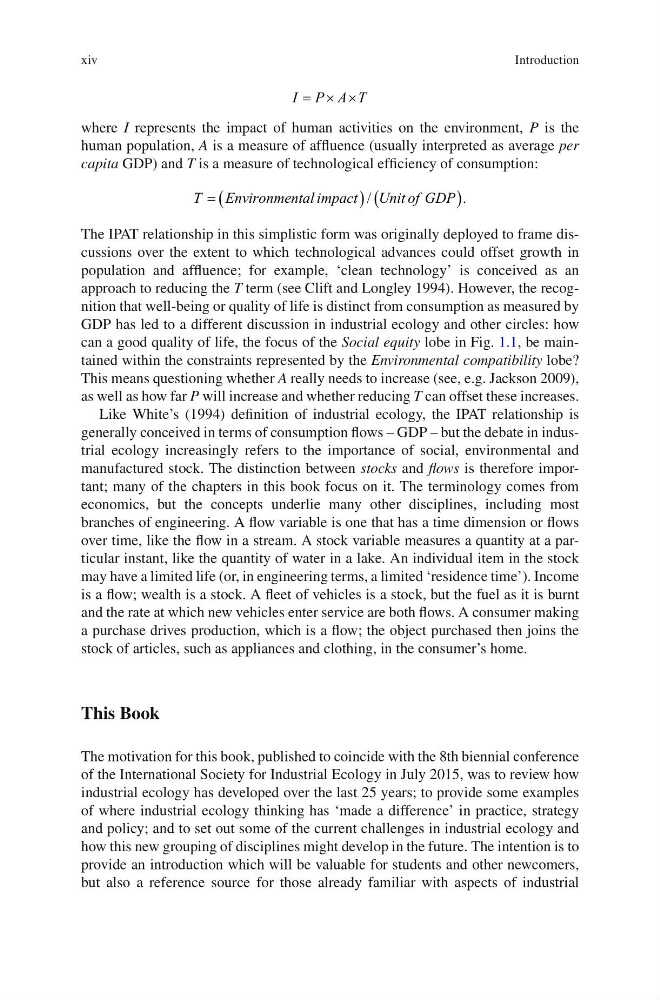
I P A T
where I represents the impact of human activities on the environment, P is the
human population, A is a measure of affl uence (usually interpreted as average per
capita GDP) and T is a measure of technological effi ciency of consumption:
T
Environmental impact Unit of GDP
/
.
The IPAT relationship in this simplistic form was originally deployed to frame discussions over the extent to which technological advances could offset growth in
population and affl uence; for example, ‘clean technology’ is conceived as an
approach to reducing the T term (see Clift and Longley 1994). However, the recognition that well-being or quality of life is distinct from consumption as measured by
GDP has led to a different discussion in industrial ecology and other circles: how
can a good quality of life, the focus of the Social equity lobe in Fig. 1.1 , be maintained within the constraints represented by the Environmental compatibility lobe?
This means questioning whether A really needs to increase (see, e.g. Jackson 2009),
as well as how far P will increase and whether reducing T can offset these increases.
Like White’s (1994) defi nition of industrial ecology, the IPAT relationship is
generally conceived in terms of consumption fl ows – GDP – but the debate in industrial ecology increasingly refers to the importance of social, environmental and
manufactured stock. The distinction between stocks and fl ows is therefore important; many of the chapters in this book focus on it. The terminology comes from
economics, but the concepts underlie many other disciplines, including most
branches of engineering. A fl ow variable is one that has a time dimension or fl ows
over time, like the fl ow in a stream. A stock variable measures a quantity at a particular instant, like the quantity of water in a lake. An individual item in the stock
may have a limited life (or, in engineering terms, a limited ‘residence time’). Income
is a fl ow; wealth is a stock. A fl eet of vehicles is a stock, but the fuel as it is burnt
and the rate at which new vehicles enter service are both fl ows. A consumer making
a purchase drives production, which is a fl ow; the object purchased then joins the
stock of articles, such as appliances and clothing, in the consumer’s home.
This Book
The motivation for this book, published to coincide with the 8th biennial conference
of the International Society for Industrial Ecology in July 2015, was to review how
industrial ecology has developed over the last 25 years; to provide some examples
of where industrial ecology thinking has ‘made a difference’ in practice, strategy
and policy; and to set out some of the current challenges in industrial ecology and
how this new grouping of disciplines might develop in the future. The intention is to
provide an introduction which will be valuable for students and other newcomers,
but also a reference source for those already familiar with aspects of industrial
Introduction
I P A T
where I represents the impact of human activities on the environment, P is the
human population, A is a measure of affl uence (usually interpreted as average per
capita GDP) and T is a measure of technological effi ciency of consumption:
T
Environmental impact Unit of GDP
/
.
The IPAT relationship in this simplistic form was originally deployed to frame discussions over the extent to which technological advances could offset growth in
population and affl uence; for example, ‘clean technology’ is conceived as an
approach to reducing the T term (see Clift and Longley 1994). However, the recognition that well-being or quality of life is distinct from consumption as measured by
GDP has led to a different discussion in industrial ecology and other circles: how
can a good quality of life, the focus of the Social equity lobe in Fig. 1.1 , be maintained within the constraints represented by the Environmental compatibility lobe?
This means questioning whether A really needs to increase (see, e.g. Jackson 2009),
as well as how far P will increase and whether reducing T can offset these increases.
Like White’s (1994) defi nition of industrial ecology, the IPAT relationship is
generally conceived in terms of consumption fl ows – GDP – but the debate in industrial ecology increasingly refers to the importance of social, environmental and
manufactured stock. The distinction between stocks and fl ows is therefore important; many of the chapters in this book focus on it. The terminology comes from
economics, but the concepts underlie many other disciplines, including most
branches of engineering. A fl ow variable is one that has a time dimension or fl ows
over time, like the fl ow in a stream. A stock variable measures a quantity at a particular instant, like the quantity of water in a lake. An individual item in the stock
may have a limited life (or, in engineering terms, a limited ‘residence time’). Income
is a fl ow; wealth is a stock. A fl eet of vehicles is a stock, but the fuel as it is burnt
and the rate at which new vehicles enter service are both fl ows. A consumer making
a purchase drives production, which is a fl ow; the object purchased then joins the
stock of articles, such as appliances and clothing, in the consumer’s home.
This Book
The motivation for this book, published to coincide with the 8th biennial conference
of the International Society for Industrial Ecology in July 2015, was to review how
industrial ecology has developed over the last 25 years; to provide some examples
of where industrial ecology thinking has ‘made a difference’ in practice, strategy
and policy; and to set out some of the current challenges in industrial ecology and
how this new grouping of disciplines might develop in the future. The intention is to
provide an introduction which will be valuable for students and other newcomers,
but also a reference source for those already familiar with aspects of industrial
Introduction