

119
because it has only a poor representation of the capital stocks and infrastructure that
are the mediators of many mitigation initiatives.
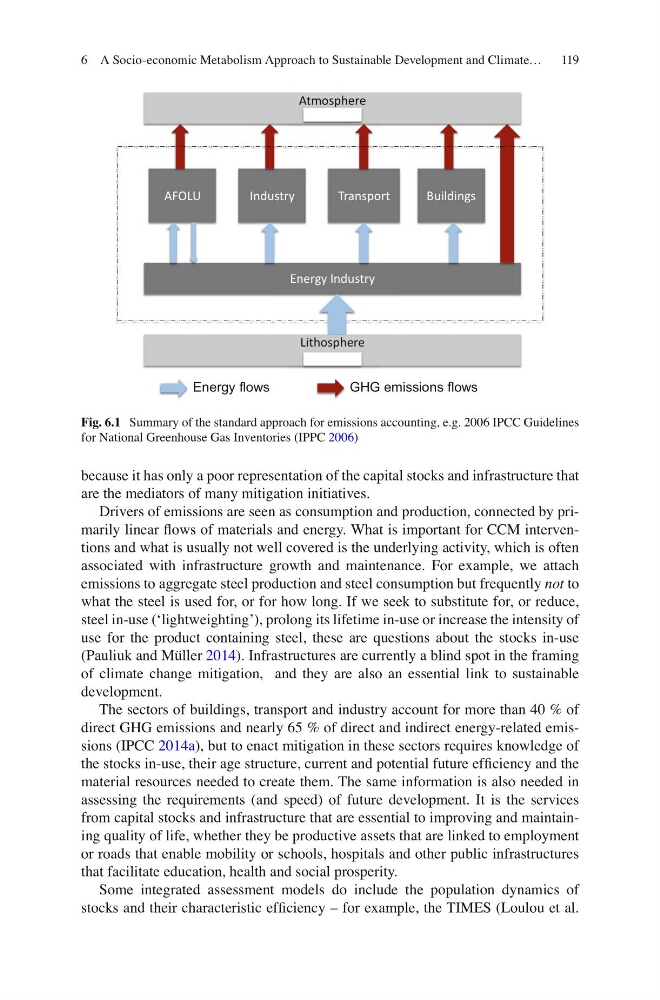
Drivers of emissions are seen as consumption and production, connected by primarily linear fl ows of materials and energy. What is important for CCM interventions and what is usually not well covered is the underlying activity, which is often
associated with infrastructure growth and maintenance. For example, we attach
emissions to aggregate steel production and steel consumption but frequently not to
what the steel is used for, or for how long. If we seek to substitute for, or reduce,
steel in-use (‘lightweighting’), prolong its lifetime in-use or increase the intensity of
use for the product containing steel, these are questions about the stocks in-use
(Pauliuk and Müller 2014 ). Infrastructures are currently a blind spot in the framing
of climate change mitigation, and they are also an essential link to sustainable
development.
The sectors of buildings, transport and industry account for more than 40 % of
direct GHG emissions and nearly 65 % of direct and indirect energy-related emissions ( IPCC 2014a ), but to enact mitigation in these sectors requires knowledge of
the stocks in-use, their age structure, current and potential future effi ciency and the
material resources needed to create them. The same information is also needed in
assessing the requirements (and speed) of future development. It is the services
from capital stocks and infrastructure that are essential to improving and maintaining quality of life, whether they be productive assets that are linked to employment
or roads that enable mobility or schools, hospitals and other public infrastructures
that facilitate education, health and social prosperity.
Some integrated assessment models do include the population dynamics of
stocks and their characteristic effi ciency – for example, the TIMES (Loulou et al.
GHG emissions flows
Energy Industry
AFOLU
Industry
Transport
Buildings
Atmosphere
Energy flows
Lithosphere
Fig. 6.1 Summary of the standard approach for emissions accounting, e.g. 2006 IPCC Guidelines
for National Greenhouse Gas Inventories (IPPC 2006 )
6 A Socio-economic Metabolism Approach to Sustainable Development and Climate…
because it has only a poor representation of the capital stocks and infrastructure that
are the mediators of many mitigation initiatives.
Drivers of emissions are seen as consumption and production, connected by primarily linear fl ows of materials and energy. What is important for CCM interventions and what is usually not well covered is the underlying activity, which is often
associated with infrastructure growth and maintenance. For example, we attach
emissions to aggregate steel production and steel consumption but frequently not to
what the steel is used for, or for how long. If we seek to substitute for, or reduce,
steel in-use (‘lightweighting’), prolong its lifetime in-use or increase the intensity of
use for the product containing steel, these are questions about the stocks in-use
(Pauliuk and Müller 2014 ). Infrastructures are currently a blind spot in the framing
of climate change mitigation, and they are also an essential link to sustainable
development.
The sectors of buildings, transport and industry account for more than 40 % of
direct GHG emissions and nearly 65 % of direct and indirect energy-related emissions ( IPCC 2014a ), but to enact mitigation in these sectors requires knowledge of
the stocks in-use, their age structure, current and potential future effi ciency and the
material resources needed to create them. The same information is also needed in
assessing the requirements (and speed) of future development. It is the services
from capital stocks and infrastructure that are essential to improving and maintaining quality of life, whether they be productive assets that are linked to employment
or roads that enable mobility or schools, hospitals and other public infrastructures
that facilitate education, health and social prosperity.
Some integrated assessment models do include the population dynamics of
stocks and their characteristic effi ciency – for example, the TIMES (Loulou et al.
GHG emissions flows
Energy Industry
AFOLU
Industry
Transport
Buildings
Atmosphere
Energy flows
Lithosphere
Fig. 6.1 Summary of the standard approach for emissions accounting, e.g. 2006 IPCC Guidelines
for National Greenhouse Gas Inventories (IPPC 2006 )
6 A Socio-economic Metabolism Approach to Sustainable Development and Climate…