

90
technology lock-in and path dependence (Reuter et al. 2005 ; Sagar and Frosch
1997 ), two of the newest additions to the industrial ecosystem, both biomass power
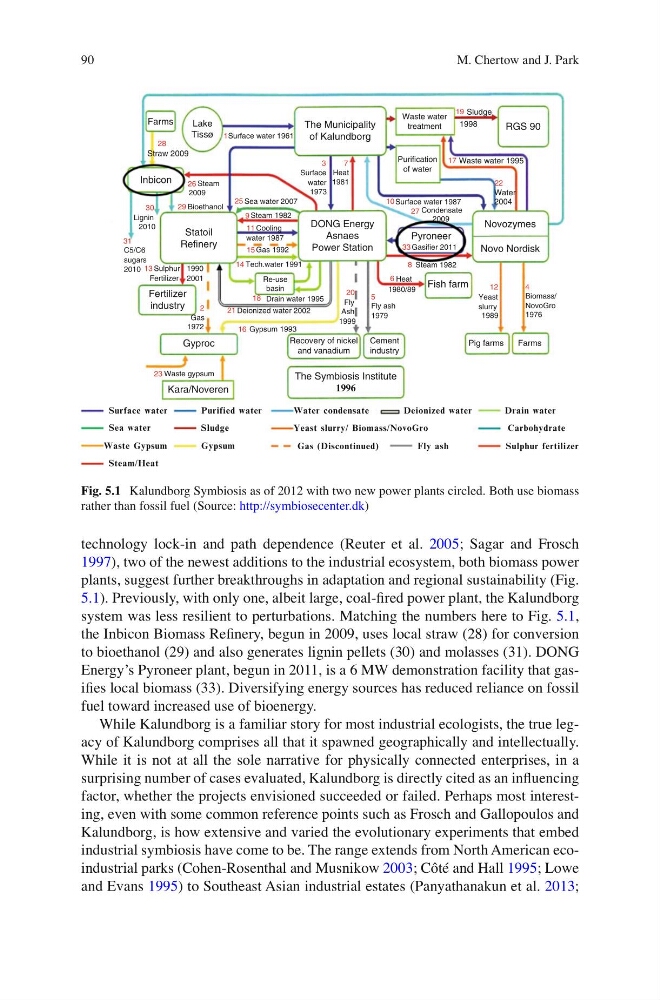
plants, suggest further breakthroughs in adaptation and regional sustainability (Fig.
5.1 ). Previously, with only one, albeit large, coal-fi red power plant, the Kalundborg
system was less resilient to perturbations. Matching the numbers here to Fig. 5.1 ,
the Inbicon Biomass Refi nery, begun in 2009, uses local straw (28) for conversion
to bioethanol (29) and also generates lignin pellets (30) and molasses (31). DONG
Energy’s Pyroneer plant, begun in 2011, is a 6 MW demonstration facility that gasifi es local biomass (33). Diversifying energy sources has reduced reliance on fossil
fuel toward increased use of bioenergy.
While Kalundborg is a familiar story for most industrial ecologists, the true legacy of Kalundborg comprises all that it spawned geographically and intellectually.
While it is not at all the sole narrative for physically connected enterprises, in a
surprising number of cases evaluated, Kalundborg is directly cited as an infl uencing
factor, whether the projects envisioned succeeded or failed. Perhaps most interesting, even with some common reference points such as Frosch and Gallopoulos and
Kalundborg, is how extensive and varied the evolutionary experiments that embed
industrial symbiosis have come to be. The range extends from North American ecoindustrial parks (Cohen-Rosenthal and Musnikow 2003 ; Côté and Hall 1995 ; Lowe
and Evans 1995 ) to Southeast Asian industrial estates (Panyathanakun et al. 2013 ;
Farms
Straw 2009
Surface water 1961
Surface
2009
Bioethanol
Lignin
C5/C6
Sulphur
Fertilizer
1990
Gas
Waste gypsum
Gyproc
The Symbiosis Institute
1996
Surface water
Purified water
Water condensate
Deionized water
Drain water
Yeast slurry/ Biomass/NovoGro
Carbohydrate
Gas (Discontinued)
Fly ash
Sulphur fertilizer
Sludge
Gypsum
Sea water
Steam/Heat
Waste Gypsum
1972
2001
sugars
2010
2010
Sea water 2007
Steam
Steam 1982
Cooling
Gas 1992
Re-use
basin
Drain water 1995
Deionized water 2002
Gypsum 1993
Recovery of nickel
and vanadium
Cement
industry
Tech.water 1991
water 1987
RGS 90
Purification
of water
Sludge
Waste water 1995
Water
2004
1998
Waste water
treatment
Heat
water
1973
1981
Lake
Tissø
Inbicon
Statoil
Refinery
Fertilizer
industry
Kara/Noveren
The Municipality
of Kalundborg
Novozymes
Pyroneer
DONG Energy
Asnaes
Power Station
Fish farm
Gasifier 2011
Yeast
Pig farms
Farms
Biomass/
NovoGro
1976
slurry
1989
Steam 1982
Heat
Fly ash
Fly
Ash
1999
1979
1980/89
Surface water 1987
Condensate
2009
Novo Nordisk
28
26
29
30
31
13
1
3
7
19
17
22
10
27
33
8
12
4
6
5
20
25
9
11
15
14
2
18
16
23
21
Fig. 5.1 Kalundborg Symbiosis as of 2012 with two new power plants circled. Both use biomass
rather than fossil fuel (Source: http://symbiosecenter.dk )
M. Chertow and J. Park
technology lock-in and path dependence (Reuter et al. 2005 ; Sagar and Frosch
1997 ), two of the newest additions to the industrial ecosystem, both biomass power
plants, suggest further breakthroughs in adaptation and regional sustainability (Fig.
5.1 ). Previously, with only one, albeit large, coal-fi red power plant, the Kalundborg
system was less resilient to perturbations. Matching the numbers here to Fig. 5.1 ,
the Inbicon Biomass Refi nery, begun in 2009, uses local straw (28) for conversion
to bioethanol (29) and also generates lignin pellets (30) and molasses (31). DONG
Energy’s Pyroneer plant, begun in 2011, is a 6 MW demonstration facility that gasifi es local biomass (33). Diversifying energy sources has reduced reliance on fossil
fuel toward increased use of bioenergy.
While Kalundborg is a familiar story for most industrial ecologists, the true legacy of Kalundborg comprises all that it spawned geographically and intellectually.
While it is not at all the sole narrative for physically connected enterprises, in a
surprising number of cases evaluated, Kalundborg is directly cited as an infl uencing
factor, whether the projects envisioned succeeded or failed. Perhaps most interesting, even with some common reference points such as Frosch and Gallopoulos and
Kalundborg, is how extensive and varied the evolutionary experiments that embed
industrial symbiosis have come to be. The range extends from North American ecoindustrial parks (Cohen-Rosenthal and Musnikow 2003 ; Côté and Hall 1995 ; Lowe
and Evans 1995 ) to Southeast Asian industrial estates (Panyathanakun et al. 2013 ;
Farms
Straw 2009
Surface water 1961
Surface
2009
Bioethanol
Lignin
C5/C6
Sulphur
Fertilizer
1990
Gas
Waste gypsum
Gyproc
The Symbiosis Institute
1996
Surface water
Purified water
Water condensate
Deionized water
Drain water
Yeast slurry/ Biomass/NovoGro
Carbohydrate
Gas (Discontinued)
Fly ash
Sulphur fertilizer
Sludge
Gypsum
Sea water
Steam/Heat
Waste Gypsum
1972
2001
sugars
2010
2010
Sea water 2007
Steam
Steam 1982
Cooling
Gas 1992
Re-use
basin
Drain water 1995
Deionized water 2002
Gypsum 1993
Recovery of nickel
and vanadium
Cement
industry
Tech.water 1991
water 1987
RGS 90
Purification
of water
Sludge
Waste water 1995
Water
2004
1998
Waste water
treatment
Heat
water
1973
1981
Lake
Tissø
Inbicon
Statoil
Refinery
Fertilizer
industry
Kara/Noveren
The Municipality
of Kalundborg
Novozymes
Pyroneer
DONG Energy
Asnaes
Power Station
Fish farm
Gasifier 2011
Yeast
Pig farms
Farms
Biomass/
NovoGro
1976
slurry
1989
Steam 1982
Heat
Fly ash
Fly
Ash
1999
1979
1980/89
Surface water 1987
Condensate
2009
Novo Nordisk
28
26
29
30
31
13
1
3
7
19
17
22
10
27
33
8
12
4
6
5
20
25
9
11
15
14
2
18
16
23
21
Fig. 5.1 Kalundborg Symbiosis as of 2012 with two new power plants circled. Both use biomass
rather than fossil fuel (Source: http://symbiosecenter.dk )
M. Chertow and J. Park