

62
8 Conclusions
10
1
10
2
10
3
10
4
(rad/sec)
0
0.5
1
1.5
2
2.5
3
S
B
z
( ) (T
2
/Hz)
10
-19
1
1.1
1.2
1.3
1.4
1.5
1.6
1.7
1.8
1.9
2
2.25
2.5
2.75
3
3.5
4
Temperature (K)
10
2
10
3
10
4
(rad/sec)
0
0.2
0.4
0.6
0.8
1
S ( ) (
0
2
/Hz)
10
-4
0
1
2
S
B
z
( ) (T
2
/Hz)
10
-22
1.2
1.23
1.26
1.29
1.32
1.35
1.4
1.45
1.5
1.55
1.6
1.7
1.8
2
2.25
2.5
3
3.5
4
1.6
Temperature (K)
0
0.5
1
1.5
2
2.5
(sec)
10
-3
0
0.2
S
EXPT
0.4
0.6
0.8
1
( =0) (
0
2
/Hz)
10
-4
0
0.5
1
1.5
2
2.5
(sec)
10
-3
0.5
1
1.5
2
2.5
S
B
z
( =0) (T
2
/ Hz)
10
-19
EXPT
MC
MC
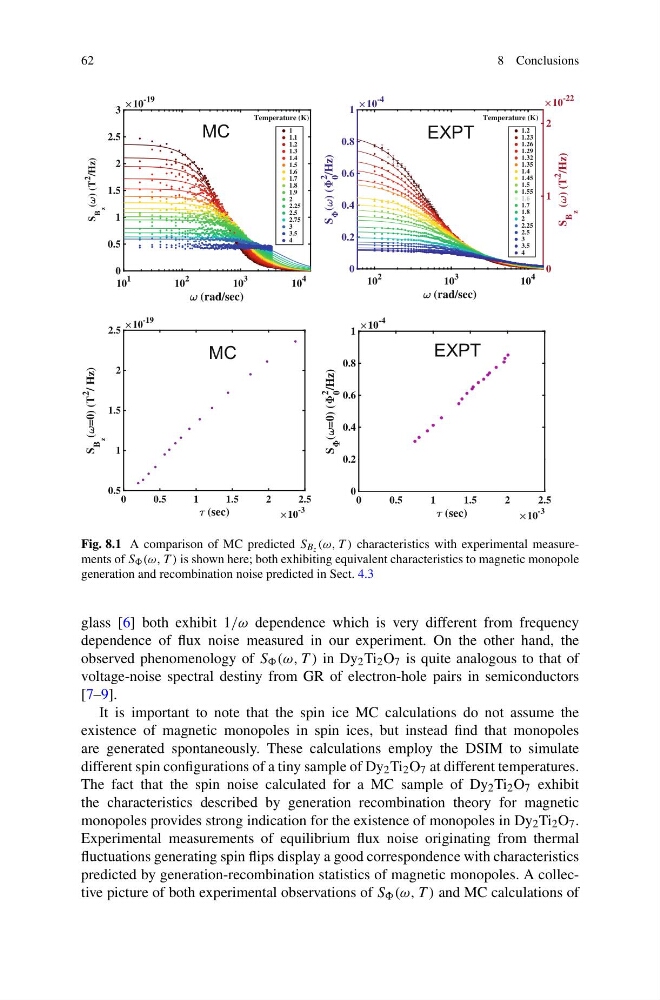
Fig. 8.1 A comparison of MC predicted S Bz (ω, T ) characteristics with experimental measurements of S (ω, T ) is shown here; both exhibiting equivalent characteristics to magnetic monopole
generation and recombination noise predicted in Sect. 4.3
glass [6] both exhibit 1/ω dependence which is very different from frequency
dependence of flux noise measured in our experiment. On the other hand, the
observed phenomenology of S (ω, T ) in Dy 2 Ti 2 O 7 is quite analogous to that of
voltage-noise spectral destiny from GR of electron-hole pairs in semiconductors
[7–9].
It is important to note that the spin ice MC calculations do not assume the
existence of magnetic monopoles in spin ices, but instead find that monopoles
are generated spontaneously. These calculations employ the DSIM to simulate
different spin configurations of a tiny sample of Dy 2 Ti 2 O 7 at different temperatures.
The fact that the spin noise calculated for a MC sample of Dy 2 Ti 2 O 7 exhibit
the characteristics described by generation recombination theory for magnetic
monopoles provides strong indication for the existence of monopoles in Dy 2 Ti 2 O 7 .
Experimental measurements of equilibrium flux noise originating from thermal
fluctuations generating spin flips display a good correspondence with characteristics
predicted by generation-recombination statistics of magnetic monopoles. A collective picture of both experimental observations of S (ω, T ) and MC calculations of
8 Conclusions
10
1
10
2
10
3
10
4
(rad/sec)
0
0.5
1
1.5
2
2.5
3
S
B
z
( ) (T
2
/Hz)
10
-19
1
1.1
1.2
1.3
1.4
1.5
1.6
1.7
1.8
1.9
2
2.25
2.5
2.75
3
3.5
4
Temperature (K)
10
2
10
3
10
4
(rad/sec)
0
0.2
0.4
0.6
0.8
1
S ( ) (
0
2
/Hz)
10
-4
0
1
2
S
B
z
( ) (T
2
/Hz)
10
-22
1.2
1.23
1.26
1.29
1.32
1.35
1.4
1.45
1.5
1.55
1.6
1.7
1.8
2
2.25
2.5
3
3.5
4
1.6
Temperature (K)
0
0.5
1
1.5
2
2.5
(sec)
10
-3
0
0.2
S
EXPT
0.4
0.6
0.8
1
( =0) (
0
2
/Hz)
10
-4
0
0.5
1
1.5
2
2.5
(sec)
10
-3
0.5
1
1.5
2
2.5
S
B
z
( =0) (T
2
/ Hz)
10
-19
EXPT
MC
MC
Fig. 8.1 A comparison of MC predicted S Bz (ω, T ) characteristics with experimental measurements of S (ω, T ) is shown here; both exhibiting equivalent characteristics to magnetic monopole
generation and recombination noise predicted in Sect. 4.3
glass [6] both exhibit 1/ω dependence which is very different from frequency
dependence of flux noise measured in our experiment. On the other hand, the
observed phenomenology of S (ω, T ) in Dy 2 Ti 2 O 7 is quite analogous to that of
voltage-noise spectral destiny from GR of electron-hole pairs in semiconductors
[7–9].
It is important to note that the spin ice MC calculations do not assume the
existence of magnetic monopoles in spin ices, but instead find that monopoles
are generated spontaneously. These calculations employ the DSIM to simulate
different spin configurations of a tiny sample of Dy 2 Ti 2 O 7 at different temperatures.
The fact that the spin noise calculated for a MC sample of Dy 2 Ti 2 O 7 exhibit
the characteristics described by generation recombination theory for magnetic
monopoles provides strong indication for the existence of monopoles in Dy 2 Ti 2 O 7 .
Experimental measurements of equilibrium flux noise originating from thermal
fluctuations generating spin flips display a good correspondence with characteristics
predicted by generation-recombination statistics of magnetic monopoles. A collective picture of both experimental observations of S (ω, T ) and MC calculations of