

References
33
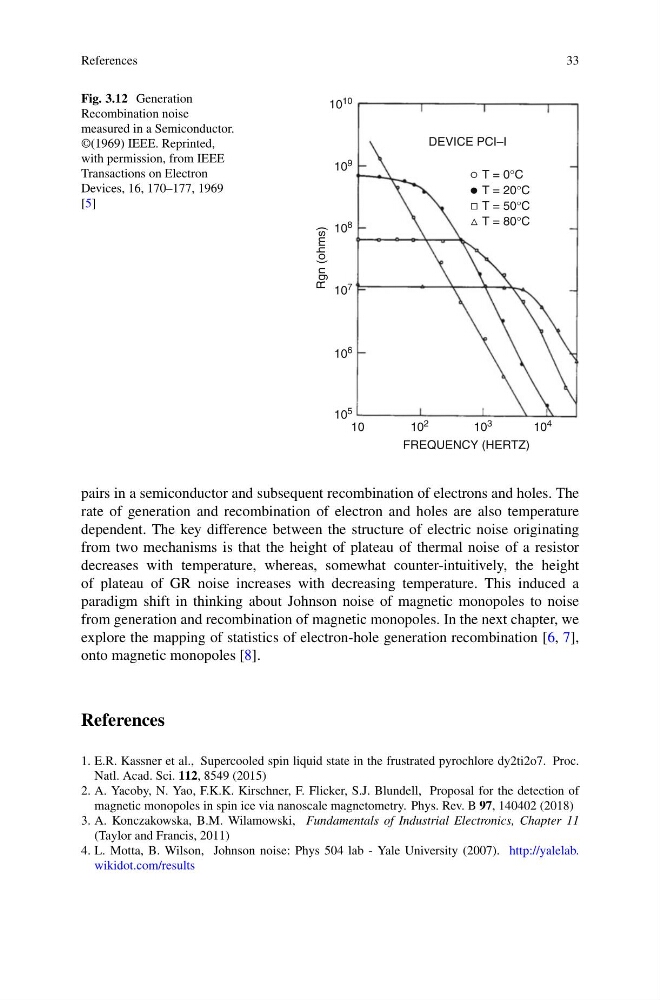
Fig. 3.12 Generation
Recombination noise
measured in a Semiconductor.
©(1969) IEEE. Reprinted,
with permission, from IEEE
Transactions on Electron
Devices, 16, 170–177, 1969
[5]
10
10
10
9
10
8
T = 0°C
T = 20°C
T = 50°C
T = 80°C
10
7
10
6
Rgn (ohms)
10
5
10
2
10
FREQUENCY (HERTZ)
DEVICE PCI–I
10
3
10
4
pairs in a semiconductor and subsequent recombination of electrons and holes. The
rate of generation and recombination of electron and holes are also temperature
dependent. The key difference between the structure of electric noise originating
from two mechanisms is that the height of plateau of thermal noise of a resistor
decreases with temperature, whereas, somewhat counter-intuitively, the height
of plateau of GR noise increases with decreasing temperature. This induced a
paradigm shift in thinking about Johnson noise of magnetic monopoles to noise
from generation and recombination of magnetic monopoles. In the next chapter, we
explore the mapping of statistics of electron-hole generation recombination [6, 7],
onto magnetic monopoles [8].
References
1. E.R. Kassner et al., Supercooled spin liquid state in the frustrated pyrochlore dy2ti2o7. Proc.
Natl. Acad. Sci. 112, 8549 (2015)
2. A. Yacoby, N. Yao, F.K.K. Kirschner, F. Flicker, S.J. Blundell, Proposal for the detection of
magnetic monopoles in spin ice via nanoscale magnetometry. Phys. Rev. B 97, 140402 (2018)
3. A. Konczakowska, B.M. Wilamowski, Fundamentals of Industrial Electronics, Chapter 11
(Taylor and Francis, 2011)
4. L. Motta, B. Wilson, Johnson noise: Phys 504 lab - Yale University (2007). http://yalelab.
wikidot.com/results
33
Fig. 3.12 Generation
Recombination noise
measured in a Semiconductor.
©(1969) IEEE. Reprinted,
with permission, from IEEE
Transactions on Electron
Devices, 16, 170–177, 1969
[5]
10
10
10
9
10
8
T = 0°C
T = 20°C
T = 50°C
T = 80°C
10
7
10
6
Rgn (ohms)
10
5
10
2
10
FREQUENCY (HERTZ)
DEVICE PCI–I
10
3
10
4
pairs in a semiconductor and subsequent recombination of electrons and holes. The
rate of generation and recombination of electron and holes are also temperature
dependent. The key difference between the structure of electric noise originating
from two mechanisms is that the height of plateau of thermal noise of a resistor
decreases with temperature, whereas, somewhat counter-intuitively, the height
of plateau of GR noise increases with decreasing temperature. This induced a
paradigm shift in thinking about Johnson noise of magnetic monopoles to noise
from generation and recombination of magnetic monopoles. In the next chapter, we
explore the mapping of statistics of electron-hole generation recombination [6, 7],
onto magnetic monopoles [8].
References
1. E.R. Kassner et al., Supercooled spin liquid state in the frustrated pyrochlore dy2ti2o7. Proc.
Natl. Acad. Sci. 112, 8549 (2015)
2. A. Yacoby, N. Yao, F.K.K. Kirschner, F. Flicker, S.J. Blundell, Proposal for the detection of
magnetic monopoles in spin ice via nanoscale magnetometry. Phys. Rev. B 97, 140402 (2018)
3. A. Konczakowska, B.M. Wilamowski, Fundamentals of Industrial Electronics, Chapter 11
(Taylor and Francis, 2011)
4. L. Motta, B. Wilson, Johnson noise: Phys 504 lab - Yale University (2007). http://yalelab.
wikidot.com/results