

12
2 Magnetic Monopoles in Spin Ices
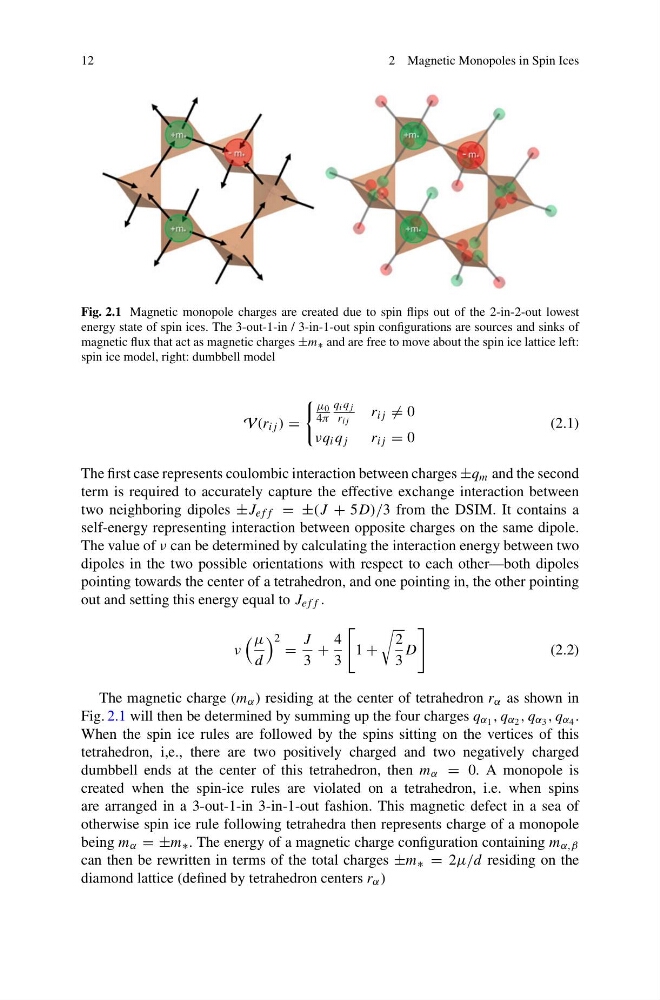
Fig. 2.1 Magnetic monopole charges are created due to spin flips out of the 2-in-2-out lowest
energy state of spin ices. The 3-out-1-in / 3-in-1-out spin configurations are sources and sinks of
magnetic flux that act as magnetic charges ±m ∗ and are free to move about the spin ice lattice left:
spin ice model, right: dumbbell model
V(r ij ) =
μ 0
4π
q i q j
r ij
r ij = 0
νq i q j
r ij = 0
(2.1)
The first case represents coulombic interaction between charges ±q m and the second
term is required to accurately capture the effective exchange interaction between
two neighboring dipoles ±J eff = ±(J + 5D)/3 from the DSIM. It contains a
self-energy representing interaction between opposite charges on the same dipole.
The value of ν can be determined by calculating the interaction energy between two
dipoles in the two possible orientations with respect to each other—both dipoles
pointing towards the center of a tetrahedron, and one pointing in, the other pointing
out and setting this energy equal to J eff .
ν
μ
d
2 =
J
3
+
4
3
1 +
2
3
D
(2.2)
The magnetic charge (m α ) residing at the center of tetrahedron r α as shown in
Fig. 2.1 will then be determined by summing up the four charges q α 1 , q α 2 , q α 3 , q α 4 .
When the spin ice rules are followed by the spins sitting on the vertices of this
tetrahedron, i,e., there are two positively charged and two negatively charged
dumbbell ends at the center of this tetrahedron, then m α = 0. A monopole is
created when the spin-ice rules are violated on a tetrahedron, i.e. when spins
are arranged in a 3-out-1-in 3-in-1-out fashion. This magnetic defect in a sea of
otherwise spin ice rule following tetrahedra then represents charge of a monopole
being m α = ±m ∗ . The energy of a magnetic charge configuration containing m α,β
can then be rewritten in terms of the total charges ±m ∗ = 2μ/d residing on the
diamond lattice (defined by tetrahedron centers r α )
2 Magnetic Monopoles in Spin Ices
Fig. 2.1 Magnetic monopole charges are created due to spin flips out of the 2-in-2-out lowest
energy state of spin ices. The 3-out-1-in / 3-in-1-out spin configurations are sources and sinks of
magnetic flux that act as magnetic charges ±m ∗ and are free to move about the spin ice lattice left:
spin ice model, right: dumbbell model
V(r ij ) =
μ 0
4π
q i q j
r ij
r ij = 0
νq i q j
r ij = 0
(2.1)
The first case represents coulombic interaction between charges ±q m and the second
term is required to accurately capture the effective exchange interaction between
two neighboring dipoles ±J eff = ±(J + 5D)/3 from the DSIM. It contains a
self-energy representing interaction between opposite charges on the same dipole.
The value of ν can be determined by calculating the interaction energy between two
dipoles in the two possible orientations with respect to each other—both dipoles
pointing towards the center of a tetrahedron, and one pointing in, the other pointing
out and setting this energy equal to J eff .
ν
μ
d
2 =
J
3
+
4
3
1 +
2
3
D
(2.2)
The magnetic charge (m α ) residing at the center of tetrahedron r α as shown in
Fig. 2.1 will then be determined by summing up the four charges q α 1 , q α 2 , q α 3 , q α 4 .
When the spin ice rules are followed by the spins sitting on the vertices of this
tetrahedron, i,e., there are two positively charged and two negatively charged
dumbbell ends at the center of this tetrahedron, then m α = 0. A monopole is
created when the spin-ice rules are violated on a tetrahedron, i.e. when spins
are arranged in a 3-out-1-in 3-in-1-out fashion. This magnetic defect in a sea of
otherwise spin ice rule following tetrahedra then represents charge of a monopole
being m α = ±m ∗ . The energy of a magnetic charge configuration containing m α,β
can then be rewritten in terms of the total charges ±m ∗ = 2μ/d residing on the
diamond lattice (defined by tetrahedron centers r α )