

4
1 Introduction
of a semi-adiabatic heat pulse to the sample. The equilibration time window for the
sample was set as 15 sec. Since the internal relaxation time of the sample merged
with that of the technique below temperatures of ∼ 0.2K, C(T ) was not well defined
below that temperature. To test whether degeneracy of spin ice broke down at low
temperatures, the total spin entropy of Dy 2 Ti 2 O 7 was determined by integrating
C(T )/T over a temperature range of 0.2K to 12K. The residual spin entropy of
this compound was found to be S = (0.67 ± 0.04)R ln 2 short of ∼ 1/3 from
the expected spin entropy from the degeneracy of Ising spin configurations on a
tetrahedron. In later experiments that waited for longer times (∼ 1000s) for the
system to equilibrate, this entropy was found to be restored to the system [12]. Such
conflicting experimental results posed questions about the nature of spin ice ground
state which remain to be resolved. Neutron time-of-flight measurements detailed
how strong crystal fields in the spin ice compounds [13] resulted in splitting the
degeneracy in f-shell occupancy of the RE 3+ ions. The lowest energy state was
found to be a doublet composed of m J = | ± 8 for Ho 2 Ti 2 O 7 and | ± 15/2 for
Dy 2 Ti 2 O 7 .
The high-magnetic moment (μ ≈ 10μ B ) of the rare-earth ions implicates
long-range dipolar interactions[14] among the Dy spins. A Dipolar Spin Ice
model (DSIM) was developed to describe the energetics of Dy 2 Ti 2 O 7 (DTO) and
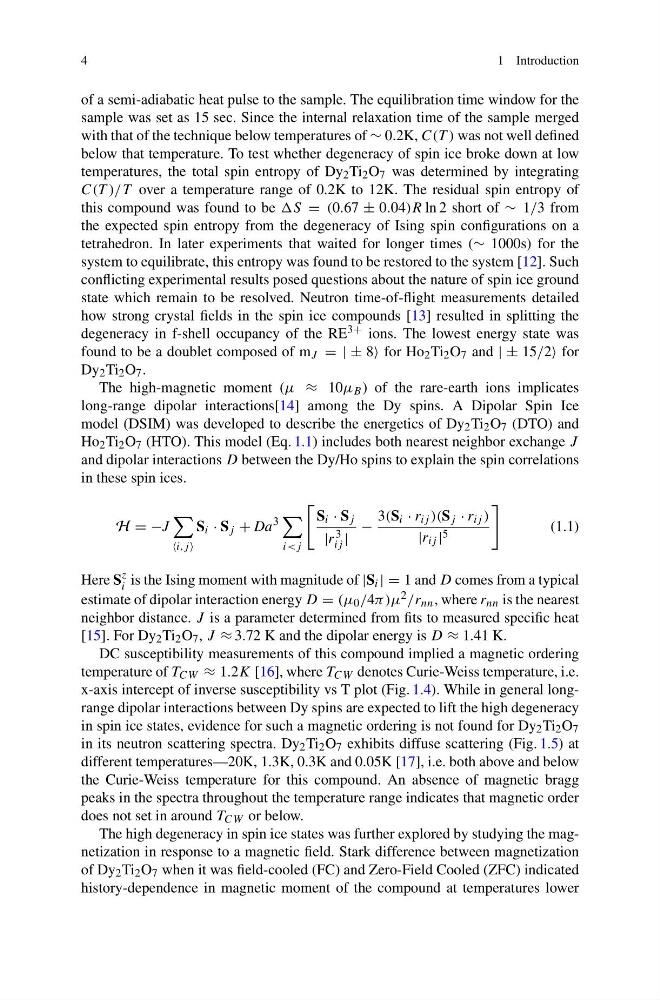
Ho 2 Ti 2 O 7 (HTO). This model (Eq. 1.1) includes both nearest neighbor exchange J
and dipolar interactions D between the Dy/Ho spins to explain the spin correlations
in these spin ices.
H = −J
i,j
S i · S j + Da
3
i
|r 3
ij |
−
3(S i · r ij )(S j · r ij )
|r ij | 5
(1.1)
Here S
z
i is the Ising moment with magnitude of |S i | = 1 and D comes from a typical
estimate of dipolar interaction energy D = (μ 0 /4π)μ 2 /r nn , where r nn is the nearest
neighbor distance. J is a parameter determined from fits to measured specific heat
[15]. For Dy 2 Ti 2 O 7 , J ≈ 3.72 K and the dipolar energy is D ≈ 1.41 K.
DC susceptibility measurements of this compound implied a magnetic ordering
temperature of T CW ≈ 1.2K [16], where T CW denotes Curie-Weiss temperature, i.e.
x-axis intercept of inverse susceptibility vs T plot (Fig. 1.4). While in general longrange dipolar interactions between Dy spins are expected to lift the high degeneracy
in spin ice states, evidence for such a magnetic ordering is not found for Dy 2 Ti 2 O 7
in its neutron scattering spectra. Dy 2 Ti 2 O 7 exhibits diffuse scattering (Fig. 1.5) at
different temperatures—20K, 1.3K, 0.3K and 0.05K [17], i.e. both above and below
the Curie-Weiss temperature for this compound. An absence of magnetic bragg
peaks in the spectra throughout the temperature range indicates that magnetic order
does not set in around T CW or below.
The high degeneracy in spin ice states was further explored by studying the magnetization in response to a magnetic field. Stark difference between magnetization
of Dy 2 Ti 2 O 7 when it was field-cooled (FC) and Zero-Field Cooled (ZFC) indicated
history-dependence in magnetic moment of the compound at temperatures lower
1 Introduction
of a semi-adiabatic heat pulse to the sample. The equilibration time window for the
sample was set as 15 sec. Since the internal relaxation time of the sample merged
with that of the technique below temperatures of ∼ 0.2K, C(T ) was not well defined
below that temperature. To test whether degeneracy of spin ice broke down at low
temperatures, the total spin entropy of Dy 2 Ti 2 O 7 was determined by integrating
C(T )/T over a temperature range of 0.2K to 12K. The residual spin entropy of
this compound was found to be S = (0.67 ± 0.04)R ln 2 short of ∼ 1/3 from
the expected spin entropy from the degeneracy of Ising spin configurations on a
tetrahedron. In later experiments that waited for longer times (∼ 1000s) for the
system to equilibrate, this entropy was found to be restored to the system [12]. Such
conflicting experimental results posed questions about the nature of spin ice ground
state which remain to be resolved. Neutron time-of-flight measurements detailed
how strong crystal fields in the spin ice compounds [13] resulted in splitting the
degeneracy in f-shell occupancy of the RE 3+ ions. The lowest energy state was
found to be a doublet composed of m J = | ± 8 for Ho 2 Ti 2 O 7 and | ± 15/2 for
Dy 2 Ti 2 O 7 .
The high-magnetic moment (μ ≈ 10μ B ) of the rare-earth ions implicates
long-range dipolar interactions[14] among the Dy spins. A Dipolar Spin Ice
model (DSIM) was developed to describe the energetics of Dy 2 Ti 2 O 7 (DTO) and
Ho 2 Ti 2 O 7 (HTO). This model (Eq. 1.1) includes both nearest neighbor exchange J
and dipolar interactions D between the Dy/Ho spins to explain the spin correlations
in these spin ices.
H = −J
i,j
S i · S j + Da
3
i
|r 3
ij |
−
3(S i · r ij )(S j · r ij )
|r ij | 5
(1.1)
Here S
z
i is the Ising moment with magnitude of |S i | = 1 and D comes from a typical
estimate of dipolar interaction energy D = (μ 0 /4π)μ 2 /r nn , where r nn is the nearest
neighbor distance. J is a parameter determined from fits to measured specific heat
[15]. For Dy 2 Ti 2 O 7 , J ≈ 3.72 K and the dipolar energy is D ≈ 1.41 K.
DC susceptibility measurements of this compound implied a magnetic ordering
temperature of T CW ≈ 1.2K [16], where T CW denotes Curie-Weiss temperature, i.e.
x-axis intercept of inverse susceptibility vs T plot (Fig. 1.4). While in general longrange dipolar interactions between Dy spins are expected to lift the high degeneracy
in spin ice states, evidence for such a magnetic ordering is not found for Dy 2 Ti 2 O 7
in its neutron scattering spectra. Dy 2 Ti 2 O 7 exhibits diffuse scattering (Fig. 1.5) at
different temperatures—20K, 1.3K, 0.3K and 0.05K [17], i.e. both above and below
the Curie-Weiss temperature for this compound. An absence of magnetic bragg
peaks in the spectra throughout the temperature range indicates that magnetic order
does not set in around T CW or below.
The high degeneracy in spin ice states was further explored by studying the magnetization in response to a magnetic field. Stark difference between magnetization
of Dy 2 Ti 2 O 7 when it was field-cooled (FC) and Zero-Field Cooled (ZFC) indicated
history-dependence in magnetic moment of the compound at temperatures lower