

2
1 Introduction
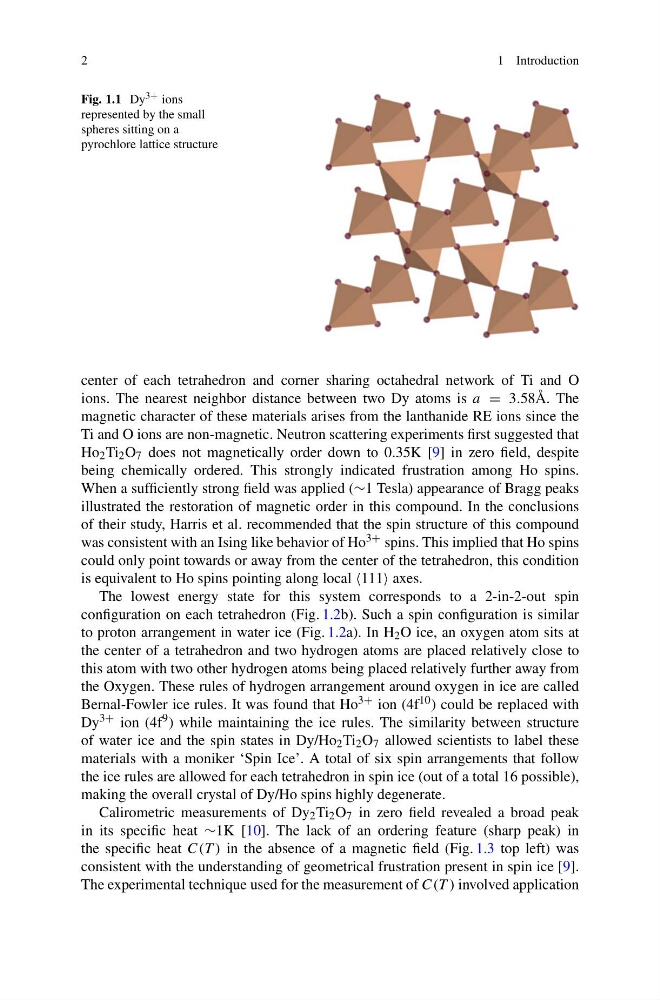
Fig. 1.1 Dy 3+ ions
represented by the small
spheres sitting on a
pyrochlore lattice structure
center of each tetrahedron and corner sharing octahedral network of Ti and O
ions. The nearest neighbor distance between two Dy atoms is a = 3.58Å. The
magnetic character of these materials arises from the lanthanide RE ions since the
Ti and O ions are non-magnetic. Neutron scattering experiments first suggested that
Ho 2 Ti 2 O 7 does not magnetically order down to 0.35K [9] in zero field, despite
being chemically ordered. This strongly indicated frustration among Ho spins.
When a sufficiently strong field was applied (∼1 Tesla) appearance of Bragg peaks
illustrated the restoration of magnetic order in this compound. In the conclusions
of their study, Harris et al. recommended that the spin structure of this compound
was consistent with an Ising like behavior of Ho 3+ spins. This implied that Ho spins
could only point towards or away from the center of the tetrahedron, this condition
is equivalent to Ho spins pointing along local 111 axes.
The lowest energy state for this system corresponds to a 2-in-2-out spin
configuration on each tetrahedron (Fig. 1.2b). Such a spin configuration is similar
to proton arrangement in water ice (Fig. 1.2a). In H 2 O ice, an oxygen atom sits at
the center of a tetrahedron and two hydrogen atoms are placed relatively close to
this atom with two other hydrogen atoms being placed relatively further away from
the Oxygen. These rules of hydrogen arrangement around oxygen in ice are called
Bernal-Fowler ice rules. It was found that Ho 3+ ion (4f 10 ) could be replaced with
Dy 3+ ion (4f 9 ) while maintaining the ice rules. The similarity between structure
of water ice and the spin states in Dy/Ho 2 Ti 2 O 7 allowed scientists to label these
materials with a moniker ‘Spin Ice’. A total of six spin arrangements that follow
the ice rules are allowed for each tetrahedron in spin ice (out of a total 16 possible),
making the overall crystal of Dy/Ho spins highly degenerate.
Calirometric measurements of Dy 2 Ti 2 O 7 in zero field revealed a broad peak
in its specific heat ∼1K [10]. The lack of an ordering feature (sharp peak) in
the specific heat C(T ) in the absence of a magnetic field (Fig. 1.3 top left) was
consistent with the understanding of geometrical frustration present in spin ice [9].
The experimental technique used for the measurement of C(T ) involved application
1 Introduction
Fig. 1.1 Dy 3+ ions
represented by the small
spheres sitting on a
pyrochlore lattice structure
center of each tetrahedron and corner sharing octahedral network of Ti and O
ions. The nearest neighbor distance between two Dy atoms is a = 3.58Å. The
magnetic character of these materials arises from the lanthanide RE ions since the
Ti and O ions are non-magnetic. Neutron scattering experiments first suggested that
Ho 2 Ti 2 O 7 does not magnetically order down to 0.35K [9] in zero field, despite
being chemically ordered. This strongly indicated frustration among Ho spins.
When a sufficiently strong field was applied (∼1 Tesla) appearance of Bragg peaks
illustrated the restoration of magnetic order in this compound. In the conclusions
of their study, Harris et al. recommended that the spin structure of this compound
was consistent with an Ising like behavior of Ho 3+ spins. This implied that Ho spins
could only point towards or away from the center of the tetrahedron, this condition
is equivalent to Ho spins pointing along local 111 axes.
The lowest energy state for this system corresponds to a 2-in-2-out spin
configuration on each tetrahedron (Fig. 1.2b). Such a spin configuration is similar
to proton arrangement in water ice (Fig. 1.2a). In H 2 O ice, an oxygen atom sits at
the center of a tetrahedron and two hydrogen atoms are placed relatively close to
this atom with two other hydrogen atoms being placed relatively further away from
the Oxygen. These rules of hydrogen arrangement around oxygen in ice are called
Bernal-Fowler ice rules. It was found that Ho 3+ ion (4f 10 ) could be replaced with
Dy 3+ ion (4f 9 ) while maintaining the ice rules. The similarity between structure
of water ice and the spin states in Dy/Ho 2 Ti 2 O 7 allowed scientists to label these
materials with a moniker ‘Spin Ice’. A total of six spin arrangements that follow
the ice rules are allowed for each tetrahedron in spin ice (out of a total 16 possible),
making the overall crystal of Dy/Ho spins highly degenerate.
Calirometric measurements of Dy 2 Ti 2 O 7 in zero field revealed a broad peak
in its specific heat ∼1K [10]. The lack of an ordering feature (sharp peak) in
the specific heat C(T ) in the absence of a magnetic field (Fig. 1.3 top left) was
consistent with the understanding of geometrical frustration present in spin ice [9].
The experimental technique used for the measurement of C(T ) involved application