

80
5 Performance Characteristics of Radar Location …
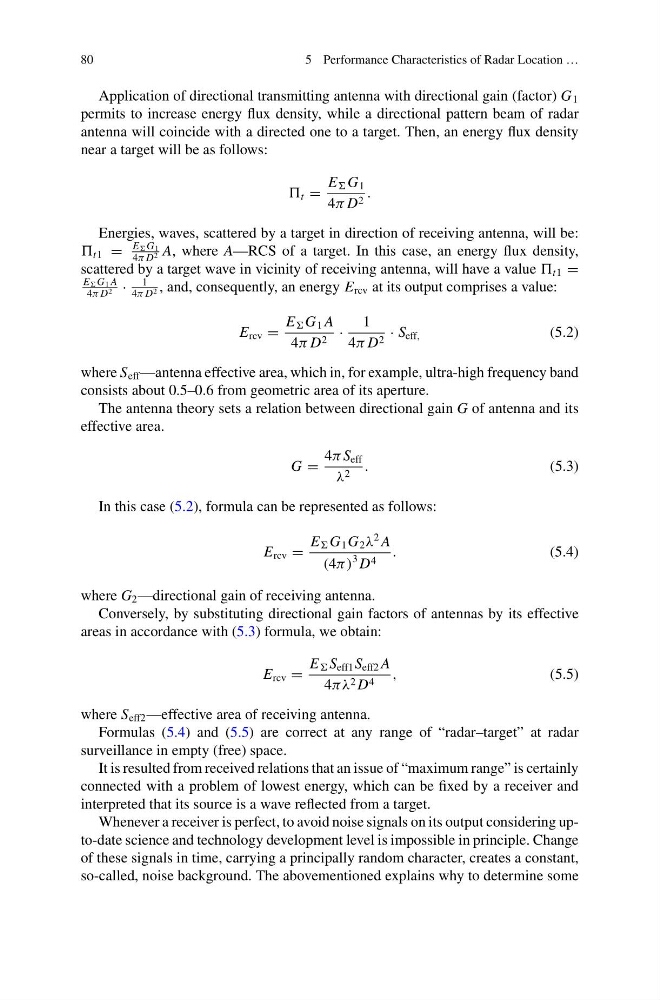
Application of directional transmitting antenna with directional gain (factor) G 1
permits to increase energy flux density, while a directional pattern beam of radar
antenna will coincide with a directed one to a target. Then, an energy flux density
near a target will be as follows:
t =
E G 1
4π D 2 .
Energies, waves, scattered by a target in direction of receiving antenna, will be:
t1 =
E G 1
4π D 2 A, where A—RCS of a target. In this case, an energy flux density,
scattered by a target wave in vicinity of receiving antenna, will have a value t1 =
E G 1 A
4π D 2 ·
1
4π D 2 , and, consequently, an energy E rcv at its output comprises a value:
E rcv =
E G 1 A
4π D 2 ·
1
4π D 2 · S eff,
(5.2)
where S eff —antenna effective area, which in, for example, ultra-high frequency band
consists about 0.5–0.6 from geometric area of its aperture.
The antenna theory sets a relation between directional gain G of antenna and its
effective area.
G =
4π S eff
λ 2 .
(5.3)
In this case (5.2), formula can be represented as follows:
E rcv =
E G 1 G 2 λ
2 A
(4π )
3 D 4 .
(5.4)
where G 2 —directional gain of receiving antenna.
Conversely, by substituting directional gain factors of antennas by its effective
areas in accordance with (5.3) formula, we obtain:
E rcv =
E S eff1 S eff2 A
4πλ 2 D 4 ,
(5.5)
where S eff2 —effective area of receiving antenna.
Formulas (5.4) and (5.5) are correct at any range of “radar–target” at radar
surveillance in empty (free) space.
It is resulted from received relations that an issue of “maximum range” is certainly
connected with a problem of lowest energy, which can be fixed by a receiver and
interpreted that its source is a wave reflected from a target.
Whenever a receiver is perfect, to avoid noise signals on its output considering upto-date science and technology development level is impossible in principle. Change
of these signals in time, carrying a principally random character, creates a constant,
so-called, noise background. The abovementioned explains why to determine some
5 Performance Characteristics of Radar Location …
Application of directional transmitting antenna with directional gain (factor) G 1
permits to increase energy flux density, while a directional pattern beam of radar
antenna will coincide with a directed one to a target. Then, an energy flux density
near a target will be as follows:
t =
E G 1
4π D 2 .
Energies, waves, scattered by a target in direction of receiving antenna, will be:
t1 =
E G 1
4π D 2 A, where A—RCS of a target. In this case, an energy flux density,
scattered by a target wave in vicinity of receiving antenna, will have a value t1 =
E G 1 A
4π D 2 ·
1
4π D 2 , and, consequently, an energy E rcv at its output comprises a value:
E rcv =
E G 1 A
4π D 2 ·
1
4π D 2 · S eff,
(5.2)
where S eff —antenna effective area, which in, for example, ultra-high frequency band
consists about 0.5–0.6 from geometric area of its aperture.
The antenna theory sets a relation between directional gain G of antenna and its
effective area.
G =
4π S eff
λ 2 .
(5.3)
In this case (5.2), formula can be represented as follows:
E rcv =
E G 1 G 2 λ
2 A
(4π )
3 D 4 .
(5.4)
where G 2 —directional gain of receiving antenna.
Conversely, by substituting directional gain factors of antennas by its effective
areas in accordance with (5.3) formula, we obtain:
E rcv =
E S eff1 S eff2 A
4πλ 2 D 4 ,
(5.5)
where S eff2 —effective area of receiving antenna.
Formulas (5.4) and (5.5) are correct at any range of “radar–target” at radar
surveillance in empty (free) space.
It is resulted from received relations that an issue of “maximum range” is certainly
connected with a problem of lowest energy, which can be fixed by a receiver and
interpreted that its source is a wave reflected from a target.
Whenever a receiver is perfect, to avoid noise signals on its output considering upto-date science and technology development level is impossible in principle. Change
of these signals in time, carrying a principally random character, creates a constant,
so-called, noise background. The abovementioned explains why to determine some