

48
3 Radar Targets and Its Reflecting Properties
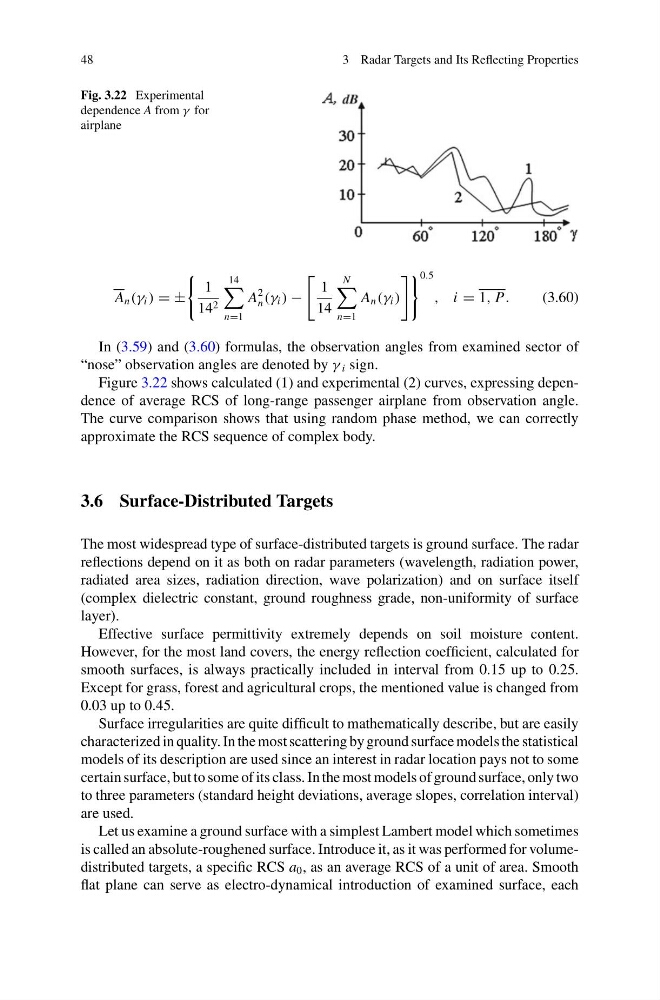
Fig. 3.22 Experimental
dependence A from γ for
airplane
A n (γ i ) = ±
1
14 2
14
n=1
A
2
n (γ i ) −
1
14
N
n=1
A n (γ i )
0.5
, i = 1, P.
(3.60)
In (3.59) and (3.60) formulas, the observation angles from examined sector of
“nose” observation angles are denoted by γ i sign.
Figure 3.22 shows calculated (1) and experimental (2) curves, expressing dependence of average RCS of long-range passenger airplane from observation angle.
The curve comparison shows that using random phase method, we can correctly
approximate the RCS sequence of complex body.
3.6 Surface-Distributed Targets
The most widespread type of surface-distributed targets is ground surface. The radar
reflections depend on it as both on radar parameters (wavelength, radiation power,
radiated area sizes, radiation direction, wave polarization) and on surface itself
(complex dielectric constant, ground roughness grade, non-uniformity of surface
layer).
Effective surface permittivity extremely depends on soil moisture content.
However, for the most land covers, the energy reflection coefficient, calculated for
smooth surfaces, is always practically included in interval from 0.15 up to 0.25.
Except for grass, forest and agricultural crops, the mentioned value is changed from
0.03 up to 0.45.
Surface irregularities are quite difficult to mathematically describe, but are easily
characterized in quality. In the most scattering by ground surface models the statistical
models of its description are used since an interest in radar location pays not to some
certain surface, but to some of its class. In the most models of ground surface, only two
to three parameters (standard height deviations, average slopes, correlation interval)
are used.
Let us examine a ground surface with a simplest Lambert model which sometimes
is called an absolute-roughened surface. Introduce it, as it was performed for volumedistributed targets, a specific RCS a 0 , as an average RCS of a unit of area. Smooth
flat plane can serve as electro-dynamical introduction of examined surface, each
3 Radar Targets and Its Reflecting Properties
Fig. 3.22 Experimental
dependence A from γ for
airplane
A n (γ i ) = ±
1
14 2
14
n=1
A
2
n (γ i ) −
1
14
N
n=1
A n (γ i )
0.5
, i = 1, P.
(3.60)
In (3.59) and (3.60) formulas, the observation angles from examined sector of
“nose” observation angles are denoted by γ i sign.
Figure 3.22 shows calculated (1) and experimental (2) curves, expressing dependence of average RCS of long-range passenger airplane from observation angle.
The curve comparison shows that using random phase method, we can correctly
approximate the RCS sequence of complex body.
3.6 Surface-Distributed Targets
The most widespread type of surface-distributed targets is ground surface. The radar
reflections depend on it as both on radar parameters (wavelength, radiation power,
radiated area sizes, radiation direction, wave polarization) and on surface itself
(complex dielectric constant, ground roughness grade, non-uniformity of surface
layer).
Effective surface permittivity extremely depends on soil moisture content.
However, for the most land covers, the energy reflection coefficient, calculated for
smooth surfaces, is always practically included in interval from 0.15 up to 0.25.
Except for grass, forest and agricultural crops, the mentioned value is changed from
0.03 up to 0.45.
Surface irregularities are quite difficult to mathematically describe, but are easily
characterized in quality. In the most scattering by ground surface models the statistical
models of its description are used since an interest in radar location pays not to some
certain surface, but to some of its class. In the most models of ground surface, only two
to three parameters (standard height deviations, average slopes, correlation interval)
are used.
Let us examine a ground surface with a simplest Lambert model which sometimes
is called an absolute-roughened surface. Introduce it, as it was performed for volumedistributed targets, a specific RCS a 0 , as an average RCS of a unit of area. Smooth
flat plane can serve as electro-dynamical introduction of examined surface, each