

30
3 Radar Targets and Its Reflecting Properties
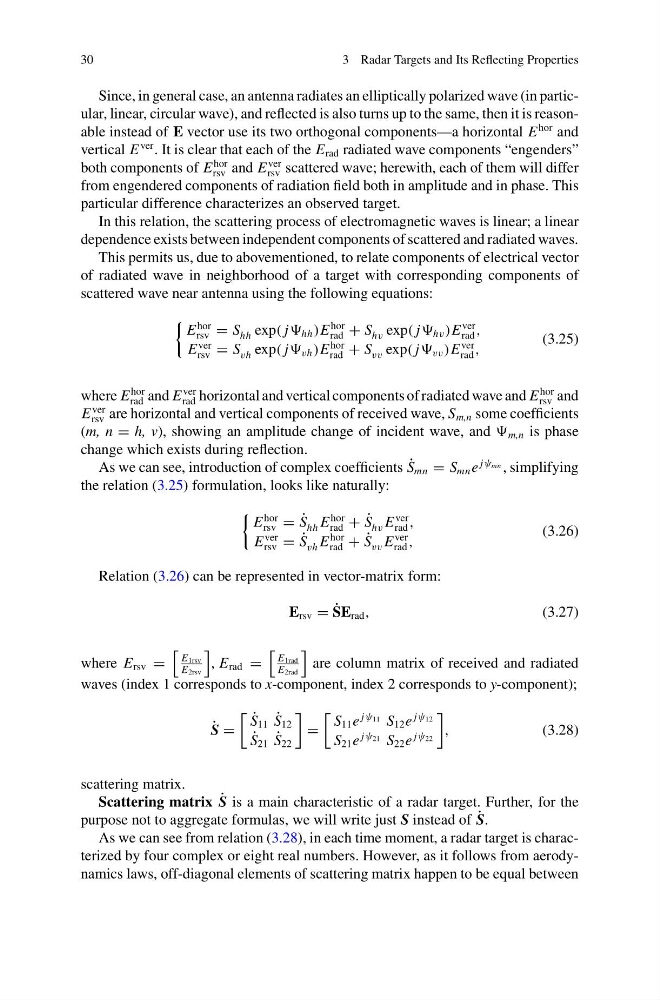
Since, in general case, an antenna radiates an elliptically polarized wave (in particular, linear, circular wave), and reflected is also turns up to the same, then it is reasonable instead of E vector use its two orthogonal components—a horizontal E
hor and
vertical E
ver . It is clear that each of the E rad radiated wave components “engenders”
both components of E
hor
rsv and E
ver
rsv scattered wave; herewith, each of them will differ
from engendered components of radiation field both in amplitude and in phase. This
particular difference characterizes an observed target.
In this relation, the scattering process of electromagnetic waves is linear; a linear
dependence exists between independent components of scattered and radiated waves.
This permits us, due to abovementioned, to relate components of electrical vector
of radiated wave in neighborhood of a target with corresponding components of
scattered wave near antenna using the following equations:
E
hor
rsv = S hh exp( j hh )E
hor
rad + S hv exp( j hv )E
ver
rad ,
E
ver
rsv = S vh exp( j vh )E
hor
rad + S vv exp( j vv )E
ver
rad ,
(3.25)
where E
hor
rad and E
ver
rad horizontal and vertical components of radiated wave and E
hor
rsv and
E
ver
rsv are horizontal and vertical components of received wave, S m,n some coefficients
(m, n = h, v), showing an amplitude change of incident wave, and m,n is phase
change which exists during reflection.
As we can see, introduction of complex coefficients ˙
S mn = S mn e
jψ mn , simplifying
the relation (3.25) formulation, looks like naturally:
E
hor
rsv = ˙
S hh E
hor
rad + ˙
S hv E
ver
rad ,
E
ver
rsv = ˙
S vh E
hor
rad + ˙
S vv E
ver
rad ,
(3.26)
Relation (3.26) can be represented in vector-matrix form:
E rsv = ˙
SE rad ,
(3.27)
where E rsv =
E 1rsv
E 2rsv
, E rad =
E 1rad
E 2rad
are column matrix of received and radiated
waves (index 1 corresponds to x-component, index 2 corresponds to y-component);
˙
S =
˙
S 11 ˙
S 12
˙
S 21 ˙
S 22
=
S 11 e
jψ 11 S 12 e
jψ 12
S 21 e
jψ 21 S 22 e
jψ 22
,
(3.28)
scattering matrix.
Scattering matrix ˙
S is a main characteristic of a radar target. Further, for the
purpose not to aggregate formulas, we will write just S instead of ˙
S.
As we can see from relation (3.28), in each time moment, a radar target is characterized by four complex or eight real numbers. However, as it follows from aerodynamics laws, off-diagonal elements of scattering matrix happen to be equal between
3 Radar Targets and Its Reflecting Properties
Since, in general case, an antenna radiates an elliptically polarized wave (in particular, linear, circular wave), and reflected is also turns up to the same, then it is reasonable instead of E vector use its two orthogonal components—a horizontal E
hor and
vertical E
ver . It is clear that each of the E rad radiated wave components “engenders”
both components of E
hor
rsv and E
ver
rsv scattered wave; herewith, each of them will differ
from engendered components of radiation field both in amplitude and in phase. This
particular difference characterizes an observed target.
In this relation, the scattering process of electromagnetic waves is linear; a linear
dependence exists between independent components of scattered and radiated waves.
This permits us, due to abovementioned, to relate components of electrical vector
of radiated wave in neighborhood of a target with corresponding components of
scattered wave near antenna using the following equations:
E
hor
rsv = S hh exp( j hh )E
hor
rad + S hv exp( j hv )E
ver
rad ,
E
ver
rsv = S vh exp( j vh )E
hor
rad + S vv exp( j vv )E
ver
rad ,
(3.25)
where E
hor
rad and E
ver
rad horizontal and vertical components of radiated wave and E
hor
rsv and
E
ver
rsv are horizontal and vertical components of received wave, S m,n some coefficients
(m, n = h, v), showing an amplitude change of incident wave, and m,n is phase
change which exists during reflection.
As we can see, introduction of complex coefficients ˙
S mn = S mn e
jψ mn , simplifying
the relation (3.25) formulation, looks like naturally:
E
hor
rsv = ˙
S hh E
hor
rad + ˙
S hv E
ver
rad ,
E
ver
rsv = ˙
S vh E
hor
rad + ˙
S vv E
ver
rad ,
(3.26)
Relation (3.26) can be represented in vector-matrix form:
E rsv = ˙
SE rad ,
(3.27)
where E rsv =
E 1rsv
E 2rsv
, E rad =
E 1rad
E 2rad
are column matrix of received and radiated
waves (index 1 corresponds to x-component, index 2 corresponds to y-component);
˙
S =
˙
S 11 ˙
S 12
˙
S 21 ˙
S 22
=
S 11 e
jψ 11 S 12 e
jψ 12
S 21 e
jψ 21 S 22 e
jψ 22
,
(3.28)
scattering matrix.
Scattering matrix ˙
S is a main characteristic of a radar target. Further, for the
purpose not to aggregate formulas, we will write just S instead of ˙
S.
As we can see from relation (3.28), in each time moment, a radar target is characterized by four complex or eight real numbers. However, as it follows from aerodynamics laws, off-diagonal elements of scattering matrix happen to be equal between