

17 Radio-Navigational Speed and Drift Angle Meters
323
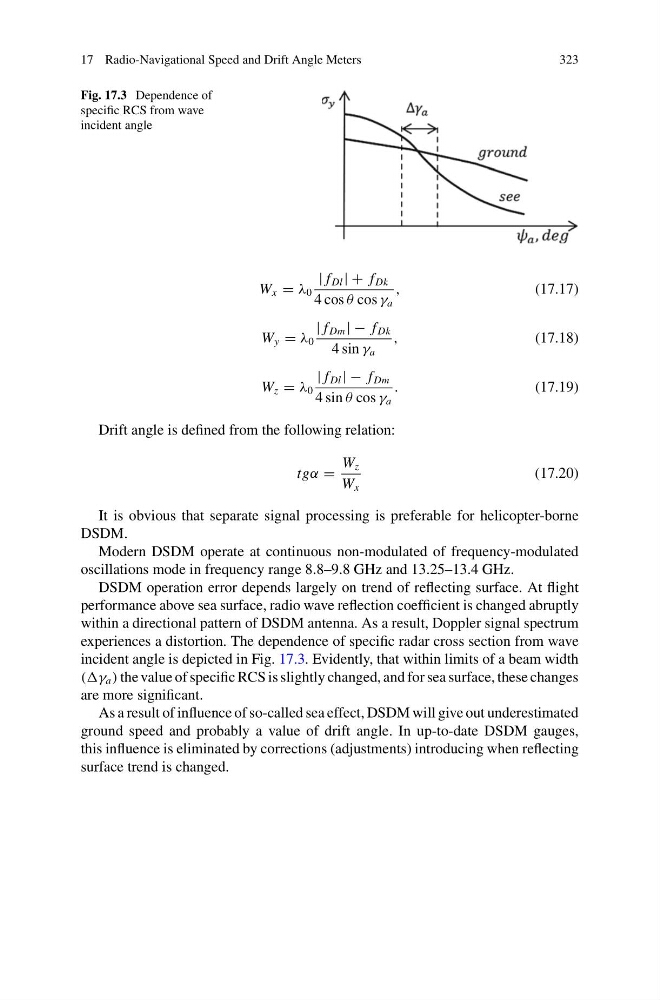
Fig. 17.3 Dependence of
specific RCS from wave
incident angle
W x = λ 0
| f Dl | + f Dk
4 cos θ cos γ a
,
(17.17)
W y = λ 0
| f Dm | − f Dk
4 sin γ a
,
(17.18)
W z = λ 0
| f Dl | − f Dm
4 sin θ cos γ a
.
(17.19)
Drift angle is defined from the following relation:
tgα =
W z
W x
(17.20)
It is obvious that separate signal processing is preferable for helicopter-borne
DSDM.
Modern DSDM operate at continuous non-modulated of frequency-modulated
oscillations mode in frequency range 8.8–9.8 GHz and 13.25–13.4 GHz.
DSDM operation error depends largely on trend of reflecting surface. At flight
performance above sea surface, radio wave reflection coefficient is changed abruptly
within a directional pattern of DSDM antenna. As a result, Doppler signal spectrum
experiences a distortion. The dependence of specific radar cross section from wave
incident angle is depicted in Fig. 17.3. Evidently, that within limits of a beam width
(γ a ) the value of specific RCS is slightly changed, and for sea surface, these changes
are more significant.
As a result of influence of so-called sea effect, DSDM will give out underestimated
ground speed and probably a value of drift angle. In up-to-date DSDM gauges,
this influence is eliminated by corrections (adjustments) introducing when reflecting
surface trend is changed.
323
Fig. 17.3 Dependence of
specific RCS from wave
incident angle
W x = λ 0
| f Dl | + f Dk
4 cos θ cos γ a
,
(17.17)
W y = λ 0
| f Dm | − f Dk
4 sin γ a
,
(17.18)
W z = λ 0
| f Dl | − f Dm
4 sin θ cos γ a
.
(17.19)
Drift angle is defined from the following relation:
tgα =
W z
W x
(17.20)
It is obvious that separate signal processing is preferable for helicopter-borne
DSDM.
Modern DSDM operate at continuous non-modulated of frequency-modulated
oscillations mode in frequency range 8.8–9.8 GHz and 13.25–13.4 GHz.
DSDM operation error depends largely on trend of reflecting surface. At flight
performance above sea surface, radio wave reflection coefficient is changed abruptly
within a directional pattern of DSDM antenna. As a result, Doppler signal spectrum
experiences a distortion. The dependence of specific radar cross section from wave
incident angle is depicted in Fig. 17.3. Evidently, that within limits of a beam width
(γ a ) the value of specific RCS is slightly changed, and for sea surface, these changes
are more significant.
As a result of influence of so-called sea effect, DSDM will give out underestimated
ground speed and probably a value of drift angle. In up-to-date DSDM gauges,
this influence is eliminated by corrections (adjustments) introducing when reflecting
surface trend is changed.