

16 Hyperbolic Radio Navigation Systems
315
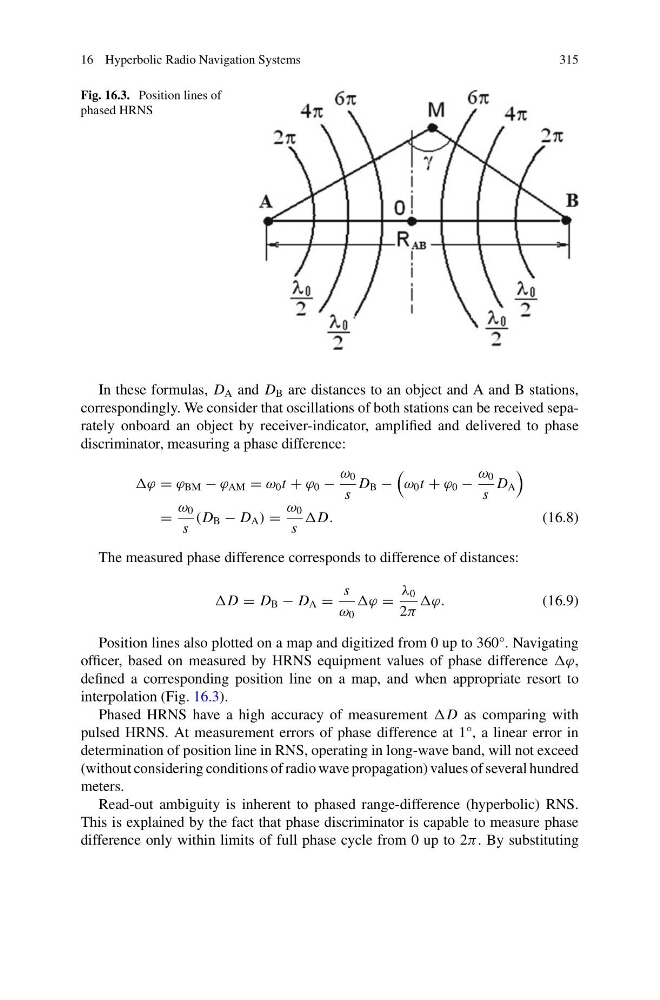
Fig. 16.3. Position lines of
phased HRNS
In these formulas, D A and D B are distances to an object and A and B stations,
correspondingly. We consider that oscillations of both stations can be received separately onboard an object by receiver-indicator, amplified and delivered to phase
discriminator, measuring a phase difference:
ϕ = ϕ BM − ϕ AM = ω 0 t + ϕ 0 −
ω 0
s
D B −
ω 0 t + ϕ 0 −
ω 0
s
D A
=
ω 0
s
(D B − D A ) =
ω 0
s
D.
(16.8)
The measured phase difference corresponds to difference of distances:
D = D B − D A =
s
ω 0
ϕ =
λ 0
2π
(16.9)
Position lines also plotted on a map and digitized from 0 up to 360°. Navigating
officer, based on measured by HRNS equipment values of phase difference ϕ,
defined a corresponding position line on a map, and when appropriate resort to
interpolation (Fig. 16.3).
Phased HRNS have a high accuracy of measurement D as comparing with
pulsed HRNS. At measurement errors of phase difference at 1°, a linear error in
determination of position line in RNS, operating in long-wave band, will not exceed
(without considering conditions of radio wave propagation) values of several hundred
meters.
Read-out ambiguity is inherent to phased range-difference (hyperbolic) RNS.
This is explained by the fact that phase discriminator is capable to measure phase
difference only within limits of full phase cycle from 0 up to 2π . By substituting
315
Fig. 16.3. Position lines of
phased HRNS
In these formulas, D A and D B are distances to an object and A and B stations,
correspondingly. We consider that oscillations of both stations can be received separately onboard an object by receiver-indicator, amplified and delivered to phase
discriminator, measuring a phase difference:
ϕ = ϕ BM − ϕ AM = ω 0 t + ϕ 0 −
ω 0
s
D B −
ω 0 t + ϕ 0 −
ω 0
s
D A
=
ω 0
s
(D B − D A ) =
ω 0
s
D.
(16.8)
The measured phase difference corresponds to difference of distances:
D = D B − D A =
s
ω 0
ϕ =
λ 0
2π
(16.9)
Position lines also plotted on a map and digitized from 0 up to 360°. Navigating
officer, based on measured by HRNS equipment values of phase difference ϕ,
defined a corresponding position line on a map, and when appropriate resort to
interpolation (Fig. 16.3).
Phased HRNS have a high accuracy of measurement D as comparing with
pulsed HRNS. At measurement errors of phase difference at 1°, a linear error in
determination of position line in RNS, operating in long-wave band, will not exceed
(without considering conditions of radio wave propagation) values of several hundred
meters.
Read-out ambiguity is inherent to phased range-difference (hyperbolic) RNS.
This is explained by the fact that phase discriminator is capable to measure phase
difference only within limits of full phase cycle from 0 up to 2π . By substituting