

16
3 Radar Targets and Its Reflecting Properties
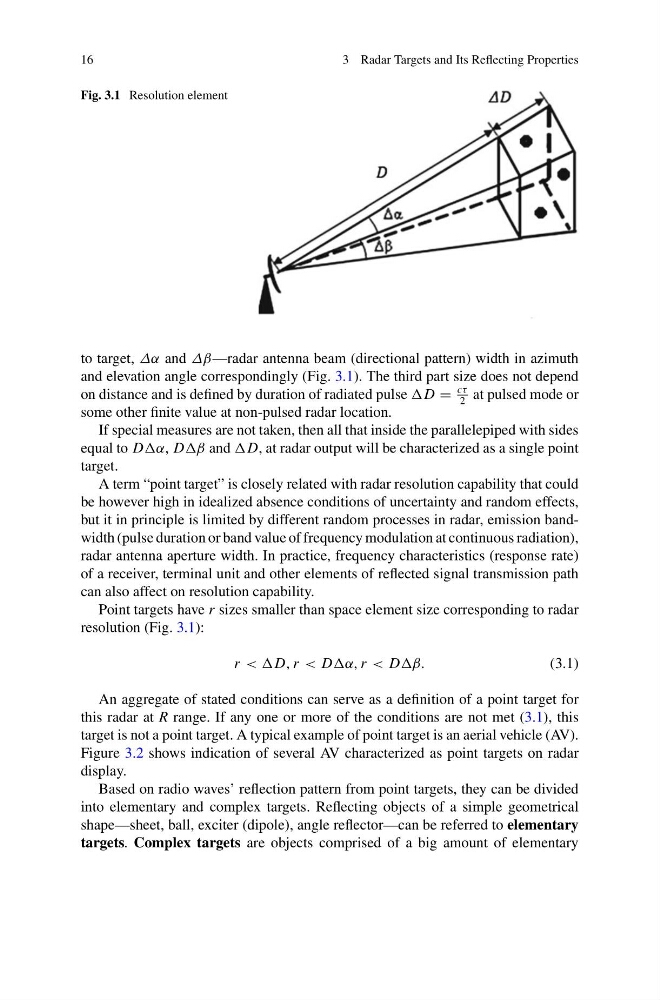
Fig. 3.1 Resolution element
to target, Δα and Δβ—radar antenna beam (directional pattern) width in azimuth
and elevation angle correspondingly (Fig. 3.1). The third part size does not depend
on distance and is defined by duration of radiated pulse D =
cτ
2
at pulsed mode or
some other finite value at non-pulsed radar location.
If special measures are not taken, then all that inside the parallelepiped with sides
equal to Dα, Dβ and D, at radar output will be characterized as a single point
target.
A term “point target” is closely related with radar resolution capability that could
be however high in idealized absence conditions of uncertainty and random effects,
but it in principle is limited by different random processes in radar, emission bandwidth (pulse duration or band value of frequency modulation at continuous radiation),
radar antenna aperture width. In practice, frequency characteristics (response rate)
of a receiver, terminal unit and other elements of reflected signal transmission path
can also affect on resolution capability.
Point targets have r sizes smaller than space element size corresponding to radar
resolution (Fig. 3.1):
r <
An aggregate of stated conditions can serve as a definition of a point target for
this radar at R range. If any one or more of the conditions are not met (3.1), this
target is not a point target. A typical example of point target is an aerial vehicle (AV).
Figure 3.2 shows indication of several AV characterized as point targets on radar
display.
Based on radio waves’ reflection pattern from point targets, they can be divided
into elementary and complex targets. Reflecting objects of a simple geometrical
shape—sheet, ball, exciter (dipole), angle reflector—can be referred to elementary
targets. Complex targets are objects comprised of a big amount of elementary
3 Radar Targets and Its Reflecting Properties
Fig. 3.1 Resolution element
to target, Δα and Δβ—radar antenna beam (directional pattern) width in azimuth
and elevation angle correspondingly (Fig. 3.1). The third part size does not depend
on distance and is defined by duration of radiated pulse D =
cτ
2
at pulsed mode or
some other finite value at non-pulsed radar location.
If special measures are not taken, then all that inside the parallelepiped with sides
equal to Dα, Dβ and D, at radar output will be characterized as a single point
target.
A term “point target” is closely related with radar resolution capability that could
be however high in idealized absence conditions of uncertainty and random effects,
but it in principle is limited by different random processes in radar, emission bandwidth (pulse duration or band value of frequency modulation at continuous radiation),
radar antenna aperture width. In practice, frequency characteristics (response rate)
of a receiver, terminal unit and other elements of reflected signal transmission path
can also affect on resolution capability.
Point targets have r sizes smaller than space element size corresponding to radar
resolution (Fig. 3.1):
r <
An aggregate of stated conditions can serve as a definition of a point target for
this radar at R range. If any one or more of the conditions are not met (3.1), this
target is not a point target. A typical example of point target is an aerial vehicle (AV).
Figure 3.2 shows indication of several AV characterized as point targets on radar
display.
Based on radio waves’ reflection pattern from point targets, they can be divided
into elementary and complex targets. Reflecting objects of a simple geometrical
shape—sheet, ball, exciter (dipole), angle reflector—can be referred to elementary
targets. Complex targets are objects comprised of a big amount of elementary