

14.3 Satellite Radio Navigation Systems
259
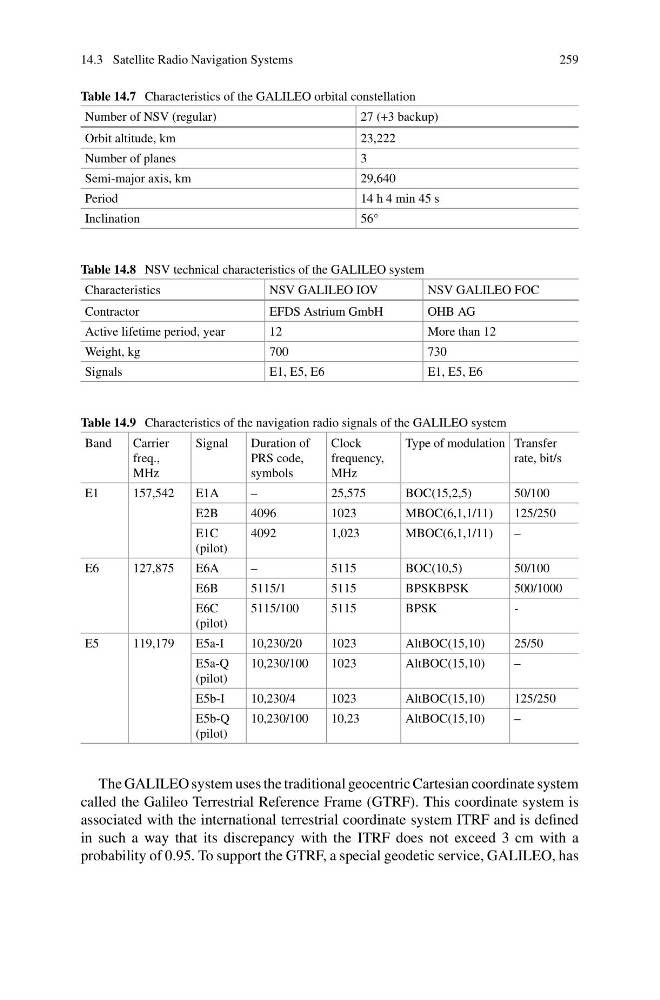
Table 14.7 Characteristics of the GALILEO orbital constellation
Number of NSV (regular)
27 (+3 backup)
Orbit altitude, km
23,222
Number of planes
3
Semi-major axis, km
29,640
Period
14 h 4 min 45 s
Inclination
56°
Table 14.8 NSV technical characteristics of the GALILEO system
Characteristics
NSV GALILEO IOV
NSV GALILEO FOC
Contractor
EFDS Astrium GmbH
OHB AG
Active lifetime period, year
12
More than 12
Weight, kg
700
730
Signals
E1, E5, E6
E1, E5, E6
Table 14.9 Characteristics of the navigation radio signals of the GALILEO system
Band
Carrier
freq.,
MHz
Signal
Duration of
PRS code,
symbols
Clock
frequency,
MHz
Type of modulation Transfer
rate, bit/s
E1
157,542
E1A
–
25,575
BOC(15,2,5)
50/100
E2B
4096
1023
MBOC(6,1,1/11)
125/250
E1C
(pilot)
4092
1,023
MBOC(6,1,1/11)
–
E6
127,875
E6A
–
5115
BOC(10,5)
50/100
E6B
5115/1
5115
BPSKBPSK
500/1000
E6C
(pilot)
5115/100
5115
BPSK
-
E5
119,179
E5a-I
10,230/20
1023
AltBOC(15,10)
25/50
E5a-Q
(pilot)
10,230/100
1023
AltBOC(15,10)
–
E5b-I
10,230/4
1023
AltBOC(15,10)
125/250
E5b-Q
(pilot)
10,230/100
10,23
AltBOC(15,10)
–
The GALILEO system uses the traditional geocentric Cartesian coordinate system
called the Galileo Terrestrial Reference Frame (GTRF). This coordinate system is
associated with the international terrestrial coordinate system ITRF and is defined
in such a way that its discrepancy with the ITRF does not exceed 3 cm with a
probability of 0.95. To support the GTRF, a special geodetic service, GALILEO, has
259
Table 14.7 Characteristics of the GALILEO orbital constellation
Number of NSV (regular)
27 (+3 backup)
Orbit altitude, km
23,222
Number of planes
3
Semi-major axis, km
29,640
Period
14 h 4 min 45 s
Inclination
56°
Table 14.8 NSV technical characteristics of the GALILEO system
Characteristics
NSV GALILEO IOV
NSV GALILEO FOC
Contractor
EFDS Astrium GmbH
OHB AG
Active lifetime period, year
12
More than 12
Weight, kg
700
730
Signals
E1, E5, E6
E1, E5, E6
Table 14.9 Characteristics of the navigation radio signals of the GALILEO system
Band
Carrier
freq.,
MHz
Signal
Duration of
PRS code,
symbols
Clock
frequency,
MHz
Type of modulation Transfer
rate, bit/s
E1
157,542
E1A
–
25,575
BOC(15,2,5)
50/100
E2B
4096
1023
MBOC(6,1,1/11)
125/250
E1C
(pilot)
4092
1,023
MBOC(6,1,1/11)
–
E6
127,875
E6A
–
5115
BOC(10,5)
50/100
E6B
5115/1
5115
BPSKBPSK
500/1000
E6C
(pilot)
5115/100
5115
BPSK
-
E5
119,179
E5a-I
10,230/20
1023
AltBOC(15,10)
25/50
E5a-Q
(pilot)
10,230/100
1023
AltBOC(15,10)
–
E5b-I
10,230/4
1023
AltBOC(15,10)
125/250
E5b-Q
(pilot)
10,230/100
10,23
AltBOC(15,10)
–
The GALILEO system uses the traditional geocentric Cartesian coordinate system
called the Galileo Terrestrial Reference Frame (GTRF). This coordinate system is
associated with the international terrestrial coordinate system ITRF and is defined
in such a way that its discrepancy with the ITRF does not exceed 3 cm with a
probability of 0.95. To support the GTRF, a special geodetic service, GALILEO, has