

14.2 Factors Affecting the Accuracy of Satellite …
249
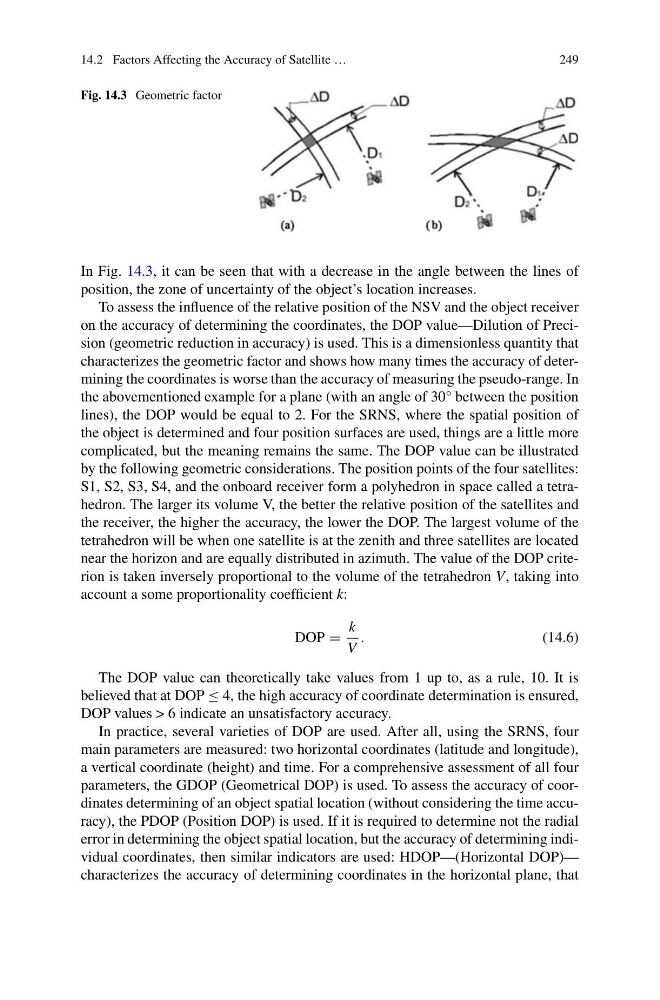
Fig. 14.3 Geometric factor
In Fig. 14.3, it can be seen that with a decrease in the angle between the lines of
position, the zone of uncertainty of the object’s location increases.
To assess the influence of the relative position of the NSV and the object receiver
on the accuracy of determining the coordinates, the DOP value—Dilution of Precision (geometric reduction in accuracy) is used. This is a dimensionless quantity that
characterizes the geometric factor and shows how many times the accuracy of determining the coordinates is worse than the accuracy of measuring the pseudo-range. In
the abovementioned example for a plane (with an angle of 30° between the position
lines), the DOP would be equal to 2. For the SRNS, where the spatial position of
the object is determined and four position surfaces are used, things are a little more
complicated, but the meaning remains the same. The DOP value can be illustrated
by the following geometric considerations. The position points of the four satellites:
S1, S2, S3, S4, and the onboard receiver form a polyhedron in space called a tetrahedron. The larger its volume V, the better the relative position of the satellites and
the receiver, the higher the accuracy, the lower the DOP. The largest volume of the
tetrahedron will be when one satellite is at the zenith and three satellites are located
near the horizon and are equally distributed in azimuth. The value of the DOP criterion is taken inversely proportional to the volume of the tetrahedron V, taking into
account a some proportionality coefficient k:
DOP =
k
V
.
(14.6)
The DOP value can theoretically take values from 1 up to, as a rule, 10. It is
believed that at DOP ≤ 4, the high accuracy of coordinate determination is ensured,
DOP values > 6 indicate an unsatisfactory accuracy.
In practice, several varieties of DOP are used. After all, using the SRNS, four
main parameters are measured: two horizontal coordinates (latitude and longitude),
a vertical coordinate (height) and time. For a comprehensive assessment of all four
parameters, the GDOP (Geometrical DOP) is used. To assess the accuracy of coordinates determining of an object spatial location (without considering the time accuracy), the PDOP (Position DOP) is used. If it is required to determine not the radial
error in determining the object spatial location, but the accuracy of determining individual coordinates, then similar indicators are used: HDOP—(Horizontal DOP)—
characterizes the accuracy of determining coordinates in the horizontal plane, that
249
Fig. 14.3 Geometric factor
In Fig. 14.3, it can be seen that with a decrease in the angle between the lines of
position, the zone of uncertainty of the object’s location increases.
To assess the influence of the relative position of the NSV and the object receiver
on the accuracy of determining the coordinates, the DOP value—Dilution of Precision (geometric reduction in accuracy) is used. This is a dimensionless quantity that
characterizes the geometric factor and shows how many times the accuracy of determining the coordinates is worse than the accuracy of measuring the pseudo-range. In
the abovementioned example for a plane (with an angle of 30° between the position
lines), the DOP would be equal to 2. For the SRNS, where the spatial position of
the object is determined and four position surfaces are used, things are a little more
complicated, but the meaning remains the same. The DOP value can be illustrated
by the following geometric considerations. The position points of the four satellites:
S1, S2, S3, S4, and the onboard receiver form a polyhedron in space called a tetrahedron. The larger its volume V, the better the relative position of the satellites and
the receiver, the higher the accuracy, the lower the DOP. The largest volume of the
tetrahedron will be when one satellite is at the zenith and three satellites are located
near the horizon and are equally distributed in azimuth. The value of the DOP criterion is taken inversely proportional to the volume of the tetrahedron V, taking into
account a some proportionality coefficient k:
DOP =
k
V
.
(14.6)
The DOP value can theoretically take values from 1 up to, as a rule, 10. It is
believed that at DOP ≤ 4, the high accuracy of coordinate determination is ensured,
DOP values > 6 indicate an unsatisfactory accuracy.
In practice, several varieties of DOP are used. After all, using the SRNS, four
main parameters are measured: two horizontal coordinates (latitude and longitude),
a vertical coordinate (height) and time. For a comprehensive assessment of all four
parameters, the GDOP (Geometrical DOP) is used. To assess the accuracy of coordinates determining of an object spatial location (without considering the time accuracy), the PDOP (Position DOP) is used. If it is required to determine not the radial
error in determining the object spatial location, but the accuracy of determining individual coordinates, then similar indicators are used: HDOP—(Horizontal DOP)—
characterizes the accuracy of determining coordinates in the horizontal plane, that