

13 Range-Finding Radio Navigation Systems
241
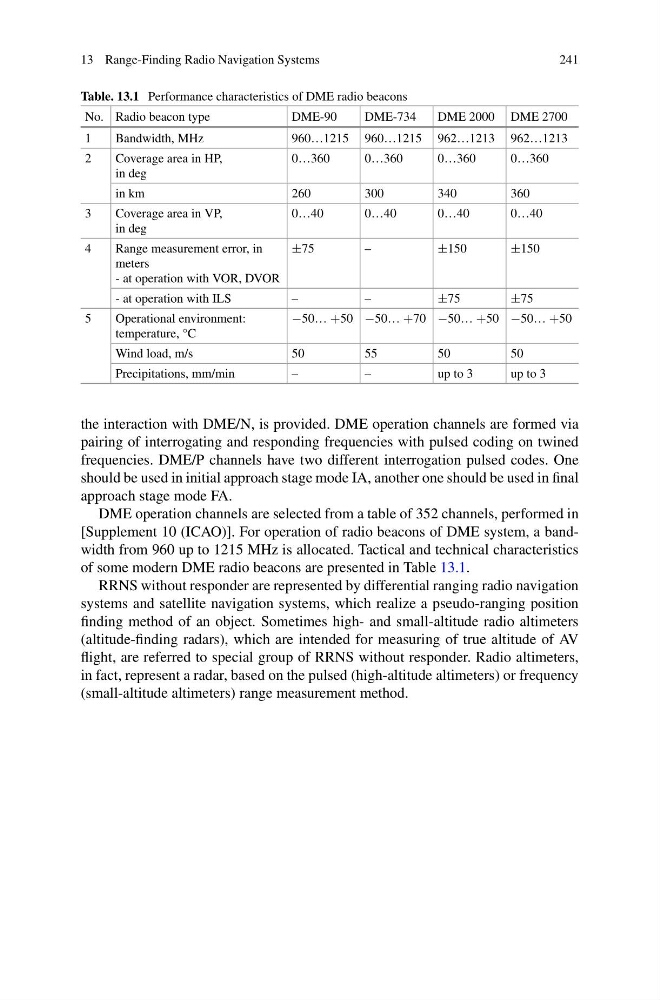
Table. 13.1 Performance characteristics of DME radio beacons
No. Radio beacon type
DME-90
DME-734
DME 2000 DME 2700
1
Bandwidth, MHz
960…1215 960…1215 962…1213 962…1213
2
Coverage area in HP,
in deg
0…360
0…360
0…360
0…360
in km
260
300
340
360
3
Coverage area in VP,
in deg
0…40
0…40
0…40
0…40
4
Range measurement error, in
meters
- at operation with VOR, DVOR
±75
–
±150
±150
- at operation with ILS
–
–
±75
±75
5
Operational environment:
temperature, °C
−50… +50 −50… +70 −50… +50 −50… +50
Wind load, m/s
50
55
50
50
Precipitations, mm/min
–
–
up to 3
up to 3
the interaction with DME/N, is provided. DME operation channels are formed via
pairing of interrogating and responding frequencies with pulsed coding on twined
frequencies. DME/P channels have two different interrogation pulsed codes. One
should be used in initial approach stage mode IA, another one should be used in final
approach stage mode FA.
DME operation channels are selected from a table of 352 channels, performed in
[Supplement 10 (ICAO)]. For operation of radio beacons of DME system, a bandwidth from 960 up to 1215 MHz is allocated. Tactical and technical characteristics
of some modern DME radio beacons are presented in Table 13.1.
RRNS without responder are represented by differential ranging radio navigation
systems and satellite navigation systems, which realize a pseudo-ranging position
finding method of an object. Sometimes high- and small-altitude radio altimeters
(altitude-finding radars), which are intended for measuring of true altitude of AV
flight, are referred to special group of RRNS without responder. Radio altimeters,
in fact, represent a radar, based on the pulsed (high-altitude altimeters) or frequency
(small-altitude altimeters) range measurement method.
241
Table. 13.1 Performance characteristics of DME radio beacons
No. Radio beacon type
DME-90
DME-734
DME 2000 DME 2700
1
Bandwidth, MHz
960…1215 960…1215 962…1213 962…1213
2
Coverage area in HP,
in deg
0…360
0…360
0…360
0…360
in km
260
300
340
360
3
Coverage area in VP,
in deg
0…40
0…40
0…40
0…40
4
Range measurement error, in
meters
- at operation with VOR, DVOR
±75
–
±150
±150
- at operation with ILS
–
–
±75
±75
5
Operational environment:
temperature, °C
−50… +50 −50… +70 −50… +50 −50… +50
Wind load, m/s
50
55
50
50
Precipitations, mm/min
–
–
up to 3
up to 3
the interaction with DME/N, is provided. DME operation channels are formed via
pairing of interrogating and responding frequencies with pulsed coding on twined
frequencies. DME/P channels have two different interrogation pulsed codes. One
should be used in initial approach stage mode IA, another one should be used in final
approach stage mode FA.
DME operation channels are selected from a table of 352 channels, performed in
[Supplement 10 (ICAO)]. For operation of radio beacons of DME system, a bandwidth from 960 up to 1215 MHz is allocated. Tactical and technical characteristics
of some modern DME radio beacons are presented in Table 13.1.
RRNS without responder are represented by differential ranging radio navigation
systems and satellite navigation systems, which realize a pseudo-ranging position
finding method of an object. Sometimes high- and small-altitude radio altimeters
(altitude-finding radars), which are intended for measuring of true altitude of AV
flight, are referred to special group of RRNS without responder. Radio altimeters,
in fact, represent a radar, based on the pulsed (high-altitude altimeters) or frequency
(small-altitude altimeters) range measurement method.