

6.1 Detection of Radio Signals
135
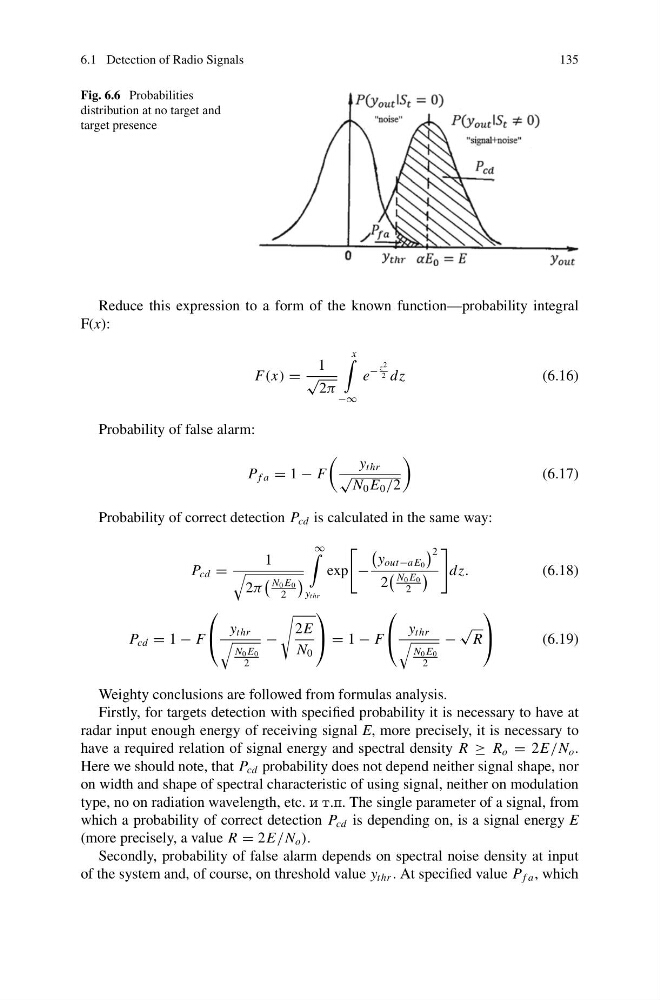
Fig. 6.6 Probabilities
distribution at no target and
target presence
Reduce this expression to a form of the known function—probability integral
F(x):
F(x) =
1
√
2π
x
−∞
e
−
z 2
2 dz
(6.16)
Probability of false alarm:
P f a = 1 − F
y thr
√
N 0 E 0 /2
(6.17)
Probability of correct detection P cd is calculated in the same way:
P cd =
1
2π
N 0 E 0
2
∞
y thr
exp
−
y out−aE 0
2
2
N 0 E 0
2
dz.
(6.18)
P cd = 1 − F
⎛
⎝ y thr
N 0 E 0
2
−
2E
N 0
⎞
⎠ = 1 − F
⎛
⎝ y thr
N 0 E 0
2
−
√
R
⎞
⎠
(6.19)
Weighty conclusions are followed from formulas analysis.
Firstly, for targets detection with specified probability it is necessary to have at
radar input enough energy of receiving signal E, more precisely, it is necessary to
have a required relation of signal energy and spectral density R ≥ R o = 2E/N o .
Here we should note, that P cd probability does not depend neither signal shape, nor
on width and shape of spectral characteristic of using signal, neither on modulation
type, no on radiation wavelength, etc. i t.p. The single parameter of a signal, from
which a probability of correct detection P cd is depending on, is a signal energy E
(more precisely, a value R = 2E/N o ).
Secondly, probability of false alarm depends on spectral noise density at input
of the system and, of course, on threshold value y thr . At specified value P f a , which
135
Fig. 6.6 Probabilities
distribution at no target and
target presence
Reduce this expression to a form of the known function—probability integral
F(x):
F(x) =
1
√
2π
x
−∞
e
−
z 2
2 dz
(6.16)
Probability of false alarm:
P f a = 1 − F
y thr
√
N 0 E 0 /2
(6.17)
Probability of correct detection P cd is calculated in the same way:
P cd =
1
2π
N 0 E 0
2
∞
y thr
exp
−
y out−aE 0
2
2
N 0 E 0
2
dz.
(6.18)
P cd = 1 − F
⎛
⎝ y thr
N 0 E 0
2
−
2E
N 0
⎞
⎠ = 1 − F
⎛
⎝ y thr
N 0 E 0
2
−
√
R
⎞
⎠
(6.19)
Weighty conclusions are followed from formulas analysis.
Firstly, for targets detection with specified probability it is necessary to have at
radar input enough energy of receiving signal E, more precisely, it is necessary to
have a required relation of signal energy and spectral density R ≥ R o = 2E/N o .
Here we should note, that P cd probability does not depend neither signal shape, nor
on width and shape of spectral characteristic of using signal, neither on modulation
type, no on radiation wavelength, etc. i t.p. The single parameter of a signal, from
which a probability of correct detection P cd is depending on, is a signal energy E
(more precisely, a value R = 2E/N o ).
Secondly, probability of false alarm depends on spectral noise density at input
of the system and, of course, on threshold value y thr . At specified value P f a , which