

128
6 Detection of Radio Signals and Its Parameters Measuring
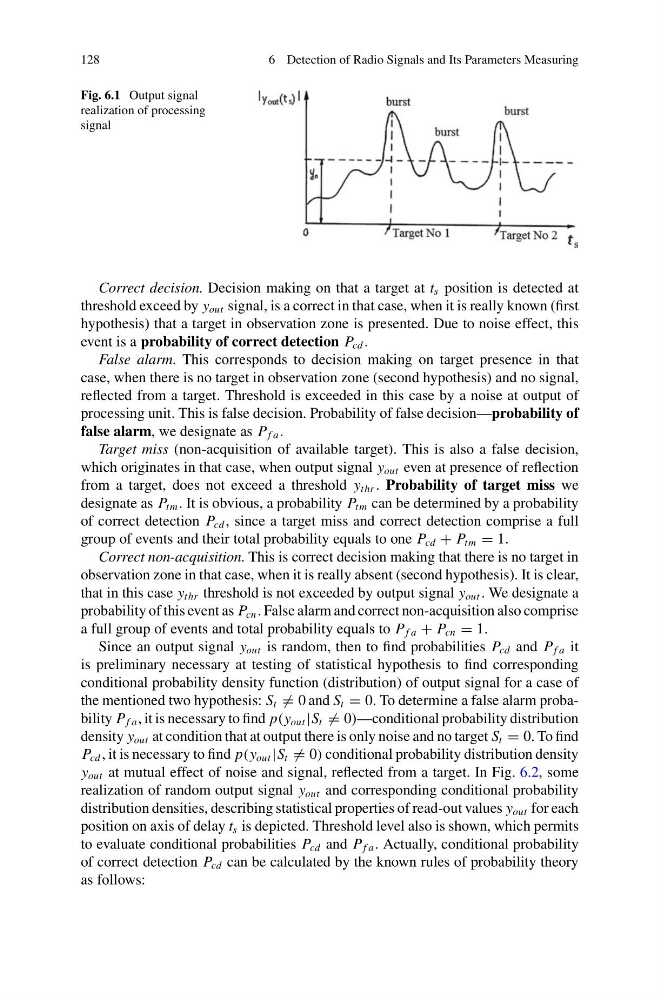
Fig. 6.1 Output signal
realization of processing
signal
Correct decision. Decision making on that a target at t s position is detected at
threshold exceed by y out signal, is a correct in that case, when it is really known (first
hypothesis) that a target in observation zone is presented. Due to noise effect, this
event is a probability of correct detection P cd .
False alarm. This corresponds to decision making on target presence in that
case, when there is no target in observation zone (second hypothesis) and no signal,
reflected from a target. Threshold is exceeded in this case by a noise at output of
processing unit. This is false decision. Probability of false decision—probability of
false alarm, we designate as P f a .
Target miss (non-acquisition of available target). This is also a false decision,
which originates in that case, when output signal y out even at presence of reflection
from a target, does not exceed a threshold y thr . Probability of target miss we
designate as P tm . It is obvious, a probability P tm can be determined by a probability
of correct detection P cd , since a target miss and correct detection comprise a full
group of events and their total probability equals to one P cd + P tm = 1.
Correct non-acquisition. This is correct decision making that there is no target in
observation zone in that case, when it is really absent (second hypothesis). It is clear,
that in this case y thr threshold is not exceeded by output signal y out . We designate a
probability of this event as P cn . False alarm and correct non-acquisition also comprise
a full group of events and total probability equals to P f a + P cn = 1.
Since an output signal y out is random, then to find probabilities P cd and P f a it
is preliminary necessary at testing of statistical hypothesis to find corresponding
conditional probability density function (distribution) of output signal for a case of
the mentioned two hypothesis: S t = 0 and S t = 0. To determine a false alarm probability P f a , it is necessary to find p(y out |S t = 0)—conditional probability distribution
density y out at condition that at output there is only noise and no target S t = 0. To find
P cd , it is necessary to find p(y out |S t = 0) conditional probability distribution density
y out at mutual effect of noise and signal, reflected from a target. In Fig. 6.2, some
realization of random output signal y out and corresponding conditional probability
distribution densities, describing statistical properties of read-out values y out for each
position on axis of delay t s is depicted. Threshold level also is shown, which permits
to evaluate conditional probabilities P cd and P f a . Actually, conditional probability
of correct detection P cd can be calculated by the known rules of probability theory
as follows:
6 Detection of Radio Signals and Its Parameters Measuring
Fig. 6.1 Output signal
realization of processing
signal
Correct decision. Decision making on that a target at t s position is detected at
threshold exceed by y out signal, is a correct in that case, when it is really known (first
hypothesis) that a target in observation zone is presented. Due to noise effect, this
event is a probability of correct detection P cd .
False alarm. This corresponds to decision making on target presence in that
case, when there is no target in observation zone (second hypothesis) and no signal,
reflected from a target. Threshold is exceeded in this case by a noise at output of
processing unit. This is false decision. Probability of false decision—probability of
false alarm, we designate as P f a .
Target miss (non-acquisition of available target). This is also a false decision,
which originates in that case, when output signal y out even at presence of reflection
from a target, does not exceed a threshold y thr . Probability of target miss we
designate as P tm . It is obvious, a probability P tm can be determined by a probability
of correct detection P cd , since a target miss and correct detection comprise a full
group of events and their total probability equals to one P cd + P tm = 1.
Correct non-acquisition. This is correct decision making that there is no target in
observation zone in that case, when it is really absent (second hypothesis). It is clear,
that in this case y thr threshold is not exceeded by output signal y out . We designate a
probability of this event as P cn . False alarm and correct non-acquisition also comprise
a full group of events and total probability equals to P f a + P cn = 1.
Since an output signal y out is random, then to find probabilities P cd and P f a it
is preliminary necessary at testing of statistical hypothesis to find corresponding
conditional probability density function (distribution) of output signal for a case of
the mentioned two hypothesis: S t = 0 and S t = 0. To determine a false alarm probability P f a , it is necessary to find p(y out |S t = 0)—conditional probability distribution
density y out at condition that at output there is only noise and no target S t = 0. To find
P cd , it is necessary to find p(y out |S t = 0) conditional probability distribution density
y out at mutual effect of noise and signal, reflected from a target. In Fig. 6.2, some
realization of random output signal y out and corresponding conditional probability
distribution densities, describing statistical properties of read-out values y out for each
position on axis of delay t s is depicted. Threshold level also is shown, which permits
to evaluate conditional probabilities P cd and P f a . Actually, conditional probability
of correct detection P cd can be calculated by the known rules of probability theory
as follows: