

5.6 Interference Immunity of Radar Location and Radio Navigation Systems
123
From the point of view of signals transmission and transformation theory, interference influence leads to linear and non-linear effects. Linear effects, as a rule, are
observed at low noise level and concludes in that nuisance (interfering) vibrations in
form independent additive components are added into receiving channels. In these
cases output interference effect does not depend on signal action and can be examined independently. Shape distortion of desired signal due to additive composition
with a noise refers to linear effects. Other forms of noise influence are connected
with nonlinear effects. Nonlinear effects appear at large level of noises when, for
example, the nonlinearity of amplitude characteristics of different receiver elements
is implied.
Operation of radars and RNS in noise conditions of different type is normal,
i.e., normal mode of its functioning. The system developed without considering
of possible interference effect, cannot be admitted as satisfactory since it is not
compatible with up-to-date requirements.
For quantitative anti-jamming performance, different criteria (index) are applied.
Among them, we can underline the following main criterion groups: tactical; energy;
informational; accuracy, generalized and combined.
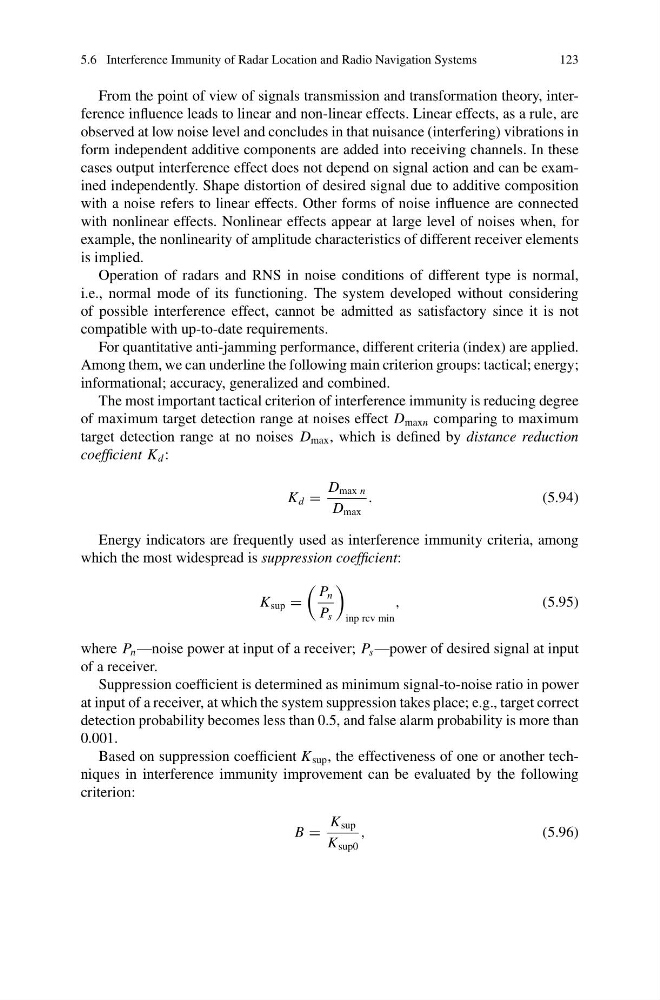
The most important tactical criterion of interference immunity is reducing degree
of maximum target detection range at noises effect D maxn comparing to maximum
target detection range at no noises D max , which is defined by distance reduction
coefficient K d :
K d =
D max n
D max
.
(5.94)
Energy indicators are frequently used as interference immunity criteria, among
which the most widespread is suppression coefficient:
K sup =
P n
P s
inp rcv min
,
(5.95)
where P n —noise power at input of a receiver; P s —power of desired signal at input
of a receiver.
Suppression coefficient is determined as minimum signal-to-noise ratio in power
at input of a receiver, at which the system suppression takes place; e.g., target correct
detection probability becomes less than 0.5, and false alarm probability is more than
0.001.
Based on suppression coefficient K sup , the effectiveness of one or another techniques in interference immunity improvement can be evaluated by the following
criterion:
B =
K sup
K sup0
,
(5.96)
123
From the point of view of signals transmission and transformation theory, interference influence leads to linear and non-linear effects. Linear effects, as a rule, are
observed at low noise level and concludes in that nuisance (interfering) vibrations in
form independent additive components are added into receiving channels. In these
cases output interference effect does not depend on signal action and can be examined independently. Shape distortion of desired signal due to additive composition
with a noise refers to linear effects. Other forms of noise influence are connected
with nonlinear effects. Nonlinear effects appear at large level of noises when, for
example, the nonlinearity of amplitude characteristics of different receiver elements
is implied.
Operation of radars and RNS in noise conditions of different type is normal,
i.e., normal mode of its functioning. The system developed without considering
of possible interference effect, cannot be admitted as satisfactory since it is not
compatible with up-to-date requirements.
For quantitative anti-jamming performance, different criteria (index) are applied.
Among them, we can underline the following main criterion groups: tactical; energy;
informational; accuracy, generalized and combined.
The most important tactical criterion of interference immunity is reducing degree
of maximum target detection range at noises effect D maxn comparing to maximum
target detection range at no noises D max , which is defined by distance reduction
coefficient K d :
K d =
D max n
D max
.
(5.94)
Energy indicators are frequently used as interference immunity criteria, among
which the most widespread is suppression coefficient:
K sup =
P n
P s
inp rcv min
,
(5.95)
where P n —noise power at input of a receiver; P s —power of desired signal at input
of a receiver.
Suppression coefficient is determined as minimum signal-to-noise ratio in power
at input of a receiver, at which the system suppression takes place; e.g., target correct
detection probability becomes less than 0.5, and false alarm probability is more than
0.001.
Based on suppression coefficient K sup , the effectiveness of one or another techniques in interference immunity improvement can be evaluated by the following
criterion:
B =
K sup
K sup0
,
(5.96)