

5.5 Bandwidth Capacity of Radar Location and Radio Navigation Systems
121
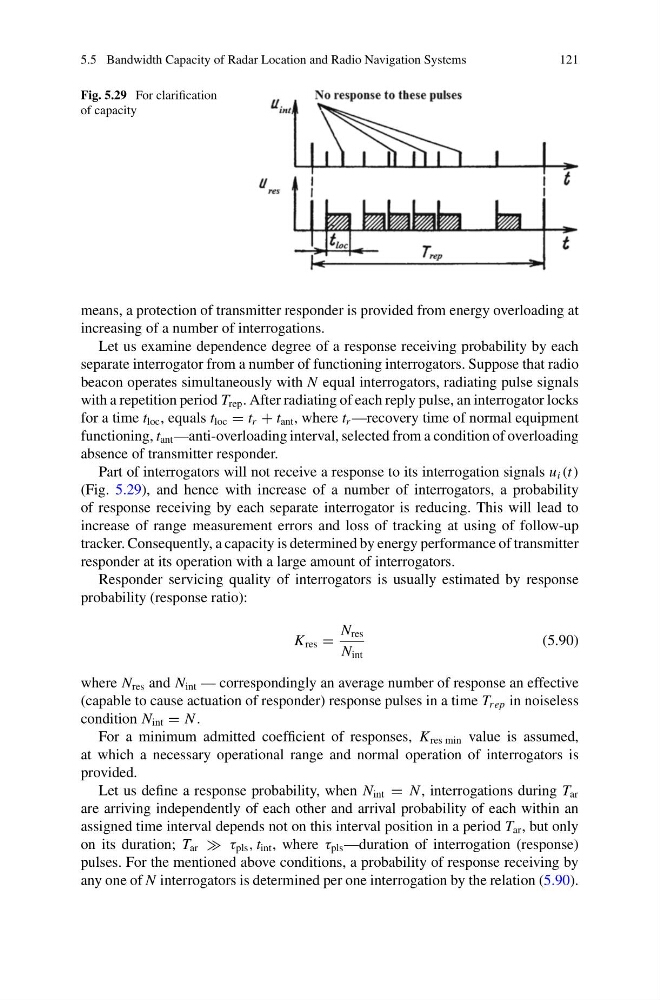
Fig. 5.29 For clarification
of capacity
means, a protection of transmitter responder is provided from energy overloading at
increasing of a number of interrogations.
Let us examine dependence degree of a response receiving probability by each
separate interrogator from a number of functioning interrogators. Suppose that radio
beacon operates simultaneously with N equal interrogators, radiating pulse signals
with a repetition period T rep . After radiating of each reply pulse, an interrogator locks
for a time t loc , equals t loc = t r + t ant , where t r —recovery time of normal equipment
functioning, t ant —anti-overloading interval, selected from a condition of overloading
absence of transmitter responder.
Part of interrogators will not receive a response to its interrogation signals u i (t)
(Fig. 5.29), and hence with increase of a number of interrogators, a probability
of response receiving by each separate interrogator is reducing. This will lead to
increase of range measurement errors and loss of tracking at using of follow-up
tracker. Consequently, a capacity is determined by energy performance of transmitter
responder at its operation with a large amount of interrogators.
Responder servicing quality of interrogators is usually estimated by response
probability (response ratio):
K res =
N res
N int
(5.90)
where N res and N int — correspondingly an average number of response an effective
(capable to cause actuation of responder) response pulses in a time T rep in noiseless
condition N int = N .
For a minimum admitted coefficient of responses, K res min value is assumed,
at which a necessary operational range and normal operation of interrogators is
provided.
Let us define a response probability, when N int = N , interrogations during T ar
are arriving independently of each other and arrival probability of each within an
assigned time interval depends not on this interval position in a period T ar , but only
on its duration; T ar τ pls , t int , where τ pls —duration of interrogation (response)
pulses. For the mentioned above conditions, a probability of response receiving by
any one of N interrogators is determined per one interrogation by the relation (5.90).
121
Fig. 5.29 For clarification
of capacity
means, a protection of transmitter responder is provided from energy overloading at
increasing of a number of interrogations.
Let us examine dependence degree of a response receiving probability by each
separate interrogator from a number of functioning interrogators. Suppose that radio
beacon operates simultaneously with N equal interrogators, radiating pulse signals
with a repetition period T rep . After radiating of each reply pulse, an interrogator locks
for a time t loc , equals t loc = t r + t ant , where t r —recovery time of normal equipment
functioning, t ant —anti-overloading interval, selected from a condition of overloading
absence of transmitter responder.
Part of interrogators will not receive a response to its interrogation signals u i (t)
(Fig. 5.29), and hence with increase of a number of interrogators, a probability
of response receiving by each separate interrogator is reducing. This will lead to
increase of range measurement errors and loss of tracking at using of follow-up
tracker. Consequently, a capacity is determined by energy performance of transmitter
responder at its operation with a large amount of interrogators.
Responder servicing quality of interrogators is usually estimated by response
probability (response ratio):
K res =
N res
N int
(5.90)
where N res and N int — correspondingly an average number of response an effective
(capable to cause actuation of responder) response pulses in a time T rep in noiseless
condition N int = N .
For a minimum admitted coefficient of responses, K res min value is assumed,
at which a necessary operational range and normal operation of interrogators is
provided.
Let us define a response probability, when N int = N , interrogations during T ar
are arriving independently of each other and arrival probability of each within an
assigned time interval depends not on this interval position in a period T ar , but only
on its duration; T ar τ pls , t int , where τ pls —duration of interrogation (response)
pulses. For the mentioned above conditions, a probability of response receiving by
any one of N interrogators is determined per one interrogation by the relation (5.90).