

5.4 Resolution Capability of Radar Location and Radio Navigation Systems
119
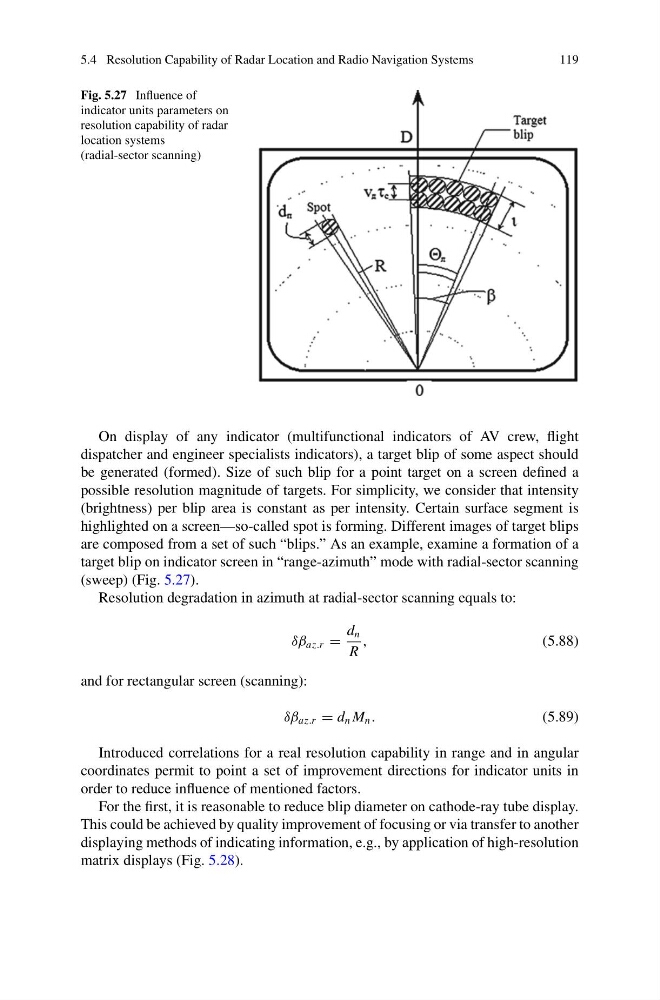
Fig. 5.27 Influence of
indicator units parameters on
resolution capability of radar
location systems
(radial-sector scanning)
On display of any indicator (multifunctional indicators of AV crew, flight
dispatcher and engineer specialists indicators), a target blip of some aspect should
be generated (formed). Size of such blip for a point target on a screen defined a
possible resolution magnitude of targets. For simplicity, we consider that intensity
(brightness) per blip area is constant as per intensity. Certain surface segment is
highlighted on a screen—so-called spot is forming. Different images of target blips
are composed from a set of such “blips.” As an example, examine a formation of a
target blip on indicator screen in “range-azimuth” mode with radial-sector scanning
(sweep) (Fig. 5.27).
Resolution degradation in azimuth at radial-sector scanning equals to:
δβ az.r =
d n
R
,
(5.88)
and for rectangular screen (scanning):
δβ az.r = d n M n .
(5.89)
Introduced correlations for a real resolution capability in range and in angular
coordinates permit to point a set of improvement directions for indicator units in
order to reduce influence of mentioned factors.
For the first, it is reasonable to reduce blip diameter on cathode-ray tube display.
This could be achieved by quality improvement of focusing or via transfer to another
displaying methods of indicating information, e.g., by application of high-resolution
matrix displays (Fig. 5.28).
119
Fig. 5.27 Influence of
indicator units parameters on
resolution capability of radar
location systems
(radial-sector scanning)
On display of any indicator (multifunctional indicators of AV crew, flight
dispatcher and engineer specialists indicators), a target blip of some aspect should
be generated (formed). Size of such blip for a point target on a screen defined a
possible resolution magnitude of targets. For simplicity, we consider that intensity
(brightness) per blip area is constant as per intensity. Certain surface segment is
highlighted on a screen—so-called spot is forming. Different images of target blips
are composed from a set of such “blips.” As an example, examine a formation of a
target blip on indicator screen in “range-azimuth” mode with radial-sector scanning
(sweep) (Fig. 5.27).
Resolution degradation in azimuth at radial-sector scanning equals to:
δβ az.r =
d n
R
,
(5.88)
and for rectangular screen (scanning):
δβ az.r = d n M n .
(5.89)
Introduced correlations for a real resolution capability in range and in angular
coordinates permit to point a set of improvement directions for indicator units in
order to reduce influence of mentioned factors.
For the first, it is reasonable to reduce blip diameter on cathode-ray tube display.
This could be achieved by quality improvement of focusing or via transfer to another
displaying methods of indicating information, e.g., by application of high-resolution
matrix displays (Fig. 5.28).