

114
5 Performance Characteristics of Radar Location …
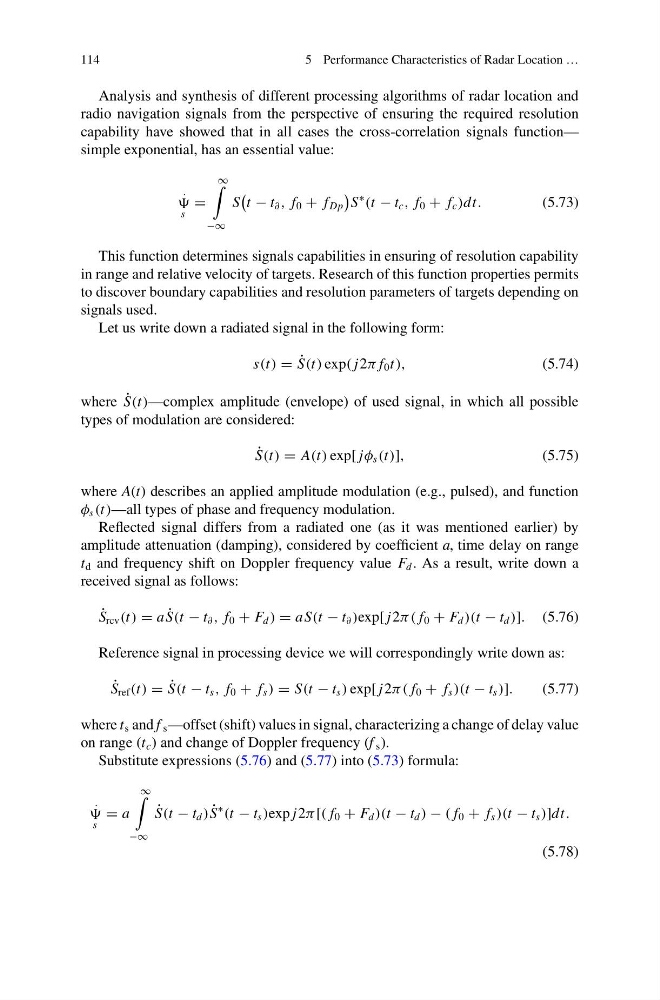
Analysis and synthesis of different processing algorithms of radar location and
radio navigation signals from the perspective of ensuring the required resolution
capability have showed that in all cases the cross-correlation signals function—
simple exponential, has an essential value:
.
s
=
∞
−∞
S
t − t ∂ , f 0 + f Dp
S
∗
(t − t c , f 0 + f c )dt.
(5.73)
This function determines signals capabilities in ensuring of resolution capability
in range and relative velocity of targets. Research of this function properties permits
to discover boundary capabilities and resolution parameters of targets depending on
signals used.
Let us write down a radiated signal in the following form:
s(t) = ˙
S(t) exp( j2π f 0 t),
(5.74)
where ˙
S(t)—complex amplitude (envelope) of used signal, in which all possible
types of modulation are considered:
˙
S(t) = A(t) exp[ jφ s (t)],
(5.75)
where A(t) describes an applied amplitude modulation (e.g., pulsed), and function
φ s (t)—all types of phase and frequency modulation.
Reflected signal differs from a radiated one (as it was mentioned earlier) by
amplitude attenuation (damping), considered by coefficient a, time delay on range
t d and frequency shift on Doppler frequency value F d . As a result, write down a
received signal as follows:
˙
S rcv (t) = a ˙
S(t − t ∂ , f 0 + F d ) = aS(t − t ∂ )exp[ j2π ( f 0 + F d )(t − t d )]. (5.76)
Reference signal in processing device we will correspondingly write down as:
˙
S ref (t) = ˙
S(t − t s , f 0 + f s ) = S(t − t s ) exp[ j2π ( f 0 + f s )(t − t s )].
(5.77)
where t s and f s —offset (shift) values in signal, characterizing a change of delay value
on range (t c ) and change of Doppler frequency (f s ).
Substitute expressions (5.76) and (5.77) into (5.73) formula:
.
s
= a
∞
−∞
˙
S(t − t d ) ˙
S
∗
(t − t s )exp j2π [( f 0 + F d )(t − t d ) − ( f 0 + f s )(t − t s )]dt.
(5.78)
5 Performance Characteristics of Radar Location …
Analysis and synthesis of different processing algorithms of radar location and
radio navigation signals from the perspective of ensuring the required resolution
capability have showed that in all cases the cross-correlation signals function—
simple exponential, has an essential value:
.
s
=
∞
−∞
S
t − t ∂ , f 0 + f Dp
S
∗
(t − t c , f 0 + f c )dt.
(5.73)
This function determines signals capabilities in ensuring of resolution capability
in range and relative velocity of targets. Research of this function properties permits
to discover boundary capabilities and resolution parameters of targets depending on
signals used.
Let us write down a radiated signal in the following form:
s(t) = ˙
S(t) exp( j2π f 0 t),
(5.74)
where ˙
S(t)—complex amplitude (envelope) of used signal, in which all possible
types of modulation are considered:
˙
S(t) = A(t) exp[ jφ s (t)],
(5.75)
where A(t) describes an applied amplitude modulation (e.g., pulsed), and function
φ s (t)—all types of phase and frequency modulation.
Reflected signal differs from a radiated one (as it was mentioned earlier) by
amplitude attenuation (damping), considered by coefficient a, time delay on range
t d and frequency shift on Doppler frequency value F d . As a result, write down a
received signal as follows:
˙
S rcv (t) = a ˙
S(t − t ∂ , f 0 + F d ) = aS(t − t ∂ )exp[ j2π ( f 0 + F d )(t − t d )]. (5.76)
Reference signal in processing device we will correspondingly write down as:
˙
S ref (t) = ˙
S(t − t s , f 0 + f s ) = S(t − t s ) exp[ j2π ( f 0 + f s )(t − t s )].
(5.77)
where t s and f s —offset (shift) values in signal, characterizing a change of delay value
on range (t c ) and change of Doppler frequency (f s ).
Substitute expressions (5.76) and (5.77) into (5.73) formula:
.
s
= a
∞
−∞
˙
S(t − t d ) ˙
S
∗
(t − t s )exp j2π [( f 0 + F d )(t − t d ) − ( f 0 + f s )(t − t s )]dt.
(5.78)