

However, on C + we know that R + is constant, so that the slope of the positive
characteristic in the xt-plane also depends on R À . Similarly, on C À we know that R À
is constant, so that the slope of the negative characteristic in the xt-plane also
depends on R + .
Let us now turn our attention to the use of these relationships to determine the
flow in a few simple cases involving piston motion. The first example deals with
expansion rather than compression waves.
2.7.1 Piston Withdrawal
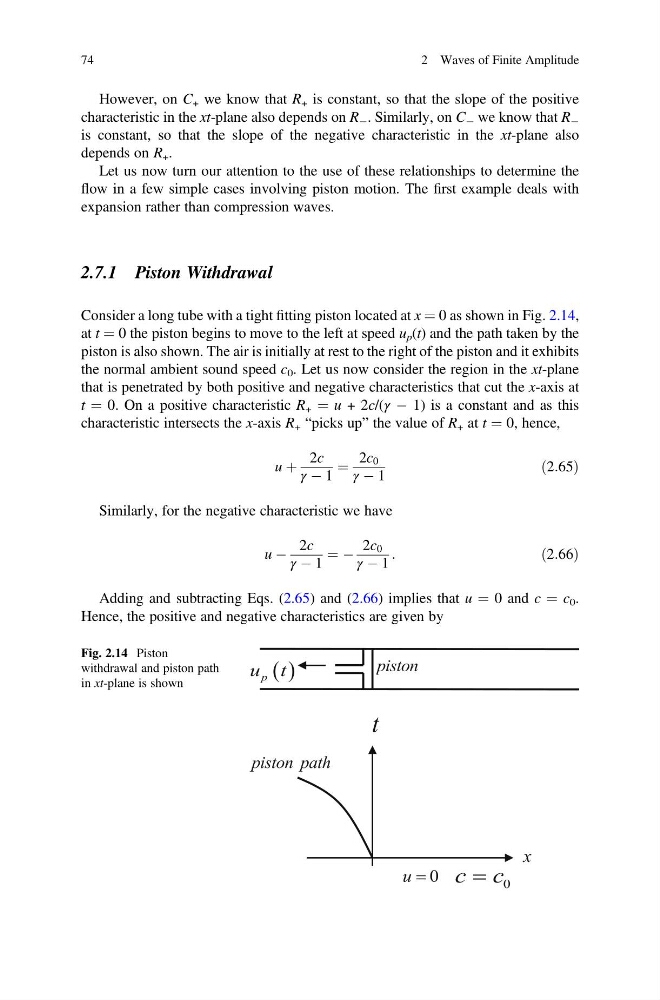
Consider a long tube with a tight fitting piston located at x ¼ 0 as shown in Fig. 2.14,
at t ¼ 0 the piston begins to move to the left at speed u p (t) and the path taken by the
piston is also shown. The air is initially at rest to the right of the piston and it exhibits
the normal ambient sound speed c 0 . Let us now consider the region in the xt-plane
that is penetrated by both positive and negative characteristics that cut the x-axis at
t ¼ 0. On a positive characteristic R + ¼ u + 2c/(γ À 1) is a constant and as this
characteristic intersects the x-axis R + “picks up” the value of R + at t ¼ 0, hence,
u þ
2c
γ À 1
¼
2c 0
γ À 1
ð2:65Þ
Similarly, for the negative characteristic we have
u À
2c
γ À 1
¼ À
2c 0
γ À 1
:
ð2:66Þ
Adding and subtracting Eqs. (2.65) and (2.66) implies that u ¼ 0 and c ¼ c 0 .
Hence, the positive and negative characteristics are given by
Fig. 2.14 Piston
withdrawal and piston path
in xt-plane is shown
74
2 Waves of Finite Amplitude
characteristic in the xt-plane also depends on R À . Similarly, on C À we know that R À
is constant, so that the slope of the negative characteristic in the xt-plane also
depends on R + .
Let us now turn our attention to the use of these relationships to determine the
flow in a few simple cases involving piston motion. The first example deals with
expansion rather than compression waves.
2.7.1 Piston Withdrawal
Consider a long tube with a tight fitting piston located at x ¼ 0 as shown in Fig. 2.14,
at t ¼ 0 the piston begins to move to the left at speed u p (t) and the path taken by the
piston is also shown. The air is initially at rest to the right of the piston and it exhibits
the normal ambient sound speed c 0 . Let us now consider the region in the xt-plane
that is penetrated by both positive and negative characteristics that cut the x-axis at
t ¼ 0. On a positive characteristic R + ¼ u + 2c/(γ À 1) is a constant and as this
characteristic intersects the x-axis R + “picks up” the value of R + at t ¼ 0, hence,
u þ
2c
γ À 1
¼
2c 0
γ À 1
ð2:65Þ
Similarly, for the negative characteristic we have
u À
2c
γ À 1
¼ À
2c 0
γ À 1
:
ð2:66Þ
Adding and subtracting Eqs. (2.65) and (2.66) implies that u ¼ 0 and c ¼ c 0 .
Hence, the positive and negative characteristics are given by
Fig. 2.14 Piston
withdrawal and piston path
in xt-plane is shown
74
2 Waves of Finite Amplitude