

2.5.2 Example: Piston Moving with a Velocity u = at
n , n> 0
Let us now consider a piston moving into a tube with a velocity given by u ¼ at
n [11]
and the displacement of the piston is x ¼ at
n + 1 /(n + 1). This implies that
t ¼
u
a
1=n
and x ¼
a
n þ 1
u
a
nþ1
ð
Þ=n :
The fluid velocity at the piston has the same velocity as the piston itself, so by
substituting these latter equations in the equation;
x u, t
ð Þ ¼ c 0 þ
γ þ 1
2
u
h
i
t þ x 0 u
ð Þ,
we can determine the constant of integration x 0 (u). Hence,
a
n þ 1
u
a
nþ1
n ¼ c 0 þ
γ þ 1
2
u
h
i u
a
1
n þ x 0 u
ð Þ,
so that
x 0 u
ð Þ ¼
a
n þ 1
u
a
nþ1
n À
c 0
a 1=n u
1
n À
1
2
γ þ 1
ð
Þ
a 1=n u
nþ1
n :
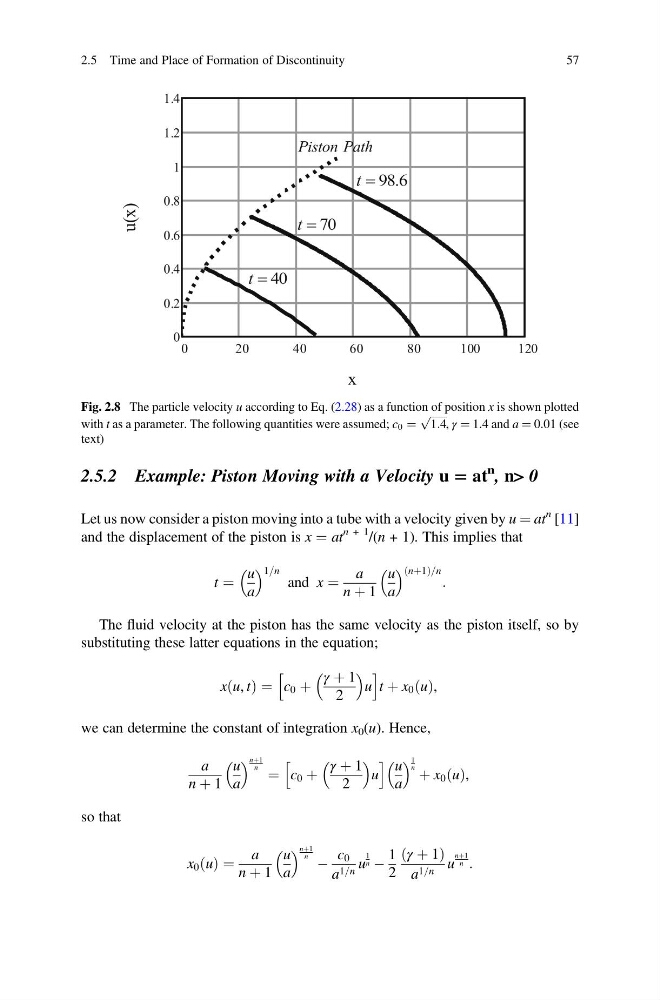
Fig. 2.8 The particle velocity u according to Eq. (2.28) as a function of position x is shown plotted
with t as a parameter. The following quantities were assumed; c 0 ¼
ffiffiffiffiffiffi ffi
1:4
p
, γ ¼ 1.4 and a ¼ 0.01 (see
text)
2.5 Time and Place of Formation of Discontinuity
57
n , n> 0
Let us now consider a piston moving into a tube with a velocity given by u ¼ at
n [11]
and the displacement of the piston is x ¼ at
n + 1 /(n + 1). This implies that
t ¼
u
a
1=n
and x ¼
a
n þ 1
u
a
nþ1
ð
Þ=n :
The fluid velocity at the piston has the same velocity as the piston itself, so by
substituting these latter equations in the equation;
x u, t
ð Þ ¼ c 0 þ
γ þ 1
2
u
h
i
t þ x 0 u
ð Þ,
we can determine the constant of integration x 0 (u). Hence,
a
n þ 1
u
a
nþ1
n ¼ c 0 þ
γ þ 1
2
u
h
i u
a
1
n þ x 0 u
ð Þ,
so that
x 0 u
ð Þ ¼
a
n þ 1
u
a
nþ1
n À
c 0
a 1=n u
1
n À
1
2
γ þ 1
ð
Þ
a 1=n u
nþ1
n :
Fig. 2.8 The particle velocity u according to Eq. (2.28) as a function of position x is shown plotted
with t as a parameter. The following quantities were assumed; c 0 ¼
ffiffiffiffiffiffi ffi
1:4
p
, γ ¼ 1.4 and a ¼ 0.01 (see
text)
2.5 Time and Place of Formation of Discontinuity
57