

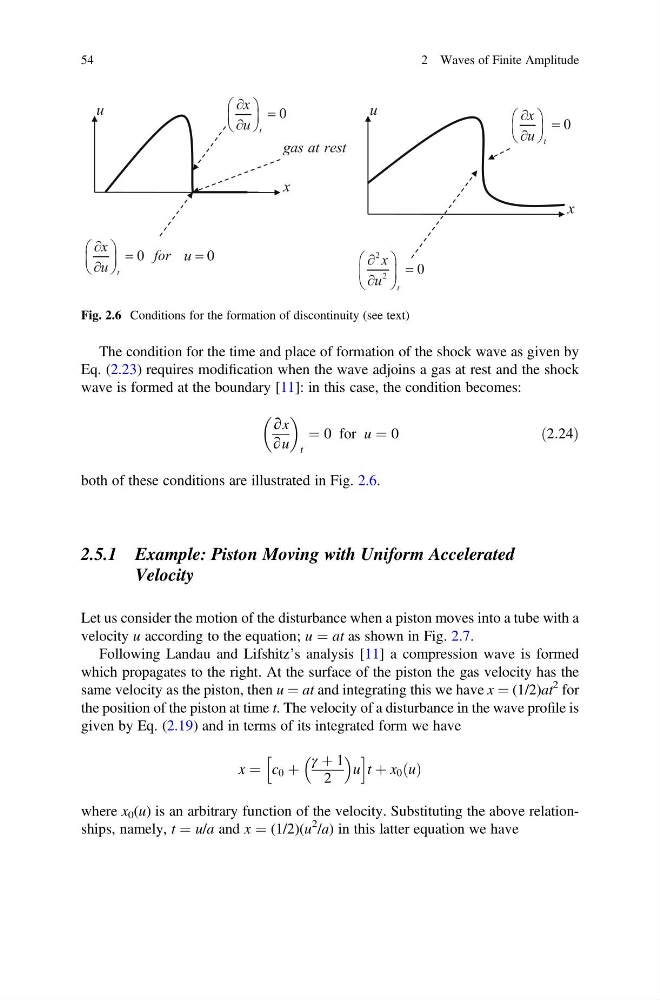
The condition for the time and place of formation of the shock wave as given by
Eq. (2.23) requires modification when the wave adjoins a gas at rest and the shock
wave is formed at the boundary [11]: in this case, the condition becomes:
∂x
∂u
t
¼ 0 for u ¼ 0
ð2:24Þ
both of these conditions are illustrated in Fig. 2.6.
2.5.1 Example: Piston Moving with Uniform Accelerated
Velocity
Let us consider the motion of the disturbance when a piston moves into a tube with a
velocity u according to the equation; u ¼ at as shown in Fig. 2.7.
Following Landau and Lifshitz’s analysis [11] a compression wave is formed
which propagates to the right. At the surface of the piston the gas velocity has the
same velocity as the piston, then u ¼ at and integrating this we have x ¼ (1/2)at
2 for
the position of the piston at time t. The velocity of a disturbance in the wave profile is
given by Eq. (2.19) and in terms of its integrated form we have
x ¼ c 0 þ
γ þ 1
2
u
h
i
t þ x 0 u
ð Þ
where x 0 (u) is an arbitrary function of the velocity. Substituting the above relationships, namely, t ¼ u/a and x ¼ (1/2)(u
2 /a) in this latter equation we have
Fig. 2.6 Conditions for the formation of discontinuity (see text)
54
2 Waves of Finite Amplitude
Eq. (2.23) requires modification when the wave adjoins a gas at rest and the shock
wave is formed at the boundary [11]: in this case, the condition becomes:
∂x
∂u
t
¼ 0 for u ¼ 0
ð2:24Þ
both of these conditions are illustrated in Fig. 2.6.
2.5.1 Example: Piston Moving with Uniform Accelerated
Velocity
Let us consider the motion of the disturbance when a piston moves into a tube with a
velocity u according to the equation; u ¼ at as shown in Fig. 2.7.
Following Landau and Lifshitz’s analysis [11] a compression wave is formed
which propagates to the right. At the surface of the piston the gas velocity has the
same velocity as the piston, then u ¼ at and integrating this we have x ¼ (1/2)at
2 for
the position of the piston at time t. The velocity of a disturbance in the wave profile is
given by Eq. (2.19) and in terms of its integrated form we have
x ¼ c 0 þ
γ þ 1
2
u
h
i
t þ x 0 u
ð Þ
where x 0 (u) is an arbitrary function of the velocity. Substituting the above relationships, namely, t ¼ u/a and x ¼ (1/2)(u
2 /a) in this latter equation we have
Fig. 2.6 Conditions for the formation of discontinuity (see text)
54
2 Waves of Finite Amplitude