

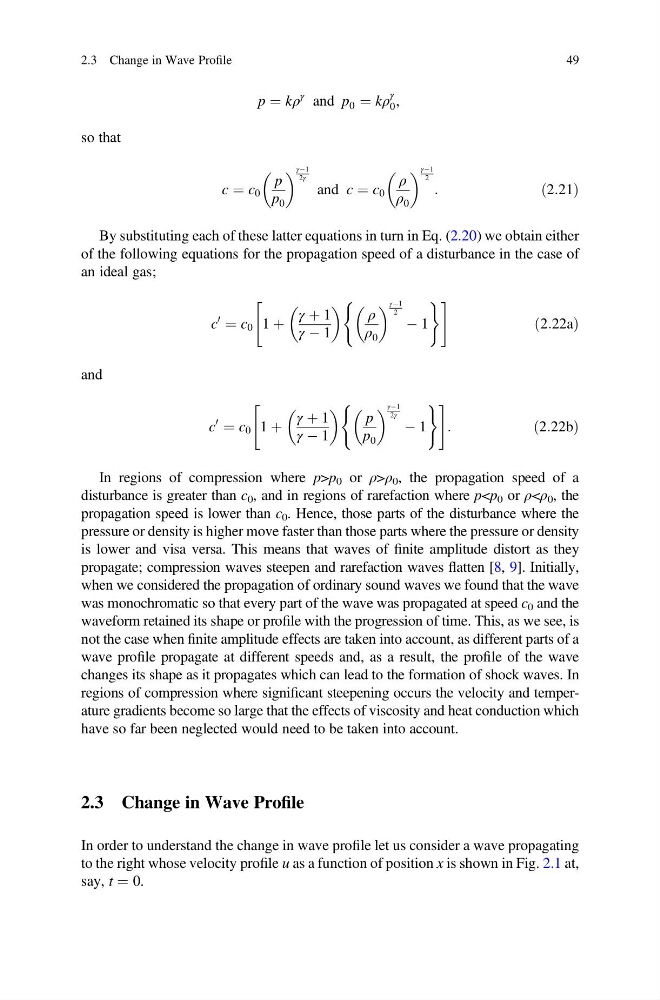
p ¼ kρ
γ and p 0 ¼ kρ
γ
0 ,
so that
c ¼ c 0
p
p 0
γÀ1
2γ
and c ¼ c 0
ρ
ρ 0
γÀ1
2 :
ð2:21Þ
By substituting each of these latter equations in turn in Eq. (2.20) we obtain either
of the following equations for the propagation speed of a disturbance in the case of
an ideal gas;
c
0
¼ c 0 1 þ
γ þ 1
γ À 1
ρ
ρ 0
γÀ1
2 À 1
(
)
"
#
ð2:22aÞ
and
c
0
¼ c 0 1 þ
γ þ 1
γ À 1
p
p 0
γÀ1
2γ À 1
(
)
"
#
:
ð2:22bÞ
In regions of compression where p>p 0 or ρ>ρ 0 , the propagation speed of a
disturbance is greater than c 0 , and in regions of rarefaction where p propagation speed is lower than c 0 . Hence, those parts of the disturbance where the
pressure or density is higher move faster than those parts where the pressure or density
is lower and visa versa. This means that waves of finite amplitude distort as they
propagate; compression waves steepen and rarefaction waves flatten [8, 9]. Initially,
when we considered the propagation of ordinary sound waves we found that the wave
was monochromatic so that every part of the wave was propagated at speed c 0 and the
waveform retained its shape or profile with the progression of time. This, as we see, is
not the case when finite amplitude effects are taken into account, as different parts of a
wave profile propagate at different speeds and, as a result, the profile of the wave
changes its shape as it propagates which can lead to the formation of shock waves. In
regions of compression where significant steepening occurs the velocity and temperature gradients become so large that the effects of viscosity and heat conduction which
have so far been neglected would need to be taken into account.
2.3 Change in Wave Profile
In order to understand the change in wave profile let us consider a wave propagating
to the right whose velocity profile u as a function of position x is shown in Fig. 2.1 at,
say, t ¼ 0.
2.3 Change in Wave Profile
49
γ and p 0 ¼ kρ
γ
0 ,
so that
c ¼ c 0
p
p 0
γÀ1
2γ
and c ¼ c 0
ρ
ρ 0
γÀ1
2 :
ð2:21Þ
By substituting each of these latter equations in turn in Eq. (2.20) we obtain either
of the following equations for the propagation speed of a disturbance in the case of
an ideal gas;
c
0
¼ c 0 1 þ
γ þ 1
γ À 1
ρ
ρ 0
γÀ1
2 À 1
(
)
"
#
ð2:22aÞ
and
c
0
¼ c 0 1 þ
γ þ 1
γ À 1
p
p 0
γÀ1
2γ À 1
(
)
"
#
:
ð2:22bÞ
In regions of compression where p>p 0 or ρ>ρ 0 , the propagation speed of a
disturbance is greater than c 0 , and in regions of rarefaction where p propagation speed is lower than c 0 . Hence, those parts of the disturbance where the
pressure or density is higher move faster than those parts where the pressure or density
is lower and visa versa. This means that waves of finite amplitude distort as they
propagate; compression waves steepen and rarefaction waves flatten [8, 9]. Initially,
when we considered the propagation of ordinary sound waves we found that the wave
was monochromatic so that every part of the wave was propagated at speed c 0 and the
waveform retained its shape or profile with the progression of time. This, as we see, is
not the case when finite amplitude effects are taken into account, as different parts of a
wave profile propagate at different speeds and, as a result, the profile of the wave
changes its shape as it propagates which can lead to the formation of shock waves. In
regions of compression where significant steepening occurs the velocity and temperature gradients become so large that the effects of viscosity and heat conduction which
have so far been neglected would need to be taken into account.
2.3 Change in Wave Profile
In order to understand the change in wave profile let us consider a wave propagating
to the right whose velocity profile u as a function of position x is shown in Fig. 2.1 at,
say, t ¼ 0.
2.3 Change in Wave Profile
49