

The contact surface separates the driven region that has been compressed and heated
by the shock wave from the driver region that has been cooled as a result of the
expansion wave. No forces exist across the contact surface so that the pressure is the
same on both sides and there is no change in particle velocity across it; there is,
however, an abrupt change in the density and temperature that clearly distinguishes
the two regions. This is clearly evident in Fig. B.6 at t ¼ 160000Δt where we observe
that the particle velocity tends to zero while the pressure within the shock tube
approaches the average of the initial values in the driver and driven section as
expected. On the other hand, the density and temperature (proportional to the
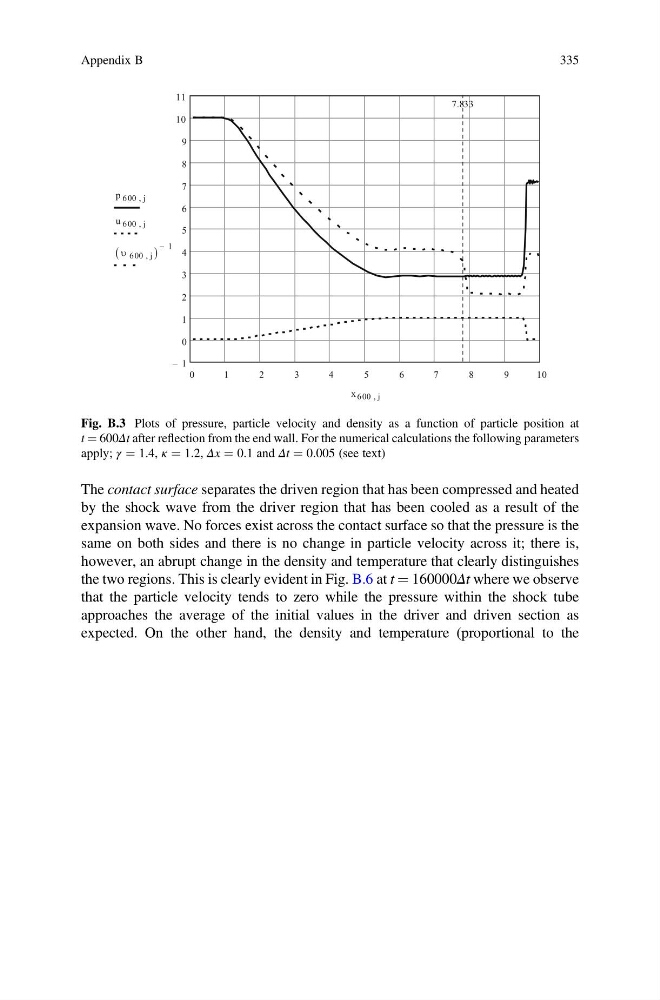
Fig. B.3 Plots of pressure, particle velocity and density as a function of particle position at
t ¼ 600Δt after reflection from the end wall. For the numerical calculations the following parameters
apply; γ ¼ 1.4, κ ¼ 1.2, Δx ¼ 0.1 and Δt ¼ 0.005 (see text)
Appendix B
335
by the shock wave from the driver region that has been cooled as a result of the
expansion wave. No forces exist across the contact surface so that the pressure is the
same on both sides and there is no change in particle velocity across it; there is,
however, an abrupt change in the density and temperature that clearly distinguishes
the two regions. This is clearly evident in Fig. B.6 at t ¼ 160000Δt where we observe
that the particle velocity tends to zero while the pressure within the shock tube
approaches the average of the initial values in the driver and driven section as
expected. On the other hand, the density and temperature (proportional to the
Fig. B.3 Plots of pressure, particle velocity and density as a function of particle position at
t ¼ 600Δt after reflection from the end wall. For the numerical calculations the following parameters
apply; γ ¼ 1.4, κ ¼ 1.2, Δx ¼ 0.1 and Δt ¼ 0.005 (see text)
Appendix B
335