

By using the equations
u ¼
R þ þ R À
2
and c ¼
R þ À R À
10
one can determine the slopes for all seven positive characteristics as shown in
Fig. A.6. For example, let us take R + ¼ 4.75 and R À ¼ À 6, hence,
u ¼
R þ þ R À
2
¼ À0:625 and c ¼
R þ À R À
10
¼ 1:075,
therefore, this positive characteristic 0f has equation,
x ¼ u þ c
ð
Þt ¼ 0:45t:
Similarly, one can determine the equations for all seven positive characteristics
and it is easy to verify that they range in slopes from 0.3 at the tail to 1.2 at the head
in increments of 0.15.
All that remains before we consider the network of curved characteristics in
region ℜ 4 is to find the coordinates of the points where the expansion fan intersects
the negative characteristic ag. For example, let us take the previously determined
positive characteristic 0f whose equation is given by x ¼ 0.45t and then form the
expression,
f t
ð Þ ¼ 0:45t À À
2c 0 t
γ À 1
þ
γ þ 1
γ À 1
c 0 t 0
t
t 0
3Àγ
1þγ
"
#
,
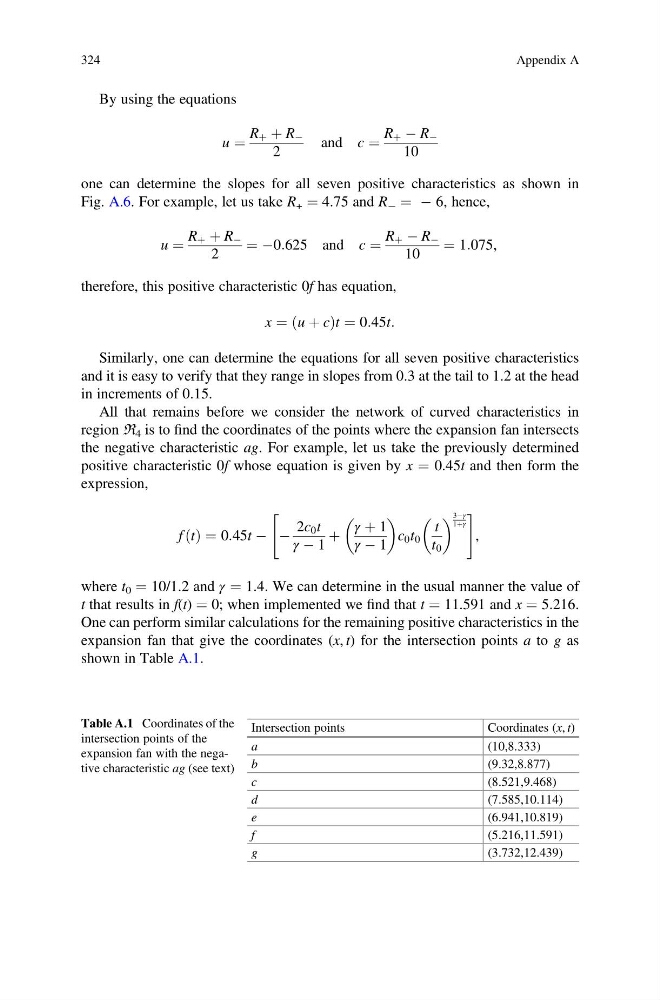
where t 0 ¼ 10/1.2 and γ ¼ 1.4. We can determine in the usual manner the value of
t that results in f(t) ¼ 0; when implemented we find that t ¼ 11.591 and x ¼ 5.216.
One can perform similar calculations for the remaining positive characteristics in the
expansion fan that give the coordinates (x, t) for the intersection points a to g as
shown in Table A.1.
Table A.1 Coordinates of the
intersection points of the
expansion fan with the negative characteristic ag (see text)
Intersection points
Coordinates (x, t)
a
(10,8.333)
b
(9.32,8.877)
c
(8.521,9.468)
d
(7.585,10.114)
e
(6.941,10.819)
f
(5.216,11.591)
g
(3.732,12.439)
324
Appendix A
u ¼
R þ þ R À
2
and c ¼
R þ À R À
10
one can determine the slopes for all seven positive characteristics as shown in
Fig. A.6. For example, let us take R + ¼ 4.75 and R À ¼ À 6, hence,
u ¼
R þ þ R À
2
¼ À0:625 and c ¼
R þ À R À
10
¼ 1:075,
therefore, this positive characteristic 0f has equation,
x ¼ u þ c
ð
Þt ¼ 0:45t:
Similarly, one can determine the equations for all seven positive characteristics
and it is easy to verify that they range in slopes from 0.3 at the tail to 1.2 at the head
in increments of 0.15.
All that remains before we consider the network of curved characteristics in
region ℜ 4 is to find the coordinates of the points where the expansion fan intersects
the negative characteristic ag. For example, let us take the previously determined
positive characteristic 0f whose equation is given by x ¼ 0.45t and then form the
expression,
f t
ð Þ ¼ 0:45t À À
2c 0 t
γ À 1
þ
γ þ 1
γ À 1
c 0 t 0
t
t 0
3Àγ
1þγ
"
#
,
where t 0 ¼ 10/1.2 and γ ¼ 1.4. We can determine in the usual manner the value of
t that results in f(t) ¼ 0; when implemented we find that t ¼ 11.591 and x ¼ 5.216.
One can perform similar calculations for the remaining positive characteristics in the
expansion fan that give the coordinates (x, t) for the intersection points a to g as
shown in Table A.1.
Table A.1 Coordinates of the
intersection points of the
expansion fan with the negative characteristic ag (see text)
Intersection points
Coordinates (x, t)
a
(10,8.333)
b
(9.32,8.877)
c
(8.521,9.468)
d
(7.585,10.114)
e
(6.941,10.819)
f
(5.216,11.591)
g
(3.732,12.439)
324
Appendix A