

R þ ¼ u þ
2c
γ À 1
¼ u þ 5c
and along C À we have the Riemann invariant
R À ¼ u À
2c
γ À 1
¼ u À 5c
where γ ¼ 1.4 is substituted in each case. By solving these latter two equations for
u and c in terms of the Riemann invariants, we find that
u ¼
R þ þ R À
2
and c ¼
R þ À R À
10
,
which gives the values of u and c at a point in terms of the Riemann invariants on the
two characteristics that pass through that point.
By substituting these latter expressions for u and c back into the equations for the
characteristics we find that
dx
dt
C þ
¼
3R þ þ 2R À
5
and
dx
dt
C À
¼
2R þ þ 3R À
5
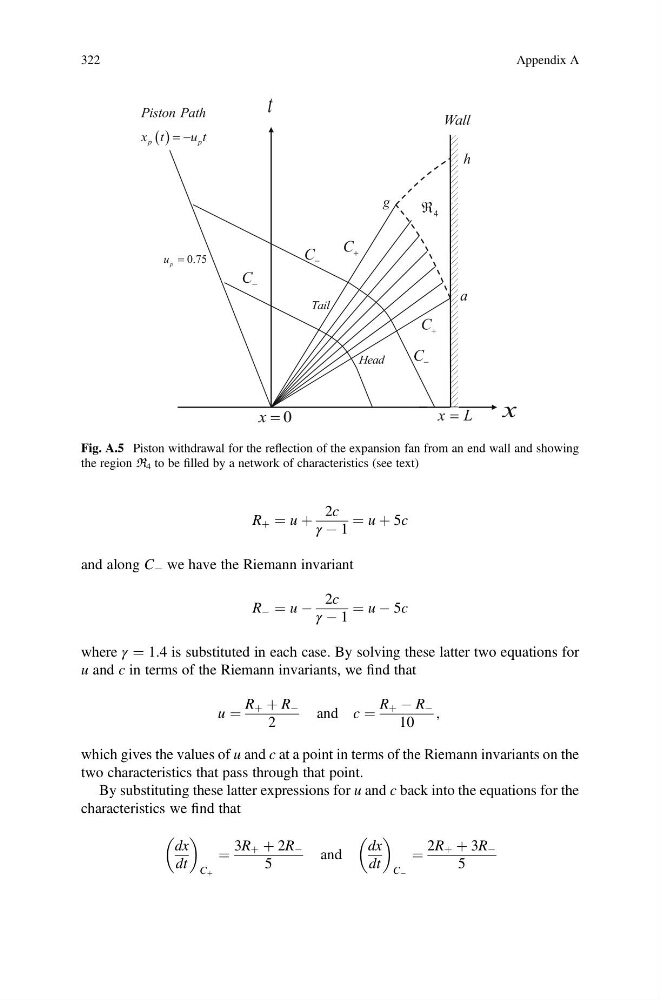
Fig. A.5 Piston withdrawal for the reflection of the expansion fan from an end wall and showing
the region ℜ 4 to be filled by a network of characteristics (see text)
322
Appendix A
2c
γ À 1
¼ u þ 5c
and along C À we have the Riemann invariant
R À ¼ u À
2c
γ À 1
¼ u À 5c
where γ ¼ 1.4 is substituted in each case. By solving these latter two equations for
u and c in terms of the Riemann invariants, we find that
u ¼
R þ þ R À
2
and c ¼
R þ À R À
10
,
which gives the values of u and c at a point in terms of the Riemann invariants on the
two characteristics that pass through that point.
By substituting these latter expressions for u and c back into the equations for the
characteristics we find that
dx
dt
C þ
¼
3R þ þ 2R À
5
and
dx
dt
C À
¼
2R þ þ 3R À
5
Fig. A.5 Piston withdrawal for the reflection of the expansion fan from an end wall and showing
the region ℜ 4 to be filled by a network of characteristics (see text)
322
Appendix A