

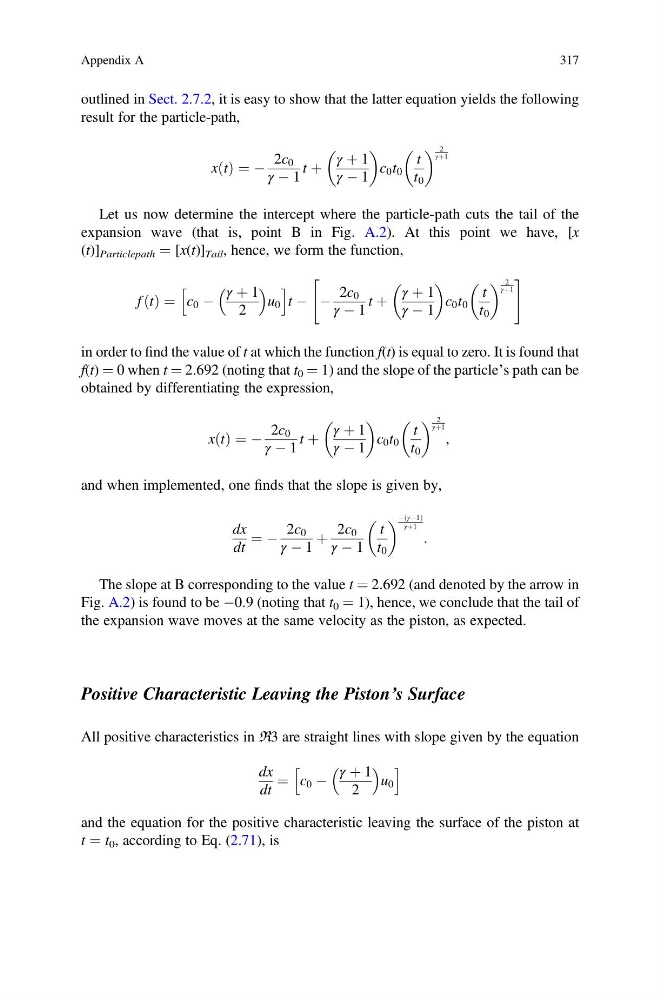
outlined in Sect. 2.7.2, it is easy to show that the latter equation yields the following
result for the particle-path,
x t
ð Þ ¼ À
2c 0
γ À 1
t þ
γ þ 1
γ À 1
c 0 t 0
t
t 0
2
γþ1
Let us now determine the intercept where the particle-path cuts the tail of the
expansion wave (that is, point B in Fig. A.2). At this point we have, [x
(t)] Particlepath ¼ [x(t)] Tail , hence, we form the function,
f t
ð Þ ¼ c 0 À
γ þ 1
2
u 0
h
i
t À À
2c 0
γ À 1
t þ
γ þ 1
γ À 1
c 0 t 0
t
t 0
2
γþ1
"
#
in order to find the value of t at which the function f(t) is equal to zero. It is found that
f(t) ¼ 0 when t ¼ 2.692 (noting that t 0 ¼ 1) and the slope of the particle’s path can be
obtained by differentiating the expression,
x t
ð Þ ¼ À
2c 0
γ À 1
t þ
γ þ 1
γ À 1
c 0 t 0
t
t 0
2
γþ1
,
and when implemented, one finds that the slope is given by,
dx
dt
¼ À
2c 0
γ À 1
þ
2c 0
γ À 1
t
t 0
À γÀ1
ð
Þ
γþ1 :
The slope at B corresponding to the value t ¼ 2.692 (and denoted by the arrow in
Fig. A.2) is found to be À0.9 (noting that t 0 ¼ 1), hence, we conclude that the tail of
the expansion wave moves at the same velocity as the piston, as expected.
Positive Characteristic Leaving the Piston’s Surface
All positive characteristics in ℜ3 are straight lines with slope given by the equation
dx
dt
¼ c 0 À
γ þ 1
2
u 0
h
i
and the equation for the positive characteristic leaving the surface of the piston at
t ¼ t 0 , according to Eq. (2.71), is
Appendix A
317
result for the particle-path,
x t
ð Þ ¼ À
2c 0
γ À 1
t þ
γ þ 1
γ À 1
c 0 t 0
t
t 0
2
γþ1
Let us now determine the intercept where the particle-path cuts the tail of the
expansion wave (that is, point B in Fig. A.2). At this point we have, [x
(t)] Particlepath ¼ [x(t)] Tail , hence, we form the function,
f t
ð Þ ¼ c 0 À
γ þ 1
2
u 0
h
i
t À À
2c 0
γ À 1
t þ
γ þ 1
γ À 1
c 0 t 0
t
t 0
2
γþ1
"
#
in order to find the value of t at which the function f(t) is equal to zero. It is found that
f(t) ¼ 0 when t ¼ 2.692 (noting that t 0 ¼ 1) and the slope of the particle’s path can be
obtained by differentiating the expression,
x t
ð Þ ¼ À
2c 0
γ À 1
t þ
γ þ 1
γ À 1
c 0 t 0
t
t 0
2
γþ1
,
and when implemented, one finds that the slope is given by,
dx
dt
¼ À
2c 0
γ À 1
þ
2c 0
γ À 1
t
t 0
À γÀ1
ð
Þ
γþ1 :
The slope at B corresponding to the value t ¼ 2.692 (and denoted by the arrow in
Fig. A.2) is found to be À0.9 (noting that t 0 ¼ 1), hence, we conclude that the tail of
the expansion wave moves at the same velocity as the piston, as expected.
Positive Characteristic Leaving the Piston’s Surface
All positive characteristics in ℜ3 are straight lines with slope given by the equation
dx
dt
¼ c 0 À
γ þ 1
2
u 0
h
i
and the equation for the positive characteristic leaving the surface of the piston at
t ¼ t 0 , according to Eq. (2.71), is
Appendix A
317