

dx
dt
¼ u À c,
where u ¼ À u 0 and c ¼ c 0 À
γÀ1
2
À Á
u 0 , hence,
dx
dt
¼
u 0
2
γ À 3
ð
ÞÀc 0 ,
and all negative characteristics in this region have this constant slope. The equation
for the positive characteristic at the tail of the expansion fan is
x t
ð Þ ¼ c 0 À
γ þ 1
2
u 0
h
i
t,
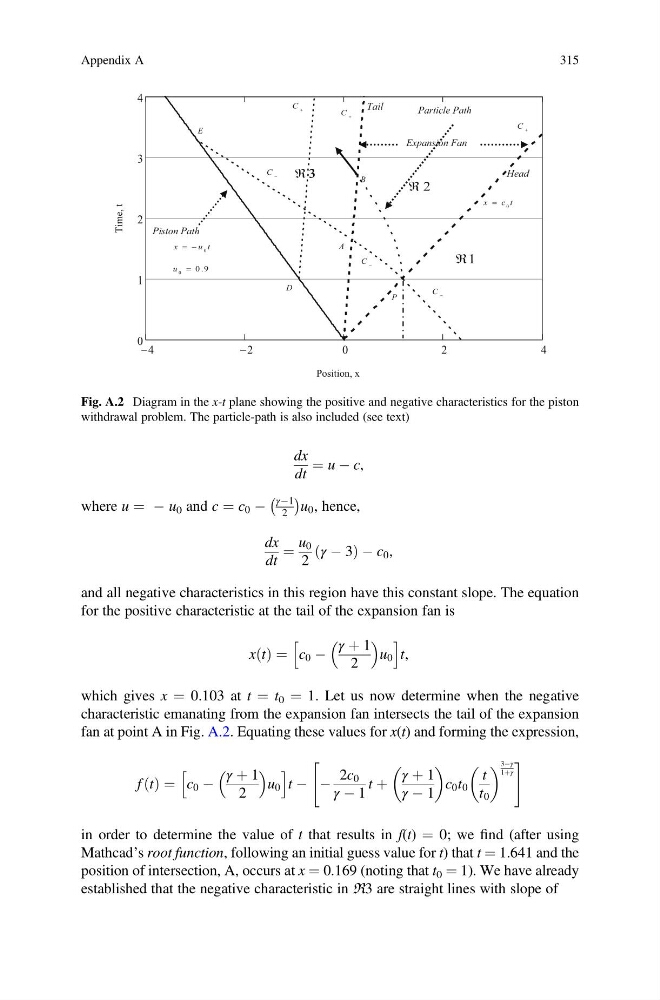
which gives x ¼ 0.103 at t ¼ t 0 ¼ 1. Let us now determine when the negative
characteristic emanating from the expansion fan intersects the tail of the expansion
fan at point A in Fig. A.2. Equating these values for x(t) and forming the expression,
f t
ð Þ ¼ c 0 À
γ þ 1
2
u 0
h
i
t À À
2c 0
γ À 1
t þ
γ þ 1
γ À 1
c 0 t 0
t
t 0
3Àγ
1þγ
"
#
in order to determine the value of t that results in f(t) ¼ 0; we find (after using
Mathcad’s root function, following an initial guess value for t) that t ¼ 1.641 and the
position of intersection, A, occurs at x ¼ 0.169 (noting that t 0 ¼ 1). We have already
established that the negative characteristic in ℜ3 are straight lines with slope of
Position, x
Time, t
Tail
Head
Particle Path
Piston Path
3
P
A
B
Expansion Fan
D
E
Fig. A.2 Diagram in the x-t plane showing the positive and negative characteristics for the piston
withdrawal problem. The particle-path is also included (see text)
Appendix A
315
dt
¼ u À c,
where u ¼ À u 0 and c ¼ c 0 À
γÀ1
2
À Á
u 0 , hence,
dx
dt
¼
u 0
2
γ À 3
ð
ÞÀc 0 ,
and all negative characteristics in this region have this constant slope. The equation
for the positive characteristic at the tail of the expansion fan is
x t
ð Þ ¼ c 0 À
γ þ 1
2
u 0
h
i
t,
which gives x ¼ 0.103 at t ¼ t 0 ¼ 1. Let us now determine when the negative
characteristic emanating from the expansion fan intersects the tail of the expansion
fan at point A in Fig. A.2. Equating these values for x(t) and forming the expression,
f t
ð Þ ¼ c 0 À
γ þ 1
2
u 0
h
i
t À À
2c 0
γ À 1
t þ
γ þ 1
γ À 1
c 0 t 0
t
t 0
3Àγ
1þγ
"
#
in order to determine the value of t that results in f(t) ¼ 0; we find (after using
Mathcad’s root function, following an initial guess value for t) that t ¼ 1.641 and the
position of intersection, A, occurs at x ¼ 0.169 (noting that t 0 ¼ 1). We have already
established that the negative characteristic in ℜ3 are straight lines with slope of
Position, x
Time, t
Tail
Head
Particle Path
Piston Path
3
P
A
B
Expansion Fan
D
E
Fig. A.2 Diagram in the x-t plane showing the positive and negative characteristics for the piston
withdrawal problem. The particle-path is also included (see text)
Appendix A
315