

1
2
ρ x þ dx, t
ð
Þ u
2 x þ dx, t
ð
Þþρ x þ dx, t
ð
Þ e x þ dx, t
ð
Þ
h
i
u x þ dx, t
ð
Þ Aþ
p x, t
ð Þu x, t
ð ÞA À p x þ dx, t
ð
Þ u x þ dx, t
ð
Þ A:
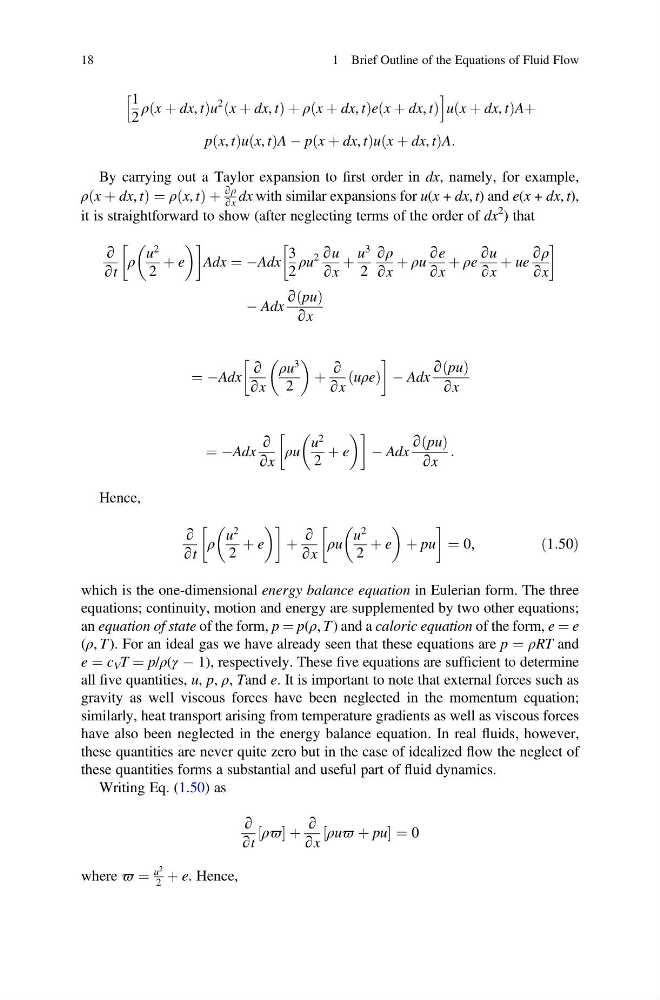
By carrying out a Taylor expansion to first order in dx, namely, for example,
ρ x þ dx, t
ð
Þ¼ρ x, t
ð Þ þ
∂ρ
∂x
dx with similar expansions for u(x + dx, t) and e(x + dx, t),
it is straightforward to show (after neglecting terms of the order of dx
2 ) that
∂
∂t
ρ
u
2
2
þ e
!
Adx ¼ ÀAdx
3
2
ρu
2 ∂u
∂x
þ
u
3
2
∂ρ
∂x
þ ρu
∂e
∂x
þ ρe
∂u
∂x
þ ue
∂ρ
∂x
!
À Adx
∂ pu
ð Þ
∂x
¼ ÀAdx
∂
∂x
ρu
3
2
þ
∂
∂x
uρe
ð Þ
!
À Adx
∂ pu
ð Þ
∂x
¼ ÀAdx
∂
∂x
ρu
u
2
2
þ e
!
À Adx
∂ pu
ð Þ
∂x
:
Hence,
∂
∂t
ρ
u
2
2
þ e
!
þ
∂
∂x
ρu
u
2
2
þ e
þ pu
!
¼ 0,
ð1:50Þ
which is the one-dimensional energy balance equation in Eulerian form. The three
equations; continuity, motion and energy are supplemented by two other equations;
an equation of state of the form, p ¼ p(ρ, T) and a caloric equation of the form, e ¼ e
(ρ, T ). For an ideal gas we have already seen that these equations are p ¼ ρRT and
e ¼ c V T ¼ p/ρ(γ À 1), respectively. These five equations are sufficient to determine
all five quantities, u, p, ρ, Tand e. It is important to note that external forces such as
gravity as well viscous forces have been neglected in the momentum equation;
similarly, heat transport arising from temperature gradients as well as viscous forces
have also been neglected in the energy balance equation. In real fluids, however,
these quantities are never quite zero but in the case of idealized flow the neglect of
these quantities forms a substantial and useful part of fluid dynamics.
Writing Eq. (1.50) as
∂
∂t
ρϖ
½ þ
∂
∂x
ρuϖ þ pu
½
¼0
where ϖ ¼
u
2
2 þ e. Hence,
18
1 Brief Outline of the Equations of Fluid Flow
2
ρ x þ dx, t
ð
Þ u
2 x þ dx, t
ð
Þþρ x þ dx, t
ð
Þ e x þ dx, t
ð
Þ
h
i
u x þ dx, t
ð
Þ Aþ
p x, t
ð Þu x, t
ð ÞA À p x þ dx, t
ð
Þ u x þ dx, t
ð
Þ A:
By carrying out a Taylor expansion to first order in dx, namely, for example,
ρ x þ dx, t
ð
Þ¼ρ x, t
ð Þ þ
∂ρ
∂x
dx with similar expansions for u(x + dx, t) and e(x + dx, t),
it is straightforward to show (after neglecting terms of the order of dx
2 ) that
∂
∂t
ρ
u
2
2
þ e
!
Adx ¼ ÀAdx
3
2
ρu
2 ∂u
∂x
þ
u
3
2
∂ρ
∂x
þ ρu
∂e
∂x
þ ρe
∂u
∂x
þ ue
∂ρ
∂x
!
À Adx
∂ pu
ð Þ
∂x
¼ ÀAdx
∂
∂x
ρu
3
2
þ
∂
∂x
uρe
ð Þ
!
À Adx
∂ pu
ð Þ
∂x
¼ ÀAdx
∂
∂x
ρu
u
2
2
þ e
!
À Adx
∂ pu
ð Þ
∂x
:
Hence,
∂
∂t
ρ
u
2
2
þ e
!
þ
∂
∂x
ρu
u
2
2
þ e
þ pu
!
¼ 0,
ð1:50Þ
which is the one-dimensional energy balance equation in Eulerian form. The three
equations; continuity, motion and energy are supplemented by two other equations;
an equation of state of the form, p ¼ p(ρ, T) and a caloric equation of the form, e ¼ e
(ρ, T ). For an ideal gas we have already seen that these equations are p ¼ ρRT and
e ¼ c V T ¼ p/ρ(γ À 1), respectively. These five equations are sufficient to determine
all five quantities, u, p, ρ, Tand e. It is important to note that external forces such as
gravity as well viscous forces have been neglected in the momentum equation;
similarly, heat transport arising from temperature gradients as well as viscous forces
have also been neglected in the energy balance equation. In real fluids, however,
these quantities are never quite zero but in the case of idealized flow the neglect of
these quantities forms a substantial and useful part of fluid dynamics.
Writing Eq. (1.50) as
∂
∂t
ρϖ
½ þ
∂
∂x
ρuϖ þ pu
½
¼0
where ϖ ¼
u
2
2 þ e. Hence,
18
1 Brief Outline of the Equations of Fluid Flow