

each case, namely, at τ ¼ 0.09 and at τ ¼ 0.11, by finding the positions where the
maximum value of q occurs. For this we generate plots of q at τ ¼ 0.09 and at
τ ¼ 0.11; noting that Δτ ¼ 5 Â 10
À6 which implies that plots of q 18000, j and q 22000, j
are required as functions of j and these are shown in Fig. 6.6. For these plots we find
that the maxima occur at j ¼ 379 and 415, respectively (see Fig. 6.6). Since λ 0,
j ¼ jΔλ we find that the maxima occur at λ 0 ¼ 0.409 and 0.448, respectively, which
gives a separation of δλ ¼ 0.039, hence, δλ/δτ ¼ 1.95. However,
δλ ¼
δR
ε
and δτ ¼
c 0 δt
ε
, see Sect:6:2
ð
Þ
where δR represents the amount by which the shock front advances in a time interval
of δt, while ε is the length expressed in terms of the energy yield and the ambient air
pressure and c 0 is the ordinary sonic speed ahead of the shock (c 0 ffi 340ms
À1 ).
Consequently,
δλ
δτ
¼
1
c 0
δR
δt
¼
U s
c 0
,
so that δλ/δτ is just the Mach number M, hence, M ¼ 1.95.
By taking c 0 ¼ 340ms
À1 we find that U s ¼ 663ms
À1 for the velocity of the shock
wave at τ ¼ 0.1. For a point source explosion with an energy yield of 20 kTons of
TNT (equal to 8.4 Â 10
13 Joules) and with the ambient air pressure
Normalized Lagrangian radius
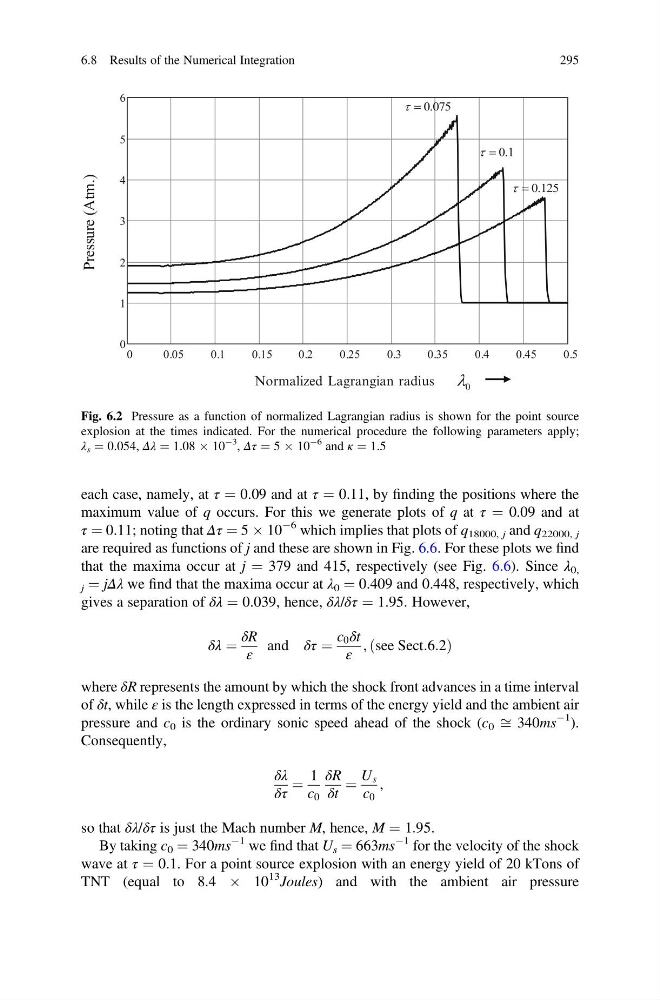
Fig. 6.2 Pressure as a function of normalized Lagrangian radius is shown for the point source
explosion at the times indicated. For the numerical procedure the following parameters apply;
λ s ¼ 0.054, Δλ ¼ 1.08 Â 10
À3
, Δτ ¼ 5 Â 10
À6 and κ ¼ 1.5
6.8 Results of the Numerical Integration
295
maximum value of q occurs. For this we generate plots of q at τ ¼ 0.09 and at
τ ¼ 0.11; noting that Δτ ¼ 5 Â 10
À6 which implies that plots of q 18000, j and q 22000, j
are required as functions of j and these are shown in Fig. 6.6. For these plots we find
that the maxima occur at j ¼ 379 and 415, respectively (see Fig. 6.6). Since λ 0,
j ¼ jΔλ we find that the maxima occur at λ 0 ¼ 0.409 and 0.448, respectively, which
gives a separation of δλ ¼ 0.039, hence, δλ/δτ ¼ 1.95. However,
δλ ¼
δR
ε
and δτ ¼
c 0 δt
ε
, see Sect:6:2
ð
Þ
where δR represents the amount by which the shock front advances in a time interval
of δt, while ε is the length expressed in terms of the energy yield and the ambient air
pressure and c 0 is the ordinary sonic speed ahead of the shock (c 0 ffi 340ms
À1 ).
Consequently,
δλ
δτ
¼
1
c 0
δR
δt
¼
U s
c 0
,
so that δλ/δτ is just the Mach number M, hence, M ¼ 1.95.
By taking c 0 ¼ 340ms
À1 we find that U s ¼ 663ms
À1 for the velocity of the shock
wave at τ ¼ 0.1. For a point source explosion with an energy yield of 20 kTons of
TNT (equal to 8.4 Â 10
13 Joules) and with the ambient air pressure
Normalized Lagrangian radius
Fig. 6.2 Pressure as a function of normalized Lagrangian radius is shown for the point source
explosion at the times indicated. For the numerical procedure the following parameters apply;
λ s ¼ 0.054, Δλ ¼ 1.08 Â 10
À3
, Δτ ¼ 5 Â 10
À6 and κ ¼ 1.5
6.8 Results of the Numerical Integration
295