

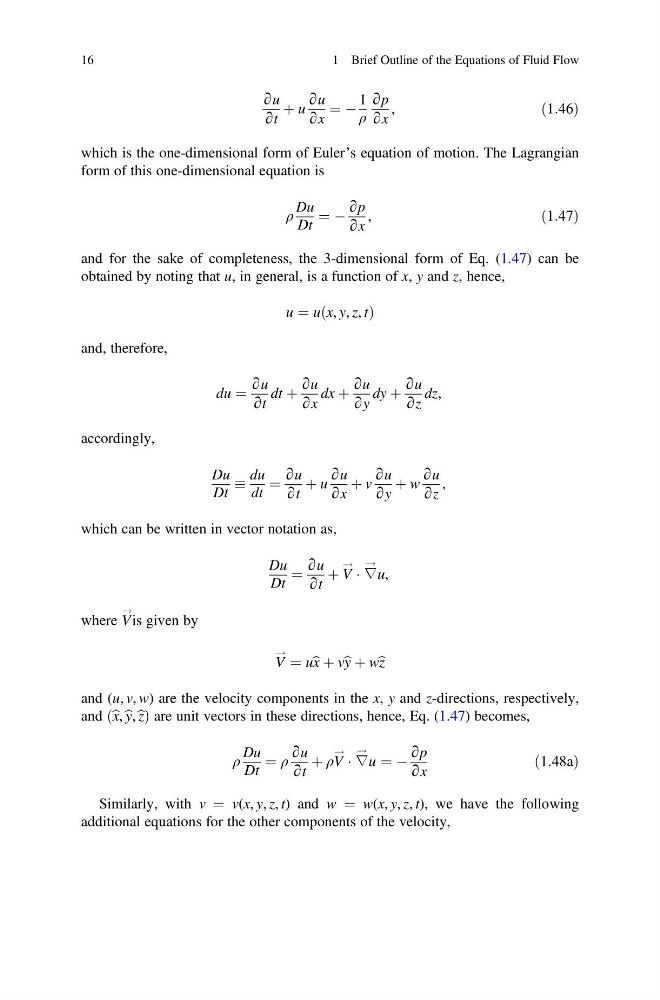
∂u
∂t
þ u
∂u
∂x
¼ À
1
ρ
∂p
∂x
,
ð1:46Þ
which is the one-dimensional form of Euler’s equation of motion. The Lagrangian
form of this one-dimensional equation is
ρ
Du
Dt
¼ À
∂p
∂x
,
ð1:47Þ
and for the sake of completeness, the 3-dimensional form of Eq. (1.47) can be
obtained by noting that u, in general, is a function of x, y and z, hence,
u ¼ u x, y, z, t
ð
Þ
and, therefore,
du ¼
∂u
∂t
dt þ
∂u
∂x
dx þ
∂u
∂y
dy þ
∂u
∂z
dz,
accordingly,
Du
Dt
du
dt
¼
∂u
∂t
þ u
∂u
∂x
þ v
∂u
∂y
þ w
∂u
∂z
,
which can be written in vector notation as,
Du
Dt
¼
∂u
∂t
þ V
! Á ∇
!
u,
where V
!
is given by
V
! ¼ ub x þ vb y þ wb z
and (u, v, w) are the velocity components in the x, y and z-directions, respectively,
and b x, b y,b z
ð
Þare unit vectors in these directions, hence, Eq. (1.47) becomes,
ρ
Du
Dt
¼ ρ
∂u
∂t
þ ρV
! Á ∇
!
u ¼ À
∂p
∂x
ð1:48aÞ
Similarly, with v ¼ v(x, y, z, t) and w ¼ w(x, y, z, t), we have the following
additional equations for the other components of the velocity,
16
1 Brief Outline of the Equations of Fluid Flow
∂t
þ u
∂u
∂x
¼ À
1
ρ
∂p
∂x
,
ð1:46Þ
which is the one-dimensional form of Euler’s equation of motion. The Lagrangian
form of this one-dimensional equation is
ρ
Du
Dt
¼ À
∂p
∂x
,
ð1:47Þ
and for the sake of completeness, the 3-dimensional form of Eq. (1.47) can be
obtained by noting that u, in general, is a function of x, y and z, hence,
u ¼ u x, y, z, t
ð
Þ
and, therefore,
du ¼
∂u
∂t
dt þ
∂u
∂x
dx þ
∂u
∂y
dy þ
∂u
∂z
dz,
accordingly,
Du
Dt
du
dt
¼
∂u
∂t
þ u
∂u
∂x
þ v
∂u
∂y
þ w
∂u
∂z
,
which can be written in vector notation as,
Du
Dt
¼
∂u
∂t
þ V
! Á ∇
!
u,
where V
!
is given by
V
! ¼ ub x þ vb y þ wb z
and (u, v, w) are the velocity components in the x, y and z-directions, respectively,
and b x, b y,b z
ð
Þare unit vectors in these directions, hence, Eq. (1.47) becomes,
ρ
Du
Dt
¼ ρ
∂u
∂t
þ ρV
! Á ∇
!
u ¼ À
∂p
∂x
ð1:48aÞ
Similarly, with v ¼ v(x, y, z, t) and w ¼ w(x, y, z, t), we have the following
additional equations for the other components of the velocity,
16
1 Brief Outline of the Equations of Fluid Flow