

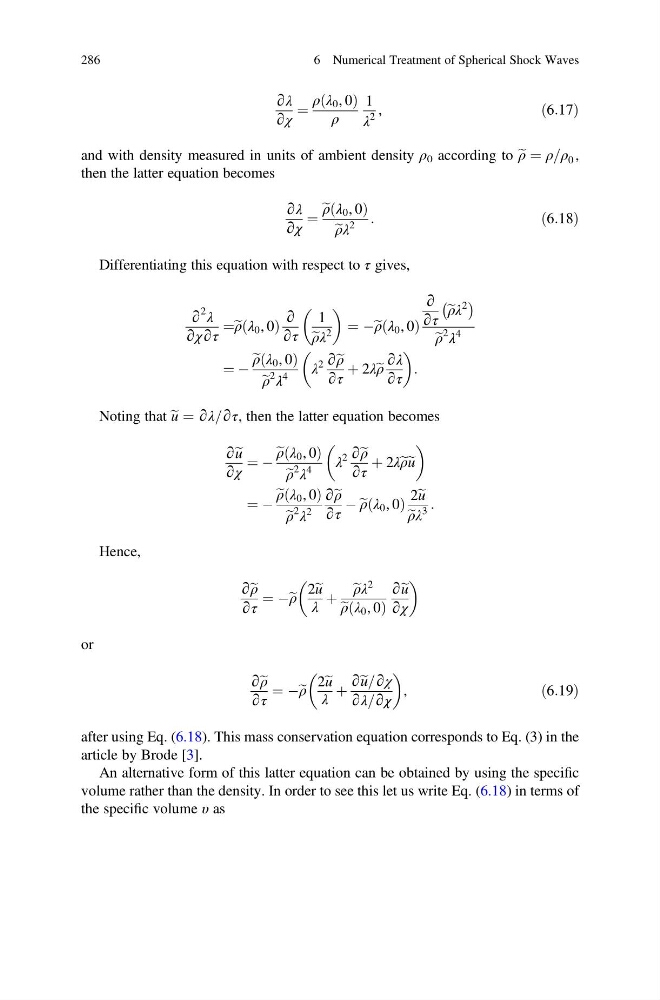
∂λ
∂χ
¼
ρ λ 0 , 0
ð
Þ
ρ
1
λ
2
,
ð6:17Þ
and with density measured in units of ambient density ρ 0 according to e ρ ¼ ρ=ρ 0 ,
then the latter equation becomes
∂λ
∂χ
¼
e ρ λ 0 , 0
ð
Þ
e ρλ
2
:
ð6:18Þ
Differentiating this equation with respect to τ gives,
∂
2 λ
∂χ∂τ
¼e ρ λ 0 , 0
ð
Þ
∂
∂τ
1
e ρλ
2
¼ Àe ρ λ 0 , 0
ð
Þ
∂
∂τ
e ρλ
2
À Á
e ρ
2 λ
4
¼ À
e ρ λ 0 , 0
ð
Þ
e ρ
2 λ
4
λ
2 ∂e ρ
∂τ
þ 2λe ρ
∂λ
∂τ
:
Noting that e u ¼ ∂λ=∂τ, then the latter equation becomes
∂e u
∂χ
¼ À
e ρ λ 0 , 0
ð
Þ
e ρ
2 λ
4
λ
2 ∂e ρ
∂τ
þ 2λe ρe u
¼ À
e ρ λ 0 , 0
ð
Þ
e ρ
2 λ
2
∂e ρ
∂τ
À e ρ λ 0 , 0
ð
Þ
2e u
e ρλ
3
:
Hence,
∂e ρ
∂τ
¼ Àe ρ
2e u
λ
þ
e ρλ
2
e ρ λ 0 , 0
ð
Þ
∂e u
∂χ
or
∂e ρ
∂τ
¼ Àe ρ
2e u
λ
þ
∂e u=∂χ
∂λ=∂χ
,
ð6:19Þ
after using Eq. (6.18). This mass conservation equation corresponds to Eq. (3) in the
article by Brode [3].
An alternative form of this latter equation can be obtained by using the specific
volume rather than the density. In order to see this let us write Eq. (6.18) in terms of
the specific volume υ as
286
6 Numerical Treatment of Spherical Shock Waves
∂χ
¼
ρ λ 0 , 0
ð
Þ
ρ
1
λ
2
,
ð6:17Þ
and with density measured in units of ambient density ρ 0 according to e ρ ¼ ρ=ρ 0 ,
then the latter equation becomes
∂λ
∂χ
¼
e ρ λ 0 , 0
ð
Þ
e ρλ
2
:
ð6:18Þ
Differentiating this equation with respect to τ gives,
∂
2 λ
∂χ∂τ
¼e ρ λ 0 , 0
ð
Þ
∂
∂τ
1
e ρλ
2
¼ Àe ρ λ 0 , 0
ð
Þ
∂
∂τ
e ρλ
2
À Á
e ρ
2 λ
4
¼ À
e ρ λ 0 , 0
ð
Þ
e ρ
2 λ
4
λ
2 ∂e ρ
∂τ
þ 2λe ρ
∂λ
∂τ
:
Noting that e u ¼ ∂λ=∂τ, then the latter equation becomes
∂e u
∂χ
¼ À
e ρ λ 0 , 0
ð
Þ
e ρ
2 λ
4
λ
2 ∂e ρ
∂τ
þ 2λe ρe u
¼ À
e ρ λ 0 , 0
ð
Þ
e ρ
2 λ
2
∂e ρ
∂τ
À e ρ λ 0 , 0
ð
Þ
2e u
e ρλ
3
:
Hence,
∂e ρ
∂τ
¼ Àe ρ
2e u
λ
þ
e ρλ
2
e ρ λ 0 , 0
ð
Þ
∂e u
∂χ
or
∂e ρ
∂τ
¼ Àe ρ
2e u
λ
þ
∂e u=∂χ
∂λ=∂χ
,
ð6:19Þ
after using Eq. (6.18). This mass conservation equation corresponds to Eq. (3) in the
article by Brode [3].
An alternative form of this latter equation can be obtained by using the specific
volume rather than the density. In order to see this let us write Eq. (6.18) in terms of
the specific volume υ as
286
6 Numerical Treatment of Spherical Shock Waves