

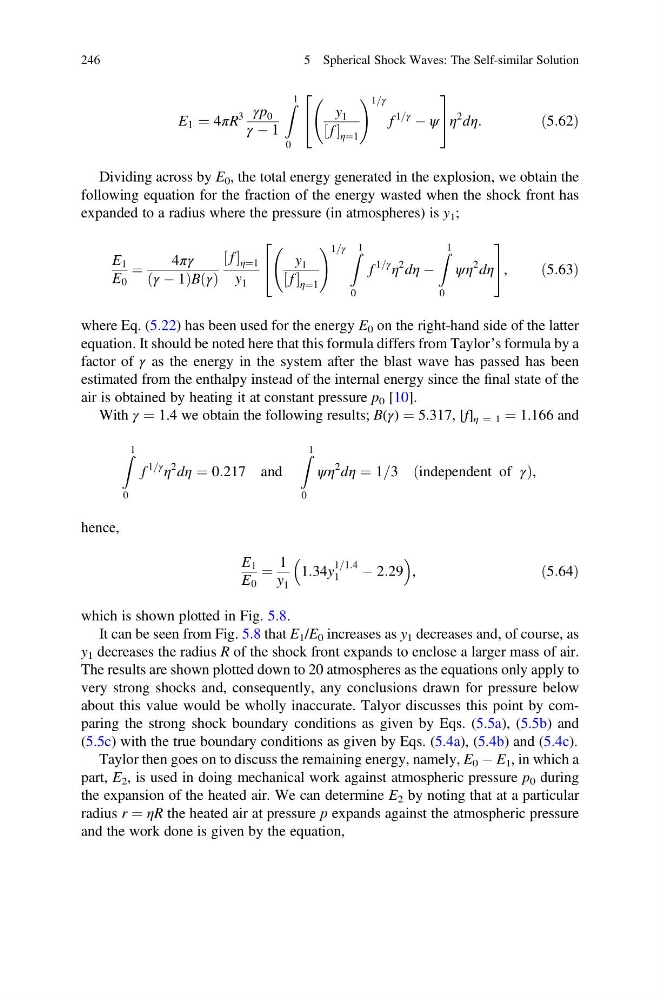
E 1 ¼ 4πR
3 γp 0
γ À 1
Z 1
0
y 1
f
½ η¼1
! 1=γ
f
1=γ
À ψ
2
4
3
5 η
2 dη:
ð5:62Þ
Dividing across by E 0 , the total energy generated in the explosion, we obtain the
following equation for the fraction of the energy wasted when the shock front has
expanded to a radius where the pressure (in atmospheres) is y 1 ;
E 1
E 0
¼
4πγ
γ À 1
ð
ÞB γ
ð Þ
f
½ η¼1
y 1
y 1
f
½ η¼1
! 1=γ Z 1
0
f
1=γ
η
2 dη À
Z 1
0
ψη
2 dη
2
4
3
5 ,
ð5:63Þ
where Eq. (5.22) has been used for the energy E 0 on the right-hand side of the latter
equation. It should be noted here that this formula differs from Taylor’s formula by a
factor of γ as the energy in the system after the blast wave has passed has been
estimated from the enthalpy instead of the internal energy since the final state of the
air is obtained by heating it at constant pressure p 0 [10].
With γ ¼ 1.4 we obtain the following results; B(γ) ¼ 5.317, [f] η ¼ 1 ¼ 1.166 and
Z 1
0
f
1=γ
η
2 dη ¼ 0:217 and
Z 1
0
ψη
2 dη ¼ 1=3 independent of γ
ð
Þ ,
hence,
E 1
E 0
¼
1
y 1
1:34y
1=1:4
1
À 2:29
,
ð5:64Þ
which is shown plotted in Fig. 5.8.
It can be seen from Fig. 5.8 that E 1 /E 0 increases as y 1 decreases and, of course, as
y 1 decreases the radius R of the shock front expands to enclose a larger mass of air.
The results are shown plotted down to 20 atmospheres as the equations only apply to
very strong shocks and, consequently, any conclusions drawn for pressure below
about this value would be wholly inaccurate. Talyor discusses this point by comparing the strong shock boundary conditions as given by Eqs. (5.5a), (5.5b) and
(5.5c) with the true boundary conditions as given by Eqs. (5.4a), (5.4b) and (5.4c).
Taylor then goes on to discuss the remaining energy, namely, E 0 À E 1 , in which a
part, E 2 , is used in doing mechanical work against atmospheric pressure p 0 during
the expansion of the heated air. We can determine E 2 by noting that at a particular
radius r ¼ ηR the heated air at pressure p expands against the atmospheric pressure
and the work done is given by the equation,
246
5 Spherical Shock Waves: The Self-similar Solution
3 γp 0
γ À 1
Z 1
0
y 1
f
½ η¼1
! 1=γ
f
1=γ
À ψ
2
4
3
5 η
2 dη:
ð5:62Þ
Dividing across by E 0 , the total energy generated in the explosion, we obtain the
following equation for the fraction of the energy wasted when the shock front has
expanded to a radius where the pressure (in atmospheres) is y 1 ;
E 1
E 0
¼
4πγ
γ À 1
ð
ÞB γ
ð Þ
f
½ η¼1
y 1
y 1
f
½ η¼1
! 1=γ Z 1
0
f
1=γ
η
2 dη À
Z 1
0
ψη
2 dη
2
4
3
5 ,
ð5:63Þ
where Eq. (5.22) has been used for the energy E 0 on the right-hand side of the latter
equation. It should be noted here that this formula differs from Taylor’s formula by a
factor of γ as the energy in the system after the blast wave has passed has been
estimated from the enthalpy instead of the internal energy since the final state of the
air is obtained by heating it at constant pressure p 0 [10].
With γ ¼ 1.4 we obtain the following results; B(γ) ¼ 5.317, [f] η ¼ 1 ¼ 1.166 and
Z 1
0
f
1=γ
η
2 dη ¼ 0:217 and
Z 1
0
ψη
2 dη ¼ 1=3 independent of γ
ð
Þ ,
hence,
E 1
E 0
¼
1
y 1
1:34y
1=1:4
1
À 2:29
,
ð5:64Þ
which is shown plotted in Fig. 5.8.
It can be seen from Fig. 5.8 that E 1 /E 0 increases as y 1 decreases and, of course, as
y 1 decreases the radius R of the shock front expands to enclose a larger mass of air.
The results are shown plotted down to 20 atmospheres as the equations only apply to
very strong shocks and, consequently, any conclusions drawn for pressure below
about this value would be wholly inaccurate. Talyor discusses this point by comparing the strong shock boundary conditions as given by Eqs. (5.5a), (5.5b) and
(5.5c) with the true boundary conditions as given by Eqs. (5.4a), (5.4b) and (5.4c).
Taylor then goes on to discuss the remaining energy, namely, E 0 À E 1 , in which a
part, E 2 , is used in doing mechanical work against atmospheric pressure p 0 during
the expansion of the heated air. We can determine E 2 by noting that at a particular
radius r ¼ ηR the heated air at pressure p expands against the atmospheric pressure
and the work done is given by the equation,
246
5 Spherical Shock Waves: The Self-similar Solution