

1.3.7 Alternate Form of the Equations for Specific Internal
Energy and Enthalpy
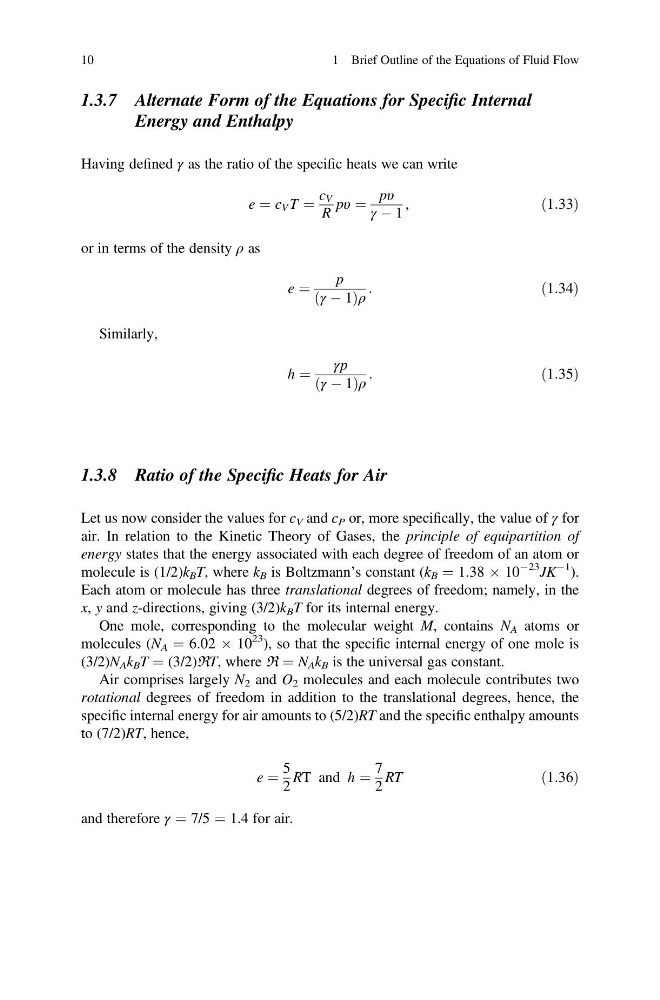
Having defined γ as the ratio of the specific heats we can write
e ¼ c V T ¼
c V
R
pυ ¼
pυ
γ À 1
,
ð1:33Þ
or in terms of the density ρ as
e ¼
p
γ À 1
ð
Þρ
:
ð1:34Þ
Similarly,
h ¼
γp
γ À 1
ð
Þρ
:
ð1:35Þ
1.3.8 Ratio of the Specific Heats for Air
Let us now consider the values for c V and c P or, more specifically, the value of γ for
air. In relation to the Kinetic Theory of Gases, the principle of equipartition of
energy states that the energy associated with each degree of freedom of an atom or
molecule is (1/2)k B T, where k B is Boltzmann’s constant (k B ¼ 1.38 Â 10
À23 JK
À1 ).
Each atom or molecule has three translational degrees of freedom; namely, in the
x, y and z-directions, giving (3/2)k B T for its internal energy.
One mole, corresponding to the molecular weight M, contains N A atoms or
molecules (N A ¼ 6.02 Â 10
23 ), so that the specific internal energy of one mole is
(3/2)N A k B T ¼ (3/2)ℜT, where ℜ ¼ N A k B is the universal gas constant.
Air comprises largely N 2 and O 2 molecules and each molecule contributes two
rotational degrees of freedom in addition to the translational degrees, hence, the
specific internal energy for air amounts to (5/2)RT and the specific enthalpy amounts
to (7/2)RT, hence,
e ¼
5
2
RT and h ¼
7
2
RT
ð1:36Þ
and therefore γ ¼ 7/5 ¼ 1.4 for air.
10
1 Brief Outline of the Equations of Fluid Flow
Energy and Enthalpy
Having defined γ as the ratio of the specific heats we can write
e ¼ c V T ¼
c V
R
pυ ¼
pυ
γ À 1
,
ð1:33Þ
or in terms of the density ρ as
e ¼
p
γ À 1
ð
Þρ
:
ð1:34Þ
Similarly,
h ¼
γp
γ À 1
ð
Þρ
:
ð1:35Þ
1.3.8 Ratio of the Specific Heats for Air
Let us now consider the values for c V and c P or, more specifically, the value of γ for
air. In relation to the Kinetic Theory of Gases, the principle of equipartition of
energy states that the energy associated with each degree of freedom of an atom or
molecule is (1/2)k B T, where k B is Boltzmann’s constant (k B ¼ 1.38 Â 10
À23 JK
À1 ).
Each atom or molecule has three translational degrees of freedom; namely, in the
x, y and z-directions, giving (3/2)k B T for its internal energy.
One mole, corresponding to the molecular weight M, contains N A atoms or
molecules (N A ¼ 6.02 Â 10
23 ), so that the specific internal energy of one mole is
(3/2)N A k B T ¼ (3/2)ℜT, where ℜ ¼ N A k B is the universal gas constant.
Air comprises largely N 2 and O 2 molecules and each molecule contributes two
rotational degrees of freedom in addition to the translational degrees, hence, the
specific internal energy for air amounts to (5/2)RT and the specific enthalpy amounts
to (7/2)RT, hence,
e ¼
5
2
RT and h ¼
7
2
RT
ð1:36Þ
and therefore γ ¼ 7/5 ¼ 1.4 for air.
10
1 Brief Outline of the Equations of Fluid Flow