

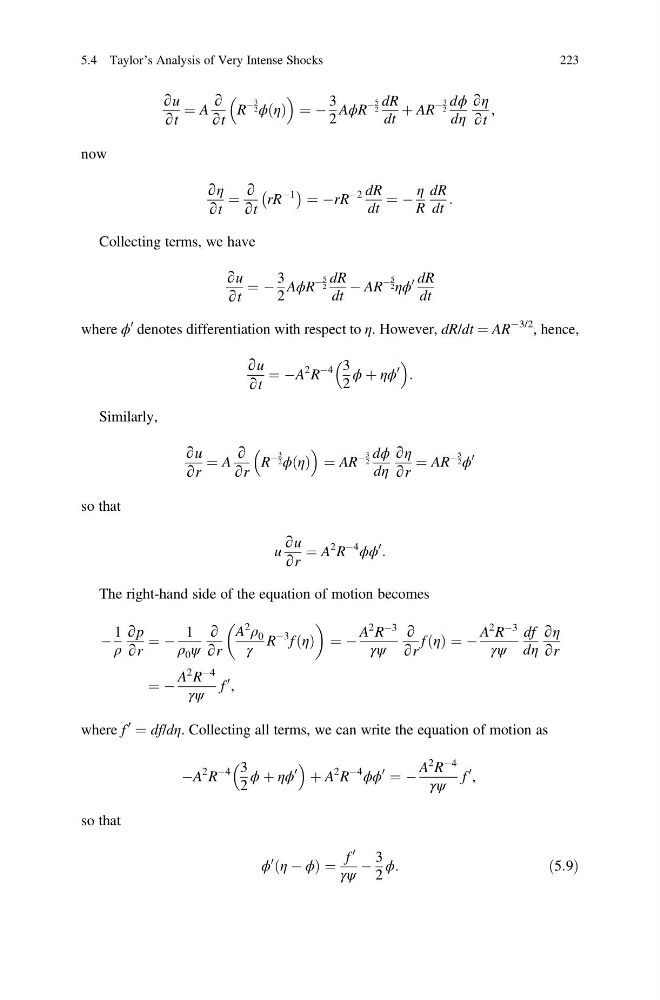
∂u
∂t
¼ A
∂
∂t
R
À
3
2 ϕ η
ð Þ
¼ À
3
2
AϕR
À
5
2
dR
dt
þ AR
À
3
2
dϕ
dη
∂η
∂t
,
now
∂η
∂t
¼
∂
∂t
rR
À1
À
Á ¼ ÀrR
À2 dR
dt
¼ À
η
R
dR
dt
:
Collecting terms, we have
∂u
∂t
¼ À
3
2
AϕR
À
5
2
dR
dt
À AR
À
5
2 ηϕ
0 dR
dt
where ϕ
0 denotes differentiation with respect to η. However, dR/dt ¼ AR
À3/2 , hence,
∂u
∂t
¼ ÀA
2 R
À4 3
2
ϕ þ ηϕ
0
:
Similarly,
∂u
∂r
¼ A
∂
∂r
R
À
3
2 ϕ η
ð Þ
¼ AR
À
3
2
dϕ
dη
∂η
∂r
¼ AR
À
5
2 ϕ
0
so that
u
∂u
∂r
¼ A
2 R
À4
ϕϕ
0
:
The right-hand side of the equation of motion becomes
À
1
ρ
∂p
∂r
¼ À
1
ρ 0 ψ
∂
∂r
A
2
ρ 0
γ
R
À3 f η
ð Þ
¼ À
A
2 R
À3
γψ
∂
∂r
f η
ð Þ ¼ À
A
2 R
À3
γψ
df
dη
∂η
∂r
¼ À
A
2 R
À4
γψ
f
0 ,
where f
0 ¼ df/dη. Collecting all terms, we can write the equation of motion as
ÀA
2 R
À4 3
2
ϕ þ ηϕ
0
þ A
2 R
À4
ϕϕ
0
¼ À
A
2 R
À4
γψ
f
0 ,
so that
ϕ
0
η À ϕ
ð
Þ¼
f
0
γψ
À
3
2
ϕ:
ð5:9Þ
5.4 Taylor’s Analysis of Very Intense Shocks
223
∂t
¼ A
∂
∂t
R
À
3
2 ϕ η
ð Þ
¼ À
3
2
AϕR
À
5
2
dR
dt
þ AR
À
3
2
dϕ
dη
∂η
∂t
,
now
∂η
∂t
¼
∂
∂t
rR
À1
À
Á ¼ ÀrR
À2 dR
dt
¼ À
η
R
dR
dt
:
Collecting terms, we have
∂u
∂t
¼ À
3
2
AϕR
À
5
2
dR
dt
À AR
À
5
2 ηϕ
0 dR
dt
where ϕ
0 denotes differentiation with respect to η. However, dR/dt ¼ AR
À3/2 , hence,
∂u
∂t
¼ ÀA
2 R
À4 3
2
ϕ þ ηϕ
0
:
Similarly,
∂u
∂r
¼ A
∂
∂r
R
À
3
2 ϕ η
ð Þ
¼ AR
À
3
2
dϕ
dη
∂η
∂r
¼ AR
À
5
2 ϕ
0
so that
u
∂u
∂r
¼ A
2 R
À4
ϕϕ
0
:
The right-hand side of the equation of motion becomes
À
1
ρ
∂p
∂r
¼ À
1
ρ 0 ψ
∂
∂r
A
2
ρ 0
γ
R
À3 f η
ð Þ
¼ À
A
2 R
À3
γψ
∂
∂r
f η
ð Þ ¼ À
A
2 R
À3
γψ
df
dη
∂η
∂r
¼ À
A
2 R
À4
γψ
f
0 ,
where f
0 ¼ df/dη. Collecting all terms, we can write the equation of motion as
ÀA
2 R
À4 3
2
ϕ þ ηϕ
0
þ A
2 R
À4
ϕϕ
0
¼ À
A
2 R
À4
γψ
f
0 ,
so that
ϕ
0
η À ϕ
ð
Þ¼
f
0
γψ
À
3
2
ϕ:
ð5:9Þ
5.4 Taylor’s Analysis of Very Intense Shocks
223