

of the destructive radius expected is dependent on the amplitude of maximum
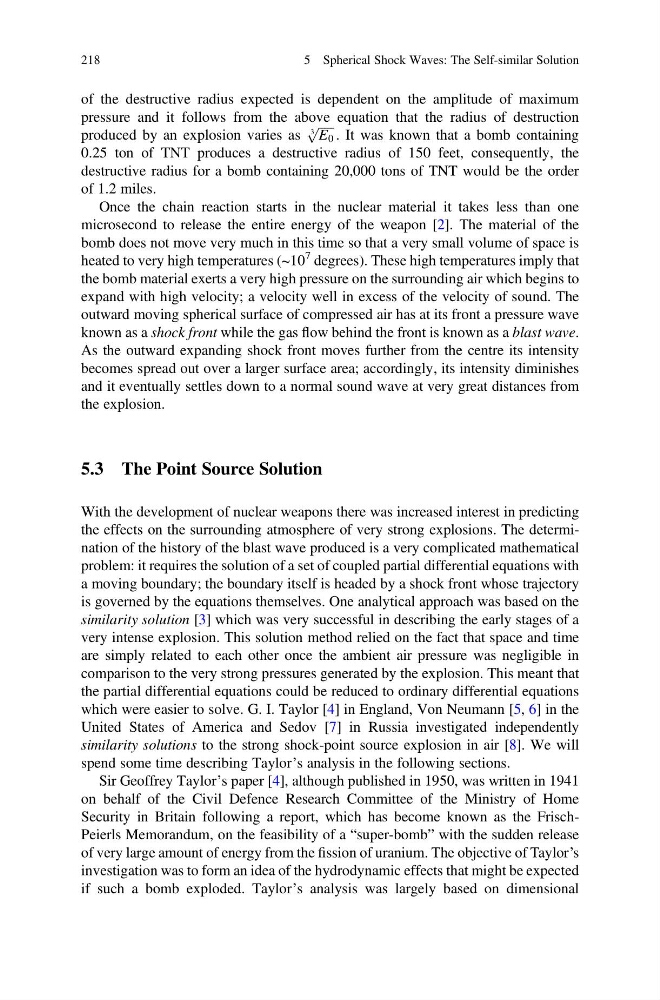
pressure and it follows from the above equation that the radius of destruction
produced by an explosion varies as
ffiffiffiffiffi
E 0
3
p
. It was known that a bomb containing
0.25 ton of TNT produces a destructive radius of 150 feet, consequently, the
destructive radius for a bomb containing 20,000 tons of TNT would be the order
of 1.2 miles.
Once the chain reaction starts in the nuclear material it takes less than one
microsecond to release the entire energy of the weapon [2]. The material of the
bomb does not move very much in this time so that a very small volume of space is
heated to very high temperatures (~10
7 degrees). These high temperatures imply that
the bomb material exerts a very high pressure on the surrounding air which begins to
expand with high velocity; a velocity well in excess of the velocity of sound. The
outward moving spherical surface of compressed air has at its front a pressure wave
known as a shock front while the gas flow behind the front is known as a blast wave.
As the outward expanding shock front moves further from the centre its intensity
becomes spread out over a larger surface area; accordingly, its intensity diminishes
and it eventually settles down to a normal sound wave at very great distances from
the explosion.
5.3 The Point Source Solution
With the development of nuclear weapons there was increased interest in predicting
the effects on the surrounding atmosphere of very strong explosions. The determination of the history of the blast wave produced is a very complicated mathematical
problem: it requires the solution of a set of coupled partial differential equations with
a moving boundary; the boundary itself is headed by a shock front whose trajectory
is governed by the equations themselves. One analytical approach was based on the
similarity solution [3] which was very successful in describing the early stages of a
very intense explosion. This solution method relied on the fact that space and time
are simply related to each other once the ambient air pressure was negligible in
comparison to the very strong pressures generated by the explosion. This meant that
the partial differential equations could be reduced to ordinary differential equations
which were easier to solve. G. I. Taylor [4] in England, Von Neumann [5, 6] in the
United States of America and Sedov [7] in Russia investigated independently
similarity solutions to the strong shock-point source explosion in air [8]. We will
spend some time describing Taylor’s analysis in the following sections.
Sir Geoffrey Taylor’s paper [4], although published in 1950, was written in 1941
on behalf of the Civil Defence Research Committee of the Ministry of Home
Security in Britain following a report, which has become known as the FrischPeierls Memorandum, on the feasibility of a “super-bomb” with the sudden release
of very large amount of energy from the fission of uranium. The objective of Taylor’s
investigation was to form an idea of the hydrodynamic effects that might be expected
if such a bomb exploded. Taylor’s analysis was largely based on dimensional
218
5 Spherical Shock Waves: The Self-similar Solution
pressure and it follows from the above equation that the radius of destruction
produced by an explosion varies as
ffiffiffiffiffi
E 0
3
p
. It was known that a bomb containing
0.25 ton of TNT produces a destructive radius of 150 feet, consequently, the
destructive radius for a bomb containing 20,000 tons of TNT would be the order
of 1.2 miles.
Once the chain reaction starts in the nuclear material it takes less than one
microsecond to release the entire energy of the weapon [2]. The material of the
bomb does not move very much in this time so that a very small volume of space is
heated to very high temperatures (~10
7 degrees). These high temperatures imply that
the bomb material exerts a very high pressure on the surrounding air which begins to
expand with high velocity; a velocity well in excess of the velocity of sound. The
outward moving spherical surface of compressed air has at its front a pressure wave
known as a shock front while the gas flow behind the front is known as a blast wave.
As the outward expanding shock front moves further from the centre its intensity
becomes spread out over a larger surface area; accordingly, its intensity diminishes
and it eventually settles down to a normal sound wave at very great distances from
the explosion.
5.3 The Point Source Solution
With the development of nuclear weapons there was increased interest in predicting
the effects on the surrounding atmosphere of very strong explosions. The determination of the history of the blast wave produced is a very complicated mathematical
problem: it requires the solution of a set of coupled partial differential equations with
a moving boundary; the boundary itself is headed by a shock front whose trajectory
is governed by the equations themselves. One analytical approach was based on the
similarity solution [3] which was very successful in describing the early stages of a
very intense explosion. This solution method relied on the fact that space and time
are simply related to each other once the ambient air pressure was negligible in
comparison to the very strong pressures generated by the explosion. This meant that
the partial differential equations could be reduced to ordinary differential equations
which were easier to solve. G. I. Taylor [4] in England, Von Neumann [5, 6] in the
United States of America and Sedov [7] in Russia investigated independently
similarity solutions to the strong shock-point source explosion in air [8]. We will
spend some time describing Taylor’s analysis in the following sections.
Sir Geoffrey Taylor’s paper [4], although published in 1950, was written in 1941
on behalf of the Civil Defence Research Committee of the Ministry of Home
Security in Britain following a report, which has become known as the FrischPeierls Memorandum, on the feasibility of a “super-bomb” with the sudden release
of very large amount of energy from the fission of uranium. The objective of Taylor’s
investigation was to form an idea of the hydrodynamic effects that might be expected
if such a bomb exploded. Taylor’s analysis was largely based on dimensional
218
5 Spherical Shock Waves: The Self-similar Solution