

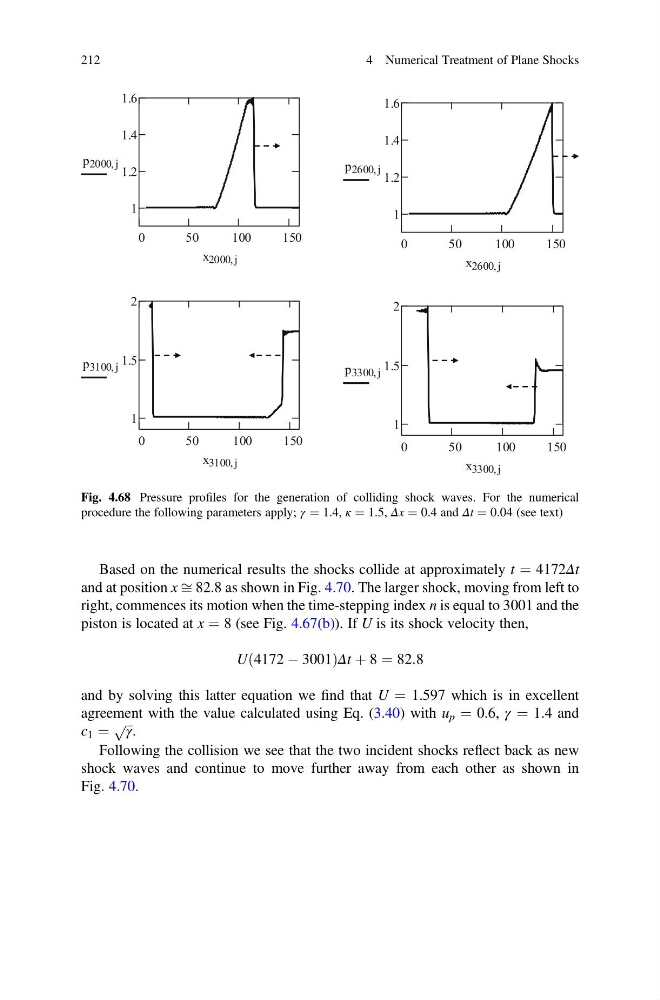
Based on the numerical results the shocks collide at approximately t ¼ 4172Δt
and at position x ffi 82.8 as shown in Fig. 4.70. The larger shock, moving from left to
right, commences its motion when the time-stepping index n is equal to 3001 and the
piston is located at x ¼ 8 (see Fig. 4.67(b)). If U is its shock velocity then,
U 4172 À 3001
ð
Þ Δt þ 8 ¼ 82:8
and by solving this latter equation we find that U ¼ 1.597 which is in excellent
agreement with the value calculated using Eq. (3.40) with u p ¼ 0.6, γ ¼ 1.4 and
c 1 ¼
ffiffi ffi
γ
p .
Following the collision we see that the two incident shocks reflect back as new
shock waves and continue to move further away from each other as shown in
Fig. 4.70.
Fig. 4.68 Pressure profiles for the generation of colliding shock waves. For the numerical
procedure the following parameters apply; γ ¼ 1.4, κ ¼ 1.5, Δx ¼ 0.4 and Δt ¼ 0.04 (see text)
212
4 Numerical Treatment of Plane Shocks
and at position x ffi 82.8 as shown in Fig. 4.70. The larger shock, moving from left to
right, commences its motion when the time-stepping index n is equal to 3001 and the
piston is located at x ¼ 8 (see Fig. 4.67(b)). If U is its shock velocity then,
U 4172 À 3001
ð
Þ Δt þ 8 ¼ 82:8
and by solving this latter equation we find that U ¼ 1.597 which is in excellent
agreement with the value calculated using Eq. (3.40) with u p ¼ 0.6, γ ¼ 1.4 and
c 1 ¼
ffiffi ffi
γ
p .
Following the collision we see that the two incident shocks reflect back as new
shock waves and continue to move further away from each other as shown in
Fig. 4.70.
Fig. 4.68 Pressure profiles for the generation of colliding shock waves. For the numerical
procedure the following parameters apply; γ ¼ 1.4, κ ¼ 1.5, Δx ¼ 0.4 and Δt ¼ 0.04 (see text)
212
4 Numerical Treatment of Plane Shocks