

ρ 2
ρ 1
¼ 1 þ
2
γ À 1
γ À 1
2
u
c 1
þ
1
2
2
γ À 1
2
γ À 1
À 1
γ À 1
2
2 u
2
c 2
1
þ ::
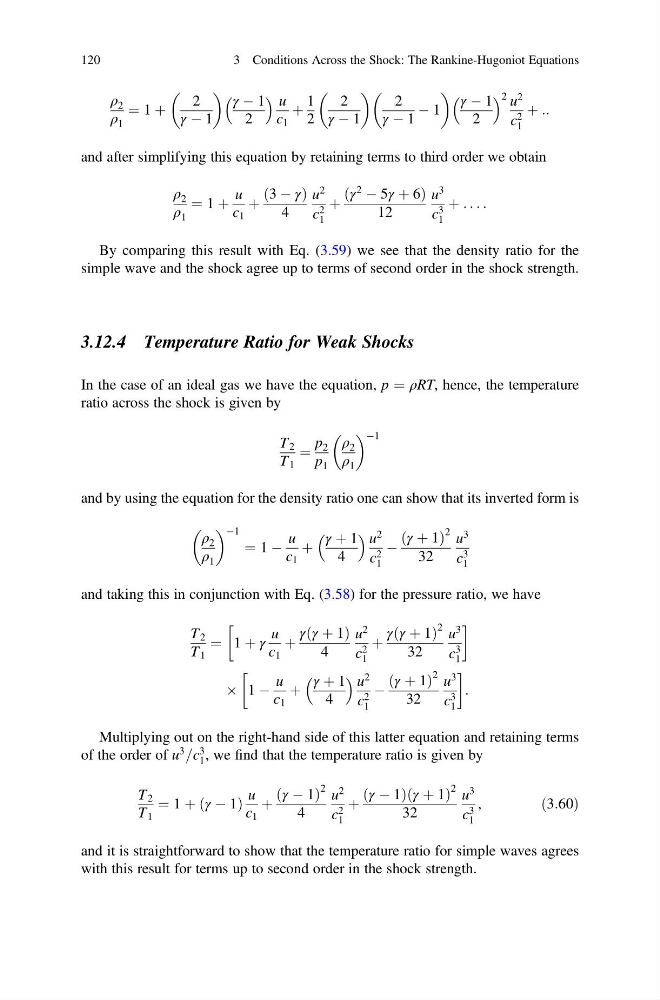
and after simplifying this equation by retaining terms to third order we obtain
ρ 2
ρ 1
¼ 1 þ
u
c 1
þ
3 À γ
ð
Þ
4
u
2
c 2
1
þ
γ
2
À 5γ þ 6
ð
Þ
12
u
3
c
3
1
þ . . . :
By comparing this result with Eq. (3.59) we see that the density ratio for the
simple wave and the shock agree up to terms of second order in the shock strength.
3.12.4 Temperature Ratio for Weak Shocks
In the case of an ideal gas we have the equation, p ¼ ρRT, hence, the temperature
ratio across the shock is given by
T 2
T 1
¼
p 2
p 1
ρ 2
ρ 1
À1
and by using the equation for the density ratio one can show that its inverted form is
ρ 2
ρ 1
À1
¼ 1 À
u
c 1
þ
γ þ 1
4
u
2
c 2
1
À
γ þ 1
ð
Þ
2
32
u
3
c
3
1
and taking this in conjunction with Eq. (3.58) for the pressure ratio, we have
T 2
T 1
¼ 1 þ γ
u
c 1
þ
γ γ þ 1
ð
Þ
4
u
2
c 2
1
þ
γ γ þ 1
ð
Þ
2
32
u
3
c
3
1
!
 1 u
c 1
þ
γ þ 1
4
u
2
c 2
1
À
γ þ 1
ð
Þ
2
32
u
3
c
3
1
!
:
Multiplying out on the right-hand side of this latter equation and retaining terms
of the order of u
3
=c
3
1 , we find that the temperature ratio is given by
T 2
T 1
¼ 1 þ γ À 1
ð
Þ
u
c 1
þ
γ À 1
ð
Þ
2
4
u
2
c 2
1
þ
γ À 1
ð
Þ γ þ 1
ð
Þ
2
32
u
3
c
3
1
,
ð3:60Þ
and it is straightforward to show that the temperature ratio for simple waves agrees
with this result for terms up to second order in the shock strength.
120
3 Conditions Across the Shock: The Rankine-Hugoniot Equations
ρ 1
¼ 1 þ
2
γ À 1
γ À 1
2
u
c 1
þ
1
2
2
γ À 1
2
γ À 1
À 1
γ À 1
2
2 u
2
c 2
1
þ ::
and after simplifying this equation by retaining terms to third order we obtain
ρ 2
ρ 1
¼ 1 þ
u
c 1
þ
3 À γ
ð
Þ
4
u
2
c 2
1
þ
γ
2
À 5γ þ 6
ð
Þ
12
u
3
c
3
1
þ . . . :
By comparing this result with Eq. (3.59) we see that the density ratio for the
simple wave and the shock agree up to terms of second order in the shock strength.
3.12.4 Temperature Ratio for Weak Shocks
In the case of an ideal gas we have the equation, p ¼ ρRT, hence, the temperature
ratio across the shock is given by
T 2
T 1
¼
p 2
p 1
ρ 2
ρ 1
À1
and by using the equation for the density ratio one can show that its inverted form is
ρ 2
ρ 1
À1
¼ 1 À
u
c 1
þ
γ þ 1
4
u
2
c 2
1
À
γ þ 1
ð
Þ
2
32
u
3
c
3
1
and taking this in conjunction with Eq. (3.58) for the pressure ratio, we have
T 2
T 1
¼ 1 þ γ
u
c 1
þ
γ γ þ 1
ð
Þ
4
u
2
c 2
1
þ
γ γ þ 1
ð
Þ
2
32
u
3
c
3
1
!
 1 u
c 1
þ
γ þ 1
4
u
2
c 2
1
À
γ þ 1
ð
Þ
2
32
u
3
c
3
1
!
:
Multiplying out on the right-hand side of this latter equation and retaining terms
of the order of u
3
=c
3
1 , we find that the temperature ratio is given by
T 2
T 1
¼ 1 þ γ À 1
ð
Þ
u
c 1
þ
γ À 1
ð
Þ
2
4
u
2
c 2
1
þ
γ À 1
ð
Þ γ þ 1
ð
Þ
2
32
u
3
c
3
1
,
ð3:60Þ
and it is straightforward to show that the temperature ratio for simple waves agrees
with this result for terms up to second order in the shock strength.
120
3 Conditions Across the Shock: The Rankine-Hugoniot Equations