

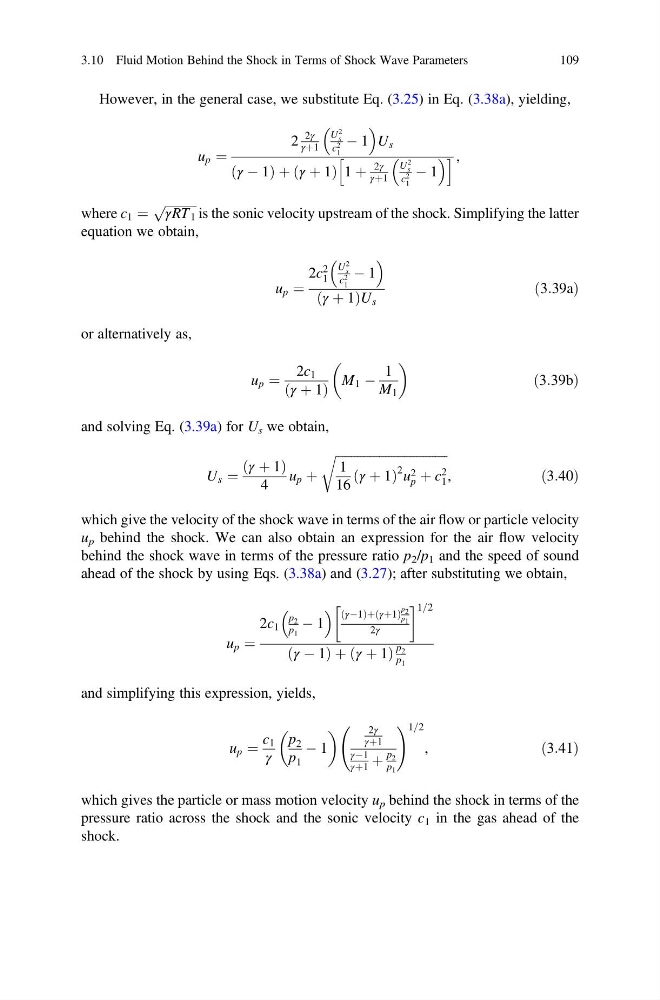
However, in the general case, we substitute Eq. (3.25) in Eq. (3.38a), yielding,
u p ¼
2
2γ
γþ1
U
2
s
c 2
1
À 1
U s
γ À 1
ð
Þþ γ þ 1
ð
Þ 1 þ
2γ
γþ1
U
2
s
c 2
1
À 1
h
i ,
where c 1 ¼
ffiffiffiffiffiffiffiffiffiffi ffi
γRT 1
p
is the sonic velocity upstream of the shock. Simplifying the latter
equation we obtain,
u p ¼
2c
2
1
U
2
s
c 2
1
À 1
γ þ 1
ð
ÞU s
ð3:39aÞ
or alternatively as,
u p ¼
2c 1
γ þ 1
ð
Þ
M 1 À
1
M 1
ð3:39bÞ
and solving Eq. (3.39a) for U s we obtain,
U s ¼
γ þ 1
ð
Þ
4
u p þ
ffiffiffiffiffiffiffiffiffiffiffiffiffiffiffiffiffiffiffiffiffiffiffiffiffiffiffiffiffiffiffiffiffiffiffiffi
1
16
γ þ 1
ð
Þ
2 u 2
p þ c 2
1
r
,
ð3:40Þ
which give the velocity of the shock wave in terms of the air flow or particle velocity
u p behind the shock. We can also obtain an expression for the air flow velocity
behind the shock wave in terms of the pressure ratio p 2 /p 1 and the speed of sound
ahead of the shock by using Eqs. (3.38a) and (3.27); after substituting we obtain,
u p ¼
2c 1
p 2
p 1
À 1
γÀ1
ð
Þþ γþ1
ð
Þ
p 2
p 1
2γ
! 1=2
γ À 1
ð
Þþ γ þ 1
ð
Þ
p 2
p 1
and simplifying this expression, yields,
u p ¼
c 1
γ
p 2
p 1
À 1
2γ
γþ1
γÀ1
γþ1 þ
p 2
p 1
! 1=2
,
ð3:41Þ
which gives the particle or mass motion velocity u p behind the shock in terms of the
pressure ratio across the shock and the sonic velocity c 1 in the gas ahead of the
shock.
3.10 Fluid Motion Behind the Shock in Terms of Shock Wave Parameters
109
u p ¼
2
2γ
γþ1
U
2
s
c 2
1
À 1
U s
γ À 1
ð
Þþ γ þ 1
ð
Þ 1 þ
2γ
γþ1
U
2
s
c 2
1
À 1
h
i ,
where c 1 ¼
ffiffiffiffiffiffiffiffiffiffi ffi
γRT 1
p
is the sonic velocity upstream of the shock. Simplifying the latter
equation we obtain,
u p ¼
2c
2
1
U
2
s
c 2
1
À 1
γ þ 1
ð
ÞU s
ð3:39aÞ
or alternatively as,
u p ¼
2c 1
γ þ 1
ð
Þ
M 1 À
1
M 1
ð3:39bÞ
and solving Eq. (3.39a) for U s we obtain,
U s ¼
γ þ 1
ð
Þ
4
u p þ
ffiffiffiffiffiffiffiffiffiffiffiffiffiffiffiffiffiffiffiffiffiffiffiffiffiffiffiffiffiffiffiffiffiffiffiffi
1
16
γ þ 1
ð
Þ
2 u 2
p þ c 2
1
r
,
ð3:40Þ
which give the velocity of the shock wave in terms of the air flow or particle velocity
u p behind the shock. We can also obtain an expression for the air flow velocity
behind the shock wave in terms of the pressure ratio p 2 /p 1 and the speed of sound
ahead of the shock by using Eqs. (3.38a) and (3.27); after substituting we obtain,
u p ¼
2c 1
p 2
p 1
À 1
γÀ1
ð
Þþ γþ1
ð
Þ
p 2
p 1
2γ
! 1=2
γ À 1
ð
Þþ γ þ 1
ð
Þ
p 2
p 1
and simplifying this expression, yields,
u p ¼
c 1
γ
p 2
p 1
À 1
2γ
γþ1
γÀ1
γþ1 þ
p 2
p 1
! 1=2
,
ð3:41Þ
which gives the particle or mass motion velocity u p behind the shock in terms of the
pressure ratio across the shock and the sonic velocity c 1 in the gas ahead of the
shock.
3.10 Fluid Motion Behind the Shock in Terms of Shock Wave Parameters
109