

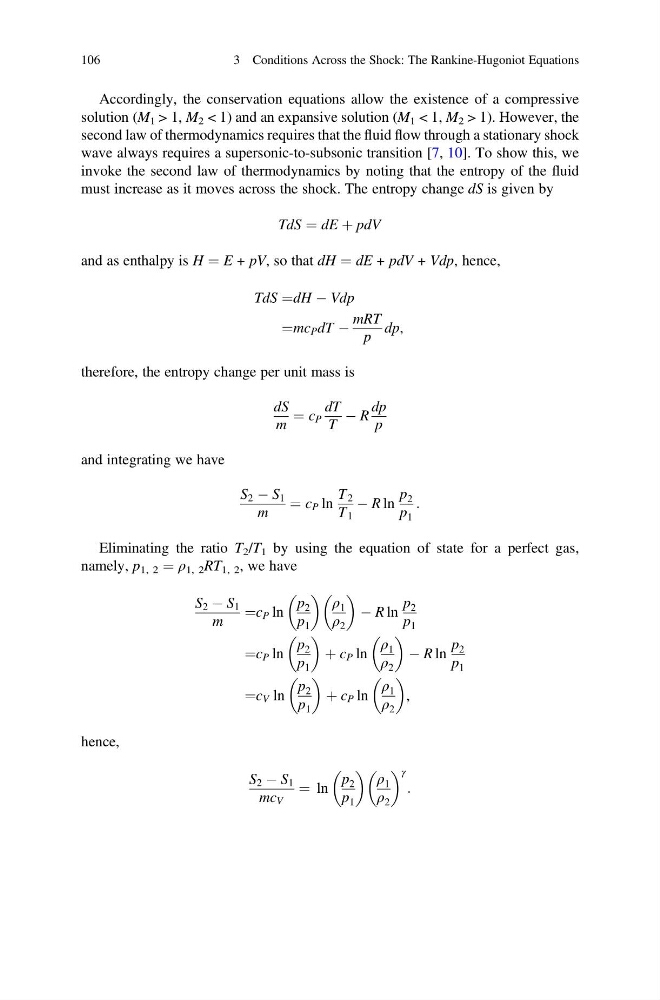
Accordingly, the conservation equations allow the existence of a compressive
solution (M 1 > 1, M 2 < 1) and an expansive solution (M 1 < 1, M 2 > 1). However, the
second law of thermodynamics requires that the fluid flow through a stationary shock
wave always requires a supersonic-to-subsonic transition [7, 10]. To show this, we
invoke the second law of thermodynamics by noting that the entropy of the fluid
must increase as it moves across the shock. The entropy change dS is given by
TdS ¼ dE þ pdV
and as enthalpy is H ¼ E + pV, so that dH ¼ dE + pdV + Vdp, hence,
TdS ¼dH À Vdp
¼mc P dT À
mRT
p
dp,
therefore, the entropy change per unit mass is
dS
m
¼ c P
dT
T
À R
dp
p
and integrating we have
S 2 À S 1
m
¼ c P ln
T 2
T 1
À R ln
p 2
p 1
:
Eliminating the ratio T 2 /T 1 by using the equation of state for a perfect gas,
namely, p 1, 2 ¼ ρ 1, 2 RT 1, 2 , we have
S 2 À S 1
m
¼c P ln
p 2
p 1
ρ 1
ρ 2
À R ln
p 2
p 1
¼c P ln
p 2
p 1
þ c P ln
ρ 1
ρ 2
À R ln
p 2
p 1
¼c V ln
p 2
p 1
þ c P ln
ρ 1
ρ 2
,
hence,
S 2 À S 1
mc V
¼ ln
p 2
p 1
ρ 1
ρ 2
γ
:
106
3 Conditions Across the Shock: The Rankine-Hugoniot Equations
solution (M 1 > 1, M 2 < 1) and an expansive solution (M 1 < 1, M 2 > 1). However, the
second law of thermodynamics requires that the fluid flow through a stationary shock
wave always requires a supersonic-to-subsonic transition [7, 10]. To show this, we
invoke the second law of thermodynamics by noting that the entropy of the fluid
must increase as it moves across the shock. The entropy change dS is given by
TdS ¼ dE þ pdV
and as enthalpy is H ¼ E + pV, so that dH ¼ dE + pdV + Vdp, hence,
TdS ¼dH À Vdp
¼mc P dT À
mRT
p
dp,
therefore, the entropy change per unit mass is
dS
m
¼ c P
dT
T
À R
dp
p
and integrating we have
S 2 À S 1
m
¼ c P ln
T 2
T 1
À R ln
p 2
p 1
:
Eliminating the ratio T 2 /T 1 by using the equation of state for a perfect gas,
namely, p 1, 2 ¼ ρ 1, 2 RT 1, 2 , we have
S 2 À S 1
m
¼c P ln
p 2
p 1
ρ 1
ρ 2
À R ln
p 2
p 1
¼c P ln
p 2
p 1
þ c P ln
ρ 1
ρ 2
À R ln
p 2
p 1
¼c V ln
p 2
p 1
þ c P ln
ρ 1
ρ 2
,
hence,
S 2 À S 1
mc V
¼ ln
p 2
p 1
ρ 1
ρ 2
γ
:
106
3 Conditions Across the Shock: The Rankine-Hugoniot Equations