

3.3 Thermodynamic Relations
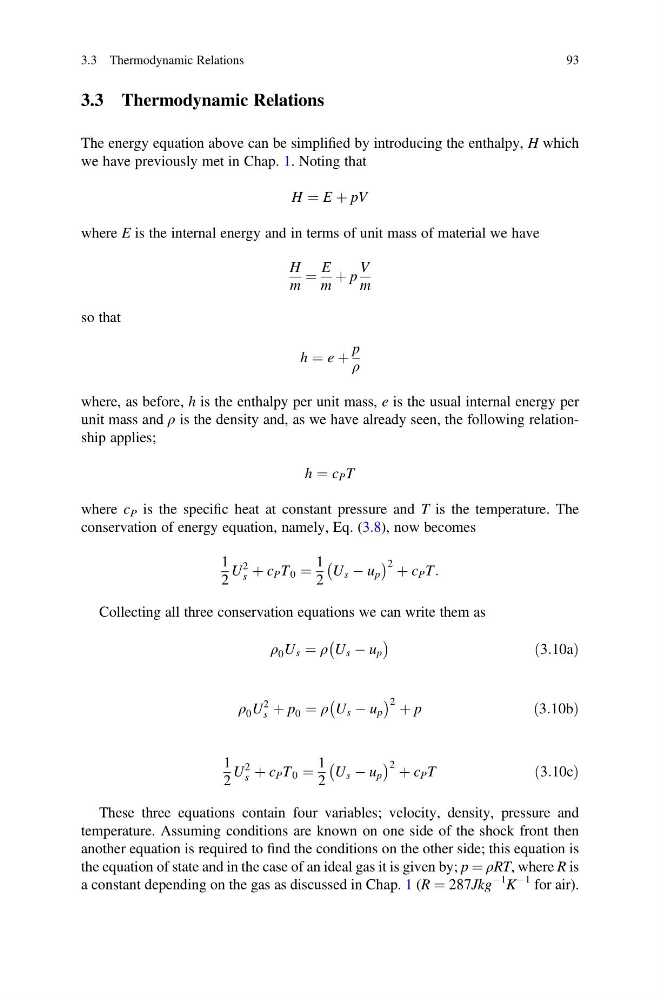
The energy equation above can be simplified by introducing the enthalpy, H which
we have previously met in Chap. 1. Noting that
H ¼ E þ pV
where E is the internal energy and in terms of unit mass of material we have
H
m
¼
E
m
þ p
V
m
so that
h ¼ e þ
p
ρ
where, as before, h is the enthalpy per unit mass, e is the usual internal energy per
unit mass and ρ is the density and, as we have already seen, the following relationship applies;
h ¼ c P T
where c P is the specific heat at constant pressure and T is the temperature. The
conservation of energy equation, namely, Eq. (3.8), now becomes
1
2
U
2
s þ c P T 0 ¼
1
2
U s À u p
À
Á 2 þ c P T:
Collecting all three conservation equations we can write them as
ρ 0 U s ¼ ρ U s À u p
À
Á
ð3:10aÞ
ρ 0 U
2
s þ p 0 ¼ ρ U s À u p
À
Á 2 þ p
ð3:10bÞ
1
2
U
2
s þ c P T 0 ¼
1
2
U s À u p
À
Á 2 þ c P T
ð3:10cÞ
These three equations contain four variables; velocity, density, pressure and
temperature. Assuming conditions are known on one side of the shock front then
another equation is required to find the conditions on the other side; this equation is
the equation of state and in the case of an ideal gas it is given by; p ¼ ρRT, where R is
a constant depending on the gas as discussed in Chap. 1 (R ¼ 287Jkg
À1 K
À1 for air).
3.3 Thermodynamic Relations
93
The energy equation above can be simplified by introducing the enthalpy, H which
we have previously met in Chap. 1. Noting that
H ¼ E þ pV
where E is the internal energy and in terms of unit mass of material we have
H
m
¼
E
m
þ p
V
m
so that
h ¼ e þ
p
ρ
where, as before, h is the enthalpy per unit mass, e is the usual internal energy per
unit mass and ρ is the density and, as we have already seen, the following relationship applies;
h ¼ c P T
where c P is the specific heat at constant pressure and T is the temperature. The
conservation of energy equation, namely, Eq. (3.8), now becomes
1
2
U
2
s þ c P T 0 ¼
1
2
U s À u p
À
Á 2 þ c P T:
Collecting all three conservation equations we can write them as
ρ 0 U s ¼ ρ U s À u p
À
Á
ð3:10aÞ
ρ 0 U
2
s þ p 0 ¼ ρ U s À u p
À
Á 2 þ p
ð3:10bÞ
1
2
U
2
s þ c P T 0 ¼
1
2
U s À u p
À
Á 2 þ c P T
ð3:10cÞ
These three equations contain four variables; velocity, density, pressure and
temperature. Assuming conditions are known on one side of the shock front then
another equation is required to find the conditions on the other side; this equation is
the equation of state and in the case of an ideal gas it is given by; p ¼ ρRT, where R is
a constant depending on the gas as discussed in Chap. 1 (R ¼ 287Jkg
À1 K
À1 for air).
3.3 Thermodynamic Relations
93