

3.2.1 Conservation of Mass
Mass conservation implies that the mass of fluid entering per unit area per unit time
is equal to the mass leaving per unit area per unit time, so that
ρ 0 U s ¼ ρ U s À u p
À
Á :
ð3:1Þ
3.2.2 Conservation of Momentum
Conservation of momentum states that the difference between the rate of momentum
arriving at the shock front and the rate of momentum leaving the shock front is equal
to the net force per unit area acting on the material as it crosses the shock front;
hence,
ρ 0 U
2
s À ρ U s À u p
À
Á 2 ¼ p À p 0
ð3:2Þ
3.2.3 Conservation of Energy
Conservation of energy requires that the total energy arriving at the shock front per
unit area per unit time minus the energy leaving the front per unit area per unit time is
equal to the rate at which work is done by the pressure difference across the front. In
general, the rate of increase of energy (kinetic energy plus internal energy) per unit
time is equal to
d
dt
1
2
ρv
2 V þ eρV
where ρ is the density, V is the volume, v is the velocity and e is the internal energy
per unit mass; hence, the rate of increase of energy per unit area per unit time
becomes
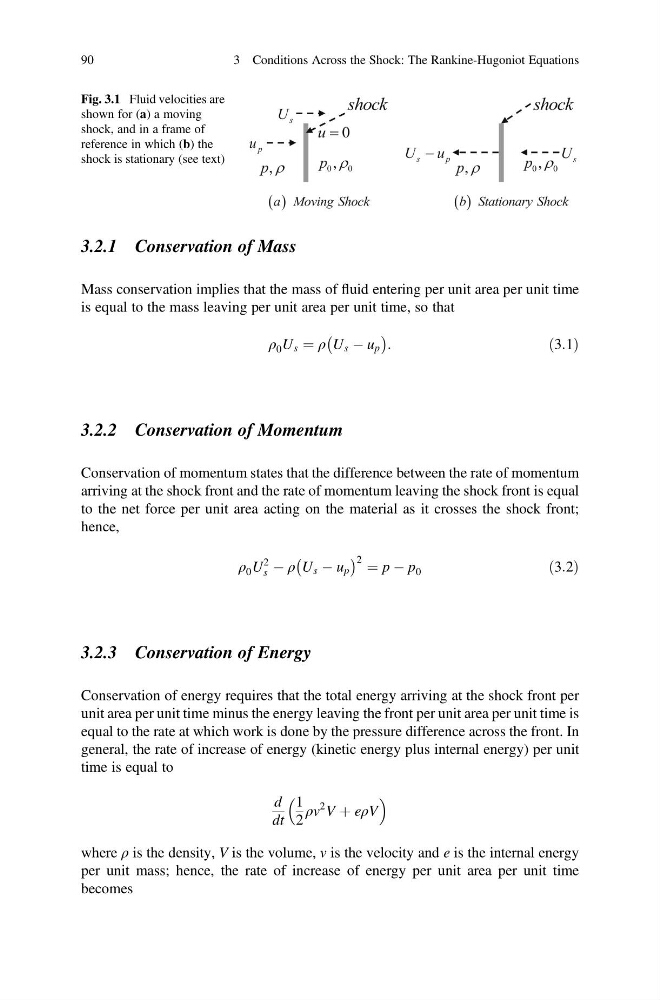
Fig. 3.1 Fluid velocities are
shown for (a) a moving
shock, and in a frame of
reference in which (b) the
shock is stationary (see text)
90
3 Conditions Across the Shock: The Rankine-Hugoniot Equations
Mass conservation implies that the mass of fluid entering per unit area per unit time
is equal to the mass leaving per unit area per unit time, so that
ρ 0 U s ¼ ρ U s À u p
À
Á :
ð3:1Þ
3.2.2 Conservation of Momentum
Conservation of momentum states that the difference between the rate of momentum
arriving at the shock front and the rate of momentum leaving the shock front is equal
to the net force per unit area acting on the material as it crosses the shock front;
hence,
ρ 0 U
2
s À ρ U s À u p
À
Á 2 ¼ p À p 0
ð3:2Þ
3.2.3 Conservation of Energy
Conservation of energy requires that the total energy arriving at the shock front per
unit area per unit time minus the energy leaving the front per unit area per unit time is
equal to the rate at which work is done by the pressure difference across the front. In
general, the rate of increase of energy (kinetic energy plus internal energy) per unit
time is equal to
d
dt
1
2
ρv
2 V þ eρV
where ρ is the density, V is the volume, v is the velocity and e is the internal energy
per unit mass; hence, the rate of increase of energy per unit area per unit time
becomes
Fig. 3.1 Fluid velocities are
shown for (a) a moving
shock, and in a frame of
reference in which (b) the
shock is stationary (see text)
90
3 Conditions Across the Shock: The Rankine-Hugoniot Equations