

46
CHAPTER 5. CRYSTAL FIELDS
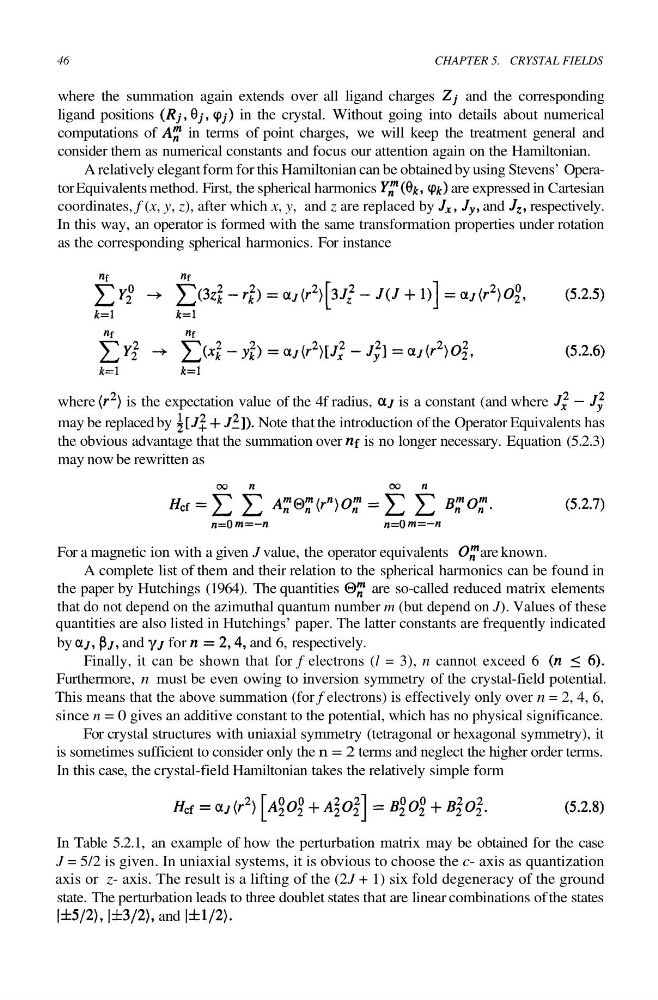
where the summation again extends over all ligand charges
and the corresponding
ligand positions
in the crystal. Without going into details about numerical
computations of
in terms of point charges, we will keep the treatment general and
consider them as numerical constants and focus our attention again on the Hamiltonian.
A relatively elegant form for this Hamiltonian can be obtained by using Stevens’ Operator Equivalents method. First, the spherical harmonics
are expressed in Cartesian
coordinates, f (x, y, z), after which x, y, and z are replaced by
and
respectively.
In this way, an operator is formed with the same transformation properties under rotation
as the corresponding spherical harmonics. For instance
where
is the expectation value of the 4f radius,
is a constant (and where
may be replaced by
Note that the introduction of the Operator Equivalents has
the obvious advantage that the summation over is no longer necessary. Equation (5.2.3)
may now be rewritten as
For a magnetic ion with a given J value, the operator equivalents
are known.
A complete list of them and their relation to the spherical harmonics can be found in
the paper by Hutchings (1964). The quantities
are so-called reduced matrix elements
that do not depend on the azimuthal quantum number m (but depend on J). Values of these
quantities are also listed in Hutchings’ paper. The latter constants are frequently indicated
by
and
for
and 6, respectively.
Finally, it can be shown that for f electrons (l = 3), n cannot exceed 6
Furthermore, n must be even owing to inversion symmetry of the crystal-field potential.
This means that the above summation (for f electrons) is effectively only over n = 2, 4, 6,
since n = 0 gives an additive constant to the potential, which has no physical significance.
For crystal structures with uniaxial symmetry (tetragonal or hexagonal symmetry), it
is sometimes sufficient to consider only the n = 2 terms and neglect the higher order terms.
In this case, the crystal-field Hamiltonian takes the relatively simple form
In Table 5.2.1, an example of how the perturbation matrix may be obtained for the case
J = 5/2 is given. In uniaxial systems, it is obvious to choose the c- axis as quantization
axis or z- axis. The result is a lifting of the (2J + 1) six fold degeneracy of the ground
state. The perturbation leads to three doublet states that are linear combinations of the states
and
CHAPTER 5. CRYSTAL FIELDS
where the summation again extends over all ligand charges
and the corresponding
ligand positions
in the crystal. Without going into details about numerical
computations of
in terms of point charges, we will keep the treatment general and
consider them as numerical constants and focus our attention again on the Hamiltonian.
A relatively elegant form for this Hamiltonian can be obtained by using Stevens’ Operator Equivalents method. First, the spherical harmonics
are expressed in Cartesian
coordinates, f (x, y, z), after which x, y, and z are replaced by
and
respectively.
In this way, an operator is formed with the same transformation properties under rotation
as the corresponding spherical harmonics. For instance
where
is the expectation value of the 4f radius,
is a constant (and where
may be replaced by
Note that the introduction of the Operator Equivalents has
the obvious advantage that the summation over is no longer necessary. Equation (5.2.3)
may now be rewritten as
For a magnetic ion with a given J value, the operator equivalents
are known.
A complete list of them and their relation to the spherical harmonics can be found in
the paper by Hutchings (1964). The quantities
are so-called reduced matrix elements
that do not depend on the azimuthal quantum number m (but depend on J). Values of these
quantities are also listed in Hutchings’ paper. The latter constants are frequently indicated
by
and
for
and 6, respectively.
Finally, it can be shown that for f electrons (l = 3), n cannot exceed 6
Furthermore, n must be even owing to inversion symmetry of the crystal-field potential.
This means that the above summation (for f electrons) is effectively only over n = 2, 4, 6,
since n = 0 gives an additive constant to the potential, which has no physical significance.
For crystal structures with uniaxial symmetry (tetragonal or hexagonal symmetry), it
is sometimes sufficient to consider only the n = 2 terms and neglect the higher order terms.
In this case, the crystal-field Hamiltonian takes the relatively simple form
In Table 5.2.1, an example of how the perturbation matrix may be obtained for the case
J = 5/2 is given. In uniaxial systems, it is obvious to choose the c- axis as quantization
axis or z- axis. The result is a lifting of the (2J + 1) six fold degeneracy of the ground
state. The perturbation leads to three doublet states that are linear combinations of the states
and