

174
CHAPTER 16. MAGNETOSTRICTIVE MATERIALS
framework describing magnetostrictive effects is fairly complex. We will restrict ourselves
therefore to a simplified discussion of these effects as given by Gignoux (1992).
Inspection of the crystal-field Hamiltonian presented in Eq. (5.2.7) shows that strain
effects can be introduced via strain dependence of the crystal-field parameters
that
characterize the surrounding of the aspherical 4f-electron charge cloud. The lowest order
magnetoelastic effects depend on the derivative of these parameters with respect to strain,
which leads to supplementary terms in the Hamiltonian that couple strains with the secondorder Stevens operators. It gives rise to isotropic as well as to anisotropic distortions of
which the latter have magnetic symmetry and are dominant. For instance, Morin and Schmitt
(1990) have shown that the magnetoelastic-energy term associated with the tetragonal-strain
mode
and hence with
reads as:
where
is a magnetoelastic coefficient and the
are strain components of the corresponding symmetry. When calculating the magnetoelastic energy at finite temperatures,
one has to form thermal averages
of the Stevens operators. These thermal averages
are generally small above the magnetic-ordering temperature in rare-earth–transition-metal
compounds, but can adopt appreciable values below
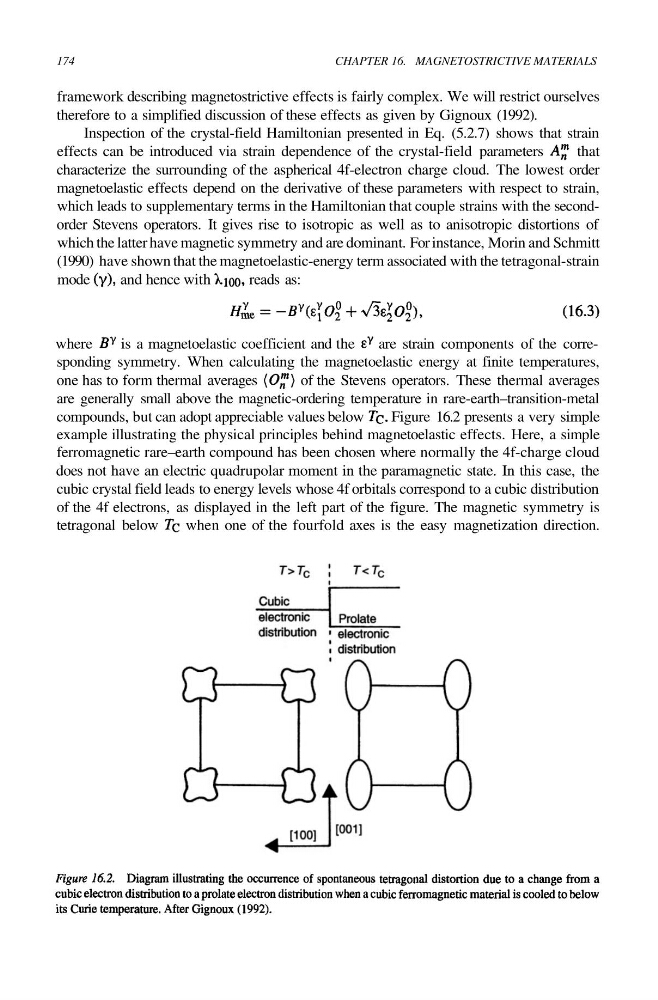
Figure 16.2 presents a very simple
example illustrating the physical principles behind magnetoelastic effects. Here, a simple
ferromagnetic rare–earth compound has been chosen where normally the 4f-charge cloud
does not have an electric quadrupolar moment in the paramagnetic state. In this case, the
cubic crystal field leads to energy levels whose 4f orbitals correspond to a cubic distribution
of the 4f electrons, as displayed in the left part of the figure. The magnetic symmetry is
tetragonal below
when one of the fourfold axes is the easy magnetization direction.
CHAPTER 16. MAGNETOSTRICTIVE MATERIALS
framework describing magnetostrictive effects is fairly complex. We will restrict ourselves
therefore to a simplified discussion of these effects as given by Gignoux (1992).
Inspection of the crystal-field Hamiltonian presented in Eq. (5.2.7) shows that strain
effects can be introduced via strain dependence of the crystal-field parameters
that
characterize the surrounding of the aspherical 4f-electron charge cloud. The lowest order
magnetoelastic effects depend on the derivative of these parameters with respect to strain,
which leads to supplementary terms in the Hamiltonian that couple strains with the secondorder Stevens operators. It gives rise to isotropic as well as to anisotropic distortions of
which the latter have magnetic symmetry and are dominant. For instance, Morin and Schmitt
(1990) have shown that the magnetoelastic-energy term associated with the tetragonal-strain
mode
and hence with
reads as:
where
is a magnetoelastic coefficient and the
are strain components of the corresponding symmetry. When calculating the magnetoelastic energy at finite temperatures,
one has to form thermal averages
of the Stevens operators. These thermal averages
are generally small above the magnetic-ordering temperature in rare-earth–transition-metal
compounds, but can adopt appreciable values below
Figure 16.2 presents a very simple
example illustrating the physical principles behind magnetoelastic effects. Here, a simple
ferromagnetic rare–earth compound has been chosen where normally the 4f-charge cloud
does not have an electric quadrupolar moment in the paramagnetic state. In this case, the
cubic crystal field leads to energy levels whose 4f orbitals correspond to a cubic distribution
of the 4f electrons, as displayed in the left part of the figure. The magnetic symmetry is
tetragonal below
when one of the fourfold axes is the easy magnetization direction.